

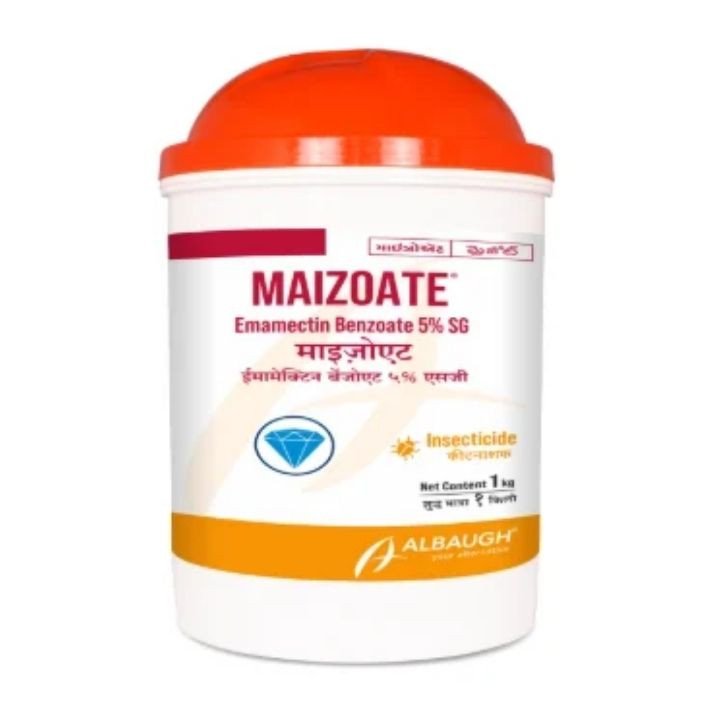
Albaugh Maizoate Insecticide (Emamectin Benzoate 5% SG)
Translaminar Insecticide for Bollworm, Pod Borer and Thrips Management
Albaugh Maizoate is an insecticide containing Emamectin Benzoate 5% SG. It provides stomach and contact action and is particularly useful against damaging insect pests such as bollworms, pod borers and thrips in label-recommended crops.
Maizoate penetrates treated leaf tissue through translaminar activity and forms a reservoir within the leaf. This helps provide continued activity against susceptible pests that feed on treated plant tissues. Emamectin Benzoate acts on the insect nervous system, resulting in paralysis and rapid cessation of feeding.
Product Specifications
| Product Name | Maizoate |
|---|---|
| Brand | Albaugh |
| Product Type | Insecticide |
| Technical Name | Emamectin Benzoate 5% SG |
| Formulation | SG - Water Soluble Granules |
| Chemical Group | Avermectin Group |
| IRAC Group | Group 6 |
| Action | Stomach & Contact Action |
| Movement | Translaminar Activity |
| Application Method | Foliar Spray |
Technical Composition
| Active Ingredient | Emamectin Benzoate |
|---|---|
| Concentration | 5% |
| Formulation | Soluble Granules (SG) |
| Insecticide Group | Avermectin - IRAC Group 6 |
Key Features of Albaugh Maizoate
- Translaminar Activity: Penetrates treated leaf tissue and forms a reservoir within leaves.
- Stomach Action: Particularly effective when susceptible pests ingest treated plant tissue.
- Contact Activity: Also provides activity when susceptible pests come into contact with treated surfaces.
- Rapid Feeding Cessation: Interferes with the insect nervous system and causes paralysis, reducing further crop feeding.
- Larval Pest Management: Particularly useful against damaging caterpillar and borer stages.
- Low Application Rate: Effective at relatively low formulation rates when applied according to the crop label.
- Targeted Crop Protection: Recommended by Albaugh for grapes, cotton, red gram and chickpea.
Benefits of Maizoate Insecticide
- Helps manage bollworms in cotton.
- Helps control pod borer in red gram.
- Helps manage pod borer in chickpea.
- Helps control thrips in grapes.
- Reduces crop damage by stopping pest feeding.
- Provides translaminar activity within treated leaves.
- Helps reach pests feeding on protected or less exposed leaf surfaces.
- Can be incorporated into integrated insect pest-management programs.
Recommended Crops, Target Pests and Dosage
| Crop | Target Pest | Recommended Dose | Water Volume |
|---|---|---|---|
| Grapes | Thrips | 44–88 g per acre | Approximately 200–400 litres per acre |
| Cotton | Bollworms | 76–88 g per acre | Approximately 200 litres per acre |
| Red Gram / Arhar / Tur | Pod Borer | 88 g per acre | Approximately 200–300 litres per acre |
| Chickpea / Bengal Gram | Pod Borer | 88 g per acre | Approximately 200 litres per acre |
Albaugh recommends an overall Maizoate dose range of approximately 44–88 g per acre, depending on the crop and target pest. Always follow the current Maizoate product label for the final dose, water volume and application timing.
Pre-Harvest Interval Reference
| Crop | Waiting Period |
|---|---|
| Grapes | 5 Days |
| Cotton | 10 Days |
| Red Gram | 14 Days |
| Chickpea | 14 Days |
Observe the waiting period stated on the current product label before harvesting treated crops.
Mode of Action
Emamectin Benzoate belongs to IRAC Group 6 and acts on chloride-channel systems in the insect nervous system. This disrupts normal nerve and muscle function in susceptible pests.
Affected insects become paralysed and stop feeding, which helps prevent additional feeding damage to treated crops. Maizoate provides both stomach and contact activity, with ingestion of treated plant tissue being particularly important for caterpillar and borer control.
Translaminar Activity
One of the important characteristics of Maizoate is its translaminar movement. After spraying, the active ingredient penetrates treated leaf tissue and creates a reservoir within the leaf.
This can help provide activity against pests feeding on the opposite side or within protected areas of treated foliage, improving crop protection compared with a purely surface-contact treatment.
Maizoate for Cotton Bollworm
Bollworms can attack cotton squares, flowers and developing bolls, causing direct damage to reproductive plant parts. Maizoate is recommended by Albaugh for bollworm management in cotton.
Application during early larval development is generally preferable because young larvae are actively feeding and are more easily exposed to treated crop surfaces.
Maizoate for Red Gram Pod Borer
Pod borer can cause significant damage in red gram by feeding on flowers and developing pods. Larvae may damage seeds directly after entering or feeding on pods.
Maizoate provides translaminar, stomach and contact activity to help manage susceptible pod borer populations when applied according to label recommendations.
Maizoate for Chickpea Pod Borer
Pod borer is an important insect pest of chickpea. Larvae feed on flowers, pods and developing seeds, potentially reducing marketable produce.
Timely application of Maizoate during the early stages of infestation can help reduce feeding damage and protect developing pods.
Maizoate for Thrips in Grapes
Thrips can feed on tender grape foliage, flowers and developing berries. Feeding injury may lead to scarring and reduced produce quality where pest pressure is high.
Albaugh specifically recommends Maizoate for thrips management in grapes. Thorough spray coverage is important, particularly around tender growth and other pest-prone plant parts.
How to Use Albaugh Maizoate
- Inspect the crop and correctly identify the target insect pest.
- Confirm that the crop and pest are included on the current Maizoate label.
- Measure the crop-specific quantity accurately.
- Partially fill the spray tank with clean water.
- Dissolve the required quantity of Maizoate in a small amount of water.
- Add the prepared solution to the spray tank while maintaining agitation.
- Add the remaining required water and mix thoroughly.
- Spray uniformly over the crop canopy.
- Ensure good coverage of both upper and lower leaf surfaces and pest-prone plant parts.
Best Time to Apply
Apply Maizoate when pest infestation is first observed or when field scouting indicates that the insect population has reached the recommended treatment threshold.
For caterpillar and borer pests, treatment during the early larval stage can improve exposure before larvae cause extensive crop damage or move into protected plant parts.
Application Tips
- Monitor crops regularly for pest activity.
- Apply during early pest infestation.
- Use the crop-specific label dose.
- Ensure thorough and uniform spray coverage.
- Pay attention to the underside of leaves and protected plant surfaces.
- Use clean water for spray preparation.
- Use properly calibrated spraying equipment.
- Avoid spraying during strong winds or immediately before heavy rainfall.
- Do not exceed the recommended application rate.
Insecticide Stewardship
Emamectin Benzoate belongs to IRAC Group 6. Repeated use of insecticides with the same mode of action can increase the risk of resistance developing in pest populations.
Where repeated insecticide applications are necessary, rotate Maizoate with suitable insecticides belonging to different mode-of-action groups and integrate chemical control with regular crop scouting and other pest-management practices.
Compatibility
Before combining Maizoate with fungicides, fertilizers, micronutrients or other pesticides, check compatibility information on the labels of all products involved.
- Use clean water for spray preparation.
- Conduct a small compatibility test for unfamiliar tank mixtures.
- Avoid combinations prohibited by any product label.
- Prepare fresh spray solution for application.
Safety Precautions
- Wear suitable gloves, protective clothing, eye protection and a mask while handling and spraying.
- Avoid direct contact with skin and eyes.
- Avoid inhaling spray mist or granule dust.
- Do not eat, drink or smoke during pesticide application.
- Wash hands and exposed skin thoroughly after use.
- Keep away from children, animals, food and animal feed.
- Avoid contamination of ponds, canals and other water sources.
- Follow the current product label regarding pollinators, aquatic organisms and other environmental precautions.
Why Farmers Can Choose Albaugh Maizoate
- Albaugh Emamectin Benzoate 5% SG insecticide.
- Stomach and contact insecticidal action.
- Strong translaminar activity.
- Helps stop pest feeding after exposure.
- Recommended for thrips in grapes.
- Recommended for bollworms in cotton.
- Recommended for pod borer in red gram and chickpea.
- Suitable for integration into need-based insect pest-management programs.
Frequently Asked Questions
Q1. What is Albaugh Maizoate?
Albaugh Maizoate is an insecticide containing Emamectin Benzoate 5% SG with stomach, contact and translaminar activity.
Q2. What is the technical composition of Maizoate?
Maizoate contains Emamectin Benzoate 5% in soluble granular formulation.
Q3. Which insecticide group does Maizoate belong to?
Emamectin Benzoate belongs to the avermectin group and is classified in IRAC Group 6.
Q4. Which crops does Albaugh recommend for Maizoate?
Albaugh's current product page specifically lists grapes, cotton, red gram and chickpea.
Q5. What pests does Maizoate control?
Albaugh specifically highlights thrips in grapes, bollworms in cotton and pod borers in red gram and chickpea.
Q6. What is the dose of Maizoate?
Albaugh states an overall recommended dose range of approximately 44–88 g per acre depending on crop and pest.
Q7. What is the dose for cotton bollworm?
The registered Emamectin Benzoate 5% SG recommendation for cotton bollworms is approximately 76–88 g per acre.
Q8. What is the dose for red gram pod borer?
The registered formulation recommendation is approximately 88 g per acre.
Q9. What is the dose for chickpea pod borer?
The registered formulation recommendation is approximately 88 g per acre.
Q10. Can Maizoate be used against thrips in grapes?
Yes. Albaugh specifically recommends Maizoate for thrips management in grapes.
Q11. Is Maizoate systemic?
Maizoate is particularly characterised by translaminar activity. It penetrates treated leaf tissue and forms a reservoir within leaves rather than acting as a conventional fully systemic insecticide throughout the entire plant.
Q12. How does Maizoate work?
Emamectin Benzoate disrupts normal nerve and muscle function in susceptible insects, causing paralysis and cessation of feeding.
Q13. When should Maizoate be sprayed?
Apply when the target pest is first observed or when pest populations reach the recommended treatment threshold. Early larval stages are generally preferred for caterpillar and borer management.
Q14. Can Maizoate be used on every crop?
No. Use Maizoate only on crops and target pests listed on the current registered product label.
Albaugh Maizoate for Bollworm, Pod Borer and Thrips Control
Albaugh Maizoate Insecticide (Emamectin Benzoate 5% SG) provides stomach, contact and translaminar activity for management of important insect pests. Albaugh recommends it particularly for thrips in grapes, bollworms in cotton and pod borers in red gram and chickpea. Correct dosage, early application and thorough crop coverage are important for effective pest management.
Disclaimer: The details provided are for informational guidance only. Always adhere to the recommended application instructions as stated on the product label and in the accompanying leaflet.
Similar Products

Best Selling
Customer Reviews
Recent Reviews
No reviews yet.