

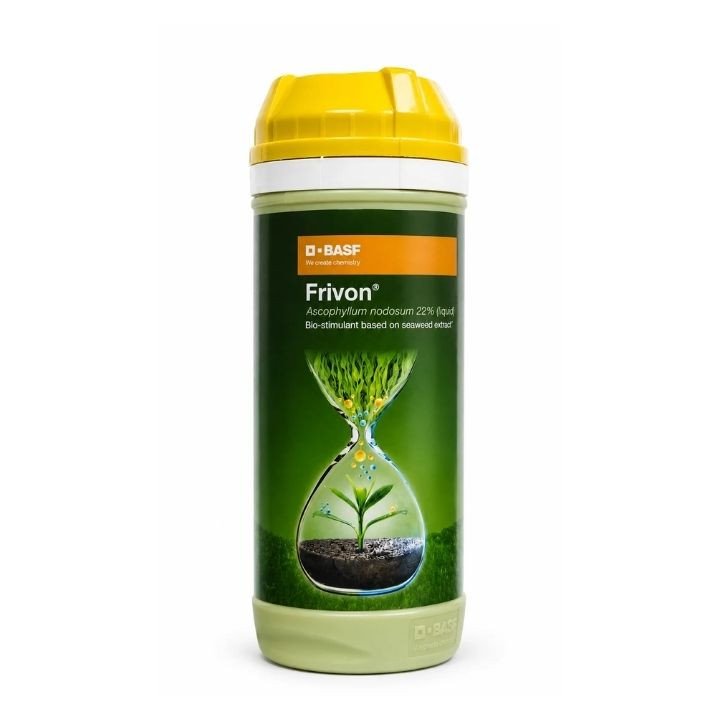
BASF Frivon Biostimulant (Ascophyllum nodosum 22% Liquid)
Seaweed-Based Biostimulant for Crop Growth, Flowering and Stress Management
BASF Frivon Biostimulant (Ascophyllum nodosum 22% Liquid) is a seaweed-based biological nutritional supplement developed to support crop growth during both vegetative and reproductive stages. It contains Ascophyllum nodosum 22% in liquid form and is designed for foliar application.
Frivon supports efficient nutrient utilization, greener crop growth, flowering, fruit retention and crop development. BASF also positions Frivon as a crop-stress management solution that helps plants perform better during challenging environmental conditions such as heat, drought and temperature fluctuations.
Product Specifications
| Product Name | Frivon |
|---|---|
| Brand | BASF |
| Product Type | Biostimulant / Seaweed-Based Biological Nutritional Supplement |
| Technical Composition | Ascophyllum nodosum 22% (Liquid) |
| Source | Natural Seaweed Extract |
| Form | Liquid |
| Application Method | Foliar Spray |
| Recommended Crops | Cotton, Soybean and Tomato |
| Major Benefits | Crop Growth, Nutrient Utilization, Flowering, Fruit Retention and Stress Management |
Technical Composition
| Ingredient | Concentration |
|---|---|
| Ascophyllum nodosum Seaweed Extract | 22% Liquid |
Key Features of BASF Frivon
- Seaweed-Based Biostimulant: Contains Ascophyllum nodosum 22% liquid derived from natural seaweed.
- Quick Nutrient Response: Supports greener leaves and more uniform crop growth.
- Vegetative Growth Support: Helps crops develop a healthy and stronger canopy during vegetative development.
- Flowering Support: Supports flowering during important reproductive growth stages.
- Fruit Retention: Helps support fruit retention and crop reproductive development.
- Stress Management: Helps crops cope with environmental stresses such as drought and temperature fluctuations.
- Improved Nutrient Utilization: Supports more efficient utilization of applied nutrients.
- Foliar Application: Designed for application directly over crop foliage using a fine mist spray.
Benefits of BASF Frivon Biostimulant
- Supports greener and more uniform plant growth.
- Helps improve crop response to applied nutrients.
- Supports both vegetative and reproductive crop stages.
- Helps improve flowering and fruit retention.
- Supports development of a stronger crop canopy.
- Helps crops maintain normal physiological activity during heat and drought stress.
- Supports crop quality parameters such as size, colour and shelf-life potential.
- Helps crops achieve better performance under suitable agronomic conditions.
Recommended Crops and Dosage
| Crop | Dosage | Number of Applications | Application Stage |
|---|---|---|---|
| Cotton | 625 ml/ha | 3 Foliar Applications | Beginning of vegetative development, flowering and fruit development stages |
| Soybean | 625 ml/ha | 2 Foliar Applications | Vegetative development and reproductive / grain development stages as recommended |
| Tomato | 625 ml/ha | 3 Foliar Applications | Beginning of vegetative development, flowering and fruit development stages |
The official BASF recommendation is 625 ml per hectare, which is approximately 250–253 ml per acre. Follow the current Frivon label for final crop-specific spray timing, water volume and application instructions.
Frivon for Cotton
In cotton, BASF recommends three foliar applications of Frivon at 625 ml per hectare. Applications are positioned around important crop stages including early vegetative development, flowering and fruit or boll development.
Timely application can help support canopy development, flowering, nutrient utilization and crop performance during periods of environmental stress.
Frivon for Soybean
For soybean, BASF recommends two foliar applications at 625 ml per hectare. The applications are intended to support crop development during important vegetative and reproductive stages.
Frivon can help improve nutrient response, maintain crop vigour and support grain-development potential when used as part of a balanced crop nutrition program.
Frivon for Tomato
In tomato, BASF recommends three foliar applications at 625 ml per hectare during important stages such as early vegetative growth, flowering and fruit development.
Frivon supports healthy canopy growth, flowering, fruit retention and crop quality when used according to label recommendations.
How BASF Frivon Works
Frivon is produced from Ascophyllum nodosum seaweed through controlled extraction, digestion and fermentation processes. The resulting seaweed-based biological nutritional supplement contains naturally derived compounds that support plant physiological processes.
Rather than acting as a pesticide, Frivon works by supporting plant growth, nutrient utilization and physiological responses during periods of environmental stress.
Biological Stress Support
BASF describes Frivon as helping plants create a biological stress shield. It supports natural crop mechanisms that help protect plant tissues from oxidative stress caused by challenging growing conditions.
This can be particularly useful during periods of heat, drought or temperature fluctuations when normal plant growth may otherwise be affected.
Osmotic Stress Support
Frivon supports osmotic protection within plant cells, helping maintain cellular turgor and structural integrity during periods of heat or limited water availability.
This does not replace proper irrigation management, but it can support crop physiological performance as part of an overall stress-management program.
Supports Greener and Uniform Growth
BASF highlights a quick nutritional response as one of the key benefits of Frivon. It helps stimulate crop growth responses and supports efficient nutrient utilization, contributing to greener foliage and more uniform crop development.
Supports Flowering and Fruit Retention
Frivon can be applied during important reproductive stages to support flowering and fruit retention. Maintaining healthy reproductive growth can help crops develop a stronger productive canopy and support marketable produce.
Supports Crop Quality
By supporting crop growth, nutrient use and stress management, Frivon can contribute to important crop-quality characteristics including:
- Fruit size development
- Uniform crop growth
- Produce colour
- Fruit retention
- Canopy strength
- Shelf-life potential
Soil and Root-Zone Support
BASF also describes Frivon as contributing to improved soil structure and moisture management around the root zone. Seaweed-derived components can support the crop environment by helping retain moisture near developing roots.
Frivon should still be used together with appropriate irrigation, soil management and balanced fertilizer practices.
How to Use BASF Frivon
- Identify the crop and recommended application stage.
- Measure the required quantity of Frivon accurately.
- Partially fill the spray tank with clean water.
- Add the measured quantity of Frivon while maintaining agitation.
- Add the remaining required water and mix thoroughly.
- Apply as a uniform foliar spray.
- Use a fine mist nozzle for complete foliage coverage.
- Avoid excessive runoff from plant surfaces.
- Follow the crop-specific number of applications recommended by BASF.
Spray Application Tips
- Use a fine mist nozzle for uniform foliage coverage.
- Apply according to the recommended crop growth stage.
- Use clean water for preparing the spray solution.
- Maintain proper sprayer calibration.
- Ensure uniform coverage of the crop canopy.
- A suitable adjuvant may be used where recommended for improved coverage.
- Avoid spraying during strong wind or extreme weather conditions.
- Follow the current product label for tank-mix compatibility.
Best Time to Apply
Frivon is intended for use during important stages of crop development rather than only after visible stress appears. Depending on the crop, BASF positions applications around:
- Beginning of vegetative development
- Flowering
- Fruit development
- Grain development
Correct timing allows the crop to receive biostimulant support during periods of high physiological demand.
Frivon as Part of a Crop Nutrition Program
Frivon is a biostimulant and biological nutritional supplement. It should be integrated with a balanced fertilizer, irrigation and crop-management program rather than being treated as a complete replacement for essential macro and micronutrient fertilizers.
Soil testing, crop-stage requirements and local agronomic recommendations should be considered when planning the overall nutrition program.
Compatibility
BASF states that a suitable adjuvant can be added for improved foliar coverage. For combinations with fertilizers, micronutrients, pesticides or other crop inputs, always check the respective product labels before tank mixing.
- Use clean spray water.
- Conduct a small compatibility test for unfamiliar mixtures.
- Avoid mixtures prohibited by either product label.
- Prepare fresh spray solution for application.
Why Farmers Can Choose BASF Frivon
- Contains Ascophyllum nodosum 22% liquid seaweed extract.
- BASF biological nutritional supplement and biostimulant.
- Supports greener and uniform crop growth.
- Helps improve nutrient utilization.
- Supports flowering and fruit retention.
- Supports crop performance during heat and drought stress.
- Helps develop a stronger crop canopy.
- Recommended by BASF for cotton, soybean and tomato.
- Designed for application during vegetative and reproductive crop stages.
Frequently Asked Questions
Q1. What is BASF Frivon?
BASF Frivon is a seaweed-based biostimulant and biological nutritional supplement containing Ascophyllum nodosum 22% in liquid form.
Q2. What is the technical composition of Frivon?
Frivon contains Ascophyllum nodosum 22% liquid seaweed extract.
Q3. Is Frivon a fertilizer or pesticide?
Frivon is a seaweed-based biostimulant and biological nutritional supplement. It is not an insecticide, fungicide or herbicide.
Q4. Which crops does BASF recommend for Frivon?
BASF's current product information specifically provides application recommendations for cotton, soybean and tomato.
Q5. What is the dose of BASF Frivon?
BASF recommends 625 ml per hectare, equivalent to approximately 250–253 ml per acre, for the crops listed on its current product page.
Q6. How many times should Frivon be applied in cotton?
BASF recommends three foliar applications in cotton at important vegetative, flowering and fruit-development stages.
Q7. How many applications are recommended for soybean?
BASF recommends two foliar applications in soybean according to crop-development stages.
Q8. How many applications are recommended for tomato?
BASF recommends three foliar applications in tomato during important vegetative, flowering and fruit-development stages.
Q9. Does Frivon help during heat or drought stress?
Yes. BASF describes Frivon as supporting natural plant stress responses during conditions such as drought and temperature fluctuations.
Q10. Does Frivon improve flowering?
Frivon supports flowering and fruit retention when applied at the recommended crop stages as part of an appropriate crop-management program.
Q11. Does Frivon help make leaves greener?
BASF highlights quicker nutrient response, greener leaves and more uniform crop growth among the product's benefits.
Q12. Can Frivon replace regular fertilizers?
No. Frivon should be used as a biostimulant alongside a balanced crop nutrition program rather than as a complete replacement for essential fertilizers.
Q13. Which spray nozzle should be used?
BASF recommends using a fine mist nozzle to obtain complete foliage coverage.
Q14. Can an adjuvant be added with Frivon?
BASF states that a suitable adjuvant may be added for improved coverage. Always verify compatibility before preparing the final tank mixture.
BASF Frivon for Growth, Flowering and Crop Stress Management
BASF Frivon Biostimulant (Ascophyllum nodosum 22% Liquid) is a seaweed-based biological nutritional supplement designed to support crop growth, nutrient utilization, flowering, fruit retention and tolerance to environmental stresses. BASF recommends Frivon for foliar use in cotton, soybean and tomato at important vegetative and reproductive growth stages.
Disclaimer: The details provided are for informational guidance only. Always adhere to the recommended application instructions as stated on the product label and in the accompanying leaflet.
Similar Products
Best Selling
Customer Reviews
Recent Reviews
No reviews yet.