

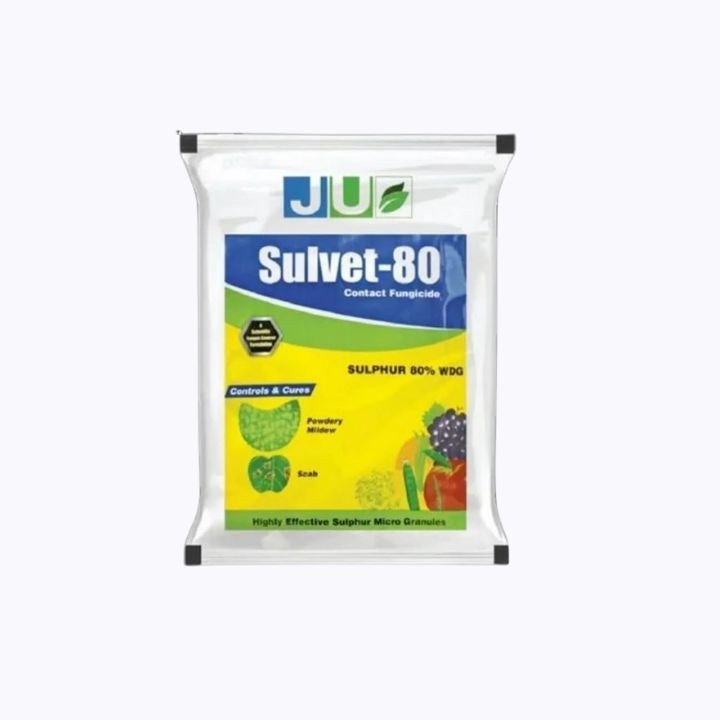
JU Sulvet-80 Sulphur 80% WDG Fungicides
JU Sulvet-80 – Sulphur 80% WDG (Contact Fungicide)
JU Sulvet-80 is a contact fungicide formulated with Sulphur 80% WDG for effective control of powdery mildew across a wide range of crops. Regular, well-timed applications help reduce disease pressure and support cleaner, higher-quality produce.
Product Specifications
| Attribute | Details |
|---|---|
| Brand | JU |
| Product Name | Sulvet-80 |
| Technical Name | Sulphur 80% WDG (Water-Dispersible Granules) |
| Mode of Action | Contact; inhibits spore germination and mycelial growth |
| FRAC Code | M02 (inorganic, multi-site) |
| Target Disease | Powdery Mildew (various crops) |
| Recommended Crops | Grapes, Mango, Apple, Cumin, Wheat, Tea, Cotton (and other listed crops) |
| Dosage* | 750–1000 g per acre (formulation) |
| Application Type | Foliar spray; thorough coverage is essential |
*Indicative range provided; always follow the current pack label and local advisory.
Key Features & Benefits
- Contact action: Provides fast surface protection against new infections.
- Wide crop suitability: Effective on horticultural, plantation, and field crops.
- Resistance management: Multi-site (FRAC M02) fungicide suitable for rotation programs.
- Ease of use: WDG granules disperse quickly and are cost-effective per acre.
How to Use
- Timing: Apply preventively at the first sign of mildew or as per local advisory; repeat at 7–10 day intervals depending on disease pressure.
- Mixing: Fill the tank halfway with clean water → add the required WDG granules → stir/agitate thoroughly → top up to final volume.
- Coverage: Ensure uniform wetting, especially on leaf undersides; keep the solution agitated during spraying.
- Spray conditions: Apply during the cooler parts of the day; avoid spraying during rain or extreme heat.
Compatibility, Cautions & Safety
- Do not mix with oils or apply within ~2 weeks of oil-based sprays (phytotoxicity risk).
- High temperature caution: Sulphur may cause phytotoxicity in very hot conditions (≥32–35 °C); follow local guidance.
- PPE: Always wear gloves, mask, and goggles; avoid spray drift; dispose of empty packs as per label instructions.
Crop Use (Guideline)
| Crop | Target | Dose (Form.)* | Notes |
|---|---|---|---|
| Grapes, Mango, Apple | Powdery Mildew | 750–1000 g/acre | Apply preventively at early symptoms; rotate with other FRAC groups. |
| Cumin, Cotton | Powdery Mildew | 750–1000 g/acre | Ensure thorough canopy coverage. |
| Wheat, Tea | Powdery Mildew | 750–1000 g/acre | Follow local advisory and seasonal intervals. |
*Exact spray interval, spray volume, and PHI should be followed as per the product pack/leaflet and local advisory.
FAQs
Q1: Is it systemic?
A1: No, this is a contact fungicide; therefore, maintaining preventive coverage and regular spray intervals is essential.
Q2: Can it be used in organic farming?
A2: Sulphur is permitted in many organic programs, but always confirm with your certifying body and check the current pack/label.
Q3: Why should it not be mixed with oil sprays?
A3: Oil mixtures or close intervals with oil sprays increase the risk of phytotoxicity; maintain a minimum 10–14 day gap (as per label/advisory).
Q4: What should be the spray interval?
A4: Typically 7–10 days, depending on weather and disease pressure. In severe pressure, shorter intervals may be needed as per advisory.
Q5: Does it also control mites?
A5: Sulphur may suppress mite activity in some cases, but this product is primarily for powdery mildew. For mite control, use a dedicated acaricide.
Disclaimer: This information is provided for reference purposes only. Always follow the recommended application guidelines outlined on the product label and leaflet.
Similar Products


Best Selling
Customer Reviews
Recent Reviews
No reviews yet.