

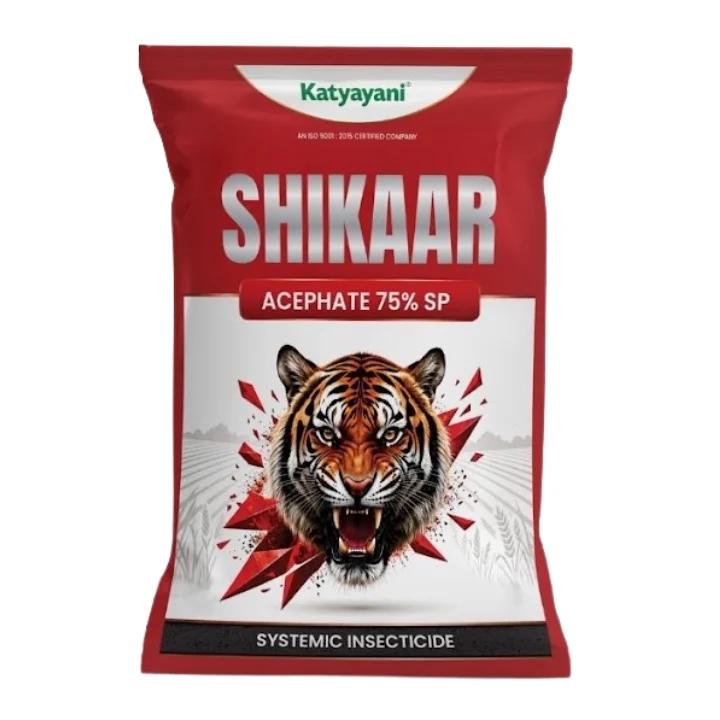


Katyayani Shikaar (Acephate 75% SP) Systemic Insecticide for Crop Pest Control
Katyayani Shikaar Acephate 75% SP Systemic Insecticide
Katyayani Shikaar is an organophosphate insecticide formulated with Acephate 75% SP for controlling specified sucking and chewing insect pests in cotton, safflower and rice crops. It provides systemic and contact activity, making it useful in managing pests that feed on plant sap, foliage and other susceptible crop parts.
Shikaar acts by inhibiting acetylcholinesterase, an enzyme essential for normal nerve functioning in insects. Its approved uses include jassids and bollworms in cotton, aphids in safflower, and yellow stem borer, leaf folder, plant hoppers and green leafhopper in rice. Applying the correct quantity against the identified pest helps protect crops from insect feeding damage.
Product Details
| Brand | Katyayani |
|---|---|
| Product Name | Shikaar |
| Technical Composition | Acephate 75% w/w |
| Formulation | Soluble Powder (SP) |
| Product Category | Insecticide |
| Chemical Group | Organophosphate |
| IRAC Classification | Group 1B |
| Mode of Action | Acetylcholinesterase Inhibition |
| Insecticidal Activity | Systemic, Contact and Ingestion |
| Recommended Crops | Cotton, Safflower, Rice (Paddy) |
| Target Pests | Jassids, Bollworms, Aphids, Yellow Stem Borer, Leaf Folder, Plant Hoppers and Green Leafhopper |
| Application Method | Foliar Spray |
| Pre-Harvest Waiting Period | 15 Days |
Key Features and Benefits
- Systemic and Contact Action: Provides insecticidal activity through plant absorption, direct contact and ingestion by susceptible pests.
- Controls Sucking Pests: Recommended against jassids in cotton, aphids in safflower and specified leafhoppers and planthoppers in paddy.
- Controls Chewing Pests: Helps manage cotton bollworms and paddy stem borers and leaf folders.
- Broad-Spectrum Formulation: Provides a range of crop- and pest-specific uses supported by registered Acephate 75% SP recommendations.
- Water-Soluble Formulation: The soluble powder can be diluted in water for foliar application according to label directions.
- Supports Crop Protection: Timely treatment helps reduce insect damage and protect healthy crop development.
Recommended Crops, Target Pests and Dosage
| Crop | Target Pest | Dose Per Acre | Water Per Acre |
|---|---|---|---|
| Cotton | Jassids | 158 g | 200–405 L |
| Cotton | Bollworms | 316 g | 200–405 L |
| Safflower | Aphids | 316 g | 200–405 L |
| Rice (Paddy) | Yellow Stem Borer, Leaf Folder, Plant Hoppers and Green Leafhopper | 270–405 g | 120–200 L |
Application: Foliar spray. Dosage depends on the crop and target pest. Use the correct crop-specific recommendation rather than applying one fixed dose across all crops.
How Does Katyayani Shikaar Work?
The active ingredient Acephate belongs to the organophosphate insecticide group and is classified under IRAC Group 1B.
Acephate inhibits the acetylcholinesterase enzyme in susceptible insects. This disrupts normal nerve signal transmission, resulting in uncontrolled nerve activity, paralysis and eventual insect death.
Its systemic and contact properties help manage labelled sucking pests and exposed chewing insects. Effective control depends on pest susceptibility, proper application timing and adequate spray coverage.
Crop-Specific Pest Management
Cotton – Jassids and Bollworms
Jassids feed on cotton leaf sap and can cause yellowing, curling and reduced plant vigour. Bollworms damage cotton squares, flowers and bolls by feeding on developing plant tissues.
Katyayani Shikaar has different registered application rates for jassids and bollworms. Identify the pest before selecting the appropriate dose. Larvae feeding inside protected plant structures may be harder to reach with insecticide sprays.
Safflower – Aphids
Aphids feed on tender safflower tissues and remove plant sap. Heavy infestations may cause plant weakening and honeydew accumulation. The labelled Acephate 75% SP treatment helps manage susceptible aphid populations.
Rice – Stem Borers, Leaf Folders and Hoppers
Yellow stem borers damage rice stems and may cause dead hearts or whiteheads. Leaf folders roll and feed inside rice leaves, while plant hoppers and green leafhoppers feed on plant sap.
The recommended foliar application supports management of these specified rice pests when used at the correct crop stage and according to the approved label.
Application Method
- Inspect the crop and identify the insect pest before treatment.
- Check the recommended dosage for the specific crop and pest.
- Wear appropriate personal protective equipment before handling the insecticide.
- Measure the required quantity using suitable equipment.
- Dissolve the powder in a small quantity of clean water, mixing thoroughly.
- Add the mixture to the spray tank and dilute with the remaining recommended water.
- Apply uniformly across the crop canopy using calibrated spraying equipment.
- Follow the product label for repeat applications, maximum spray frequency and harvesting restrictions.
When to Apply
Apply when the target pests are present and treatment is justified by field monitoring or locally recommended economic threshold levels. Early identification is especially important for pests that enter stems, leaves or developing bolls.
Avoid spraying during strong winds, rainfall or unfavourable weather. Follow locally recommended application timing and the original product label.
Safety Precautions and Storage
- Use only on approved crop and pest combinations.
- Do not exceed the recommended application rate.
- Wear protective gloves, suitable clothing, eye protection and respiratory protection as directed on the label.
- Avoid inhaling spray dust or mist and prevent skin and eye exposure.
- Acephate can cause organophosphate poisoning. Seek immediate medical assistance if exposure or poisoning is suspected.
- Avoid spraying while honey bees are actively foraging.
- Prevent contamination of drinking water, ponds and aquatic environments.
- Avoid unnecessary repeated applications of IRAC Group 1B insecticides to reduce resistance pressure.
- Observe the 15-day pre-harvest waiting period.
- Store in the original sealed container in a cool, dry and ventilated location, away from children, food and animal feed.
Frequently Asked Questions
1. What is Katyayani Shikaar used for?
Katyayani Shikaar is an Acephate 75% SP insecticide used for managing specified sucking and chewing pests in cotton, safflower and rice crops.
2. What is the Shikaar dosage for cotton?
The recommended dosage is 158 g per acre for jassids and 316 g per acre for bollworms, according to the manufacturer's recommendations.
3. What is the dosage for paddy?
The recommended dosage is 270–405 g per acre for specified paddy pests, diluted in 120–200 litres of water.
4. Is Katyayani Shikaar a systemic insecticide?
Yes. Its active ingredient, Acephate, provides systemic and contact insecticidal activity.
5. Can Shikaar be used on all crops?
No. The verified crop recommendations cover cotton, safflower and rice. Other applications require specific label approval.
6. What is the waiting period before harvesting?
The registered Acephate 75% SP recommendation specifies a 15-day pre-harvest interval for the listed crops.
Disclaimer: The recommended crops, target pests, dosage and waiting period are based on the official Katyayani Shikaar product information and Indian registered Acephate 75% SP references. Always follow the current original product label, safety instructions and locally applicable agricultural recommendations before use.
Similar Products





Best Selling

Customer Reviews
Recent Reviews
No reviews yet.