

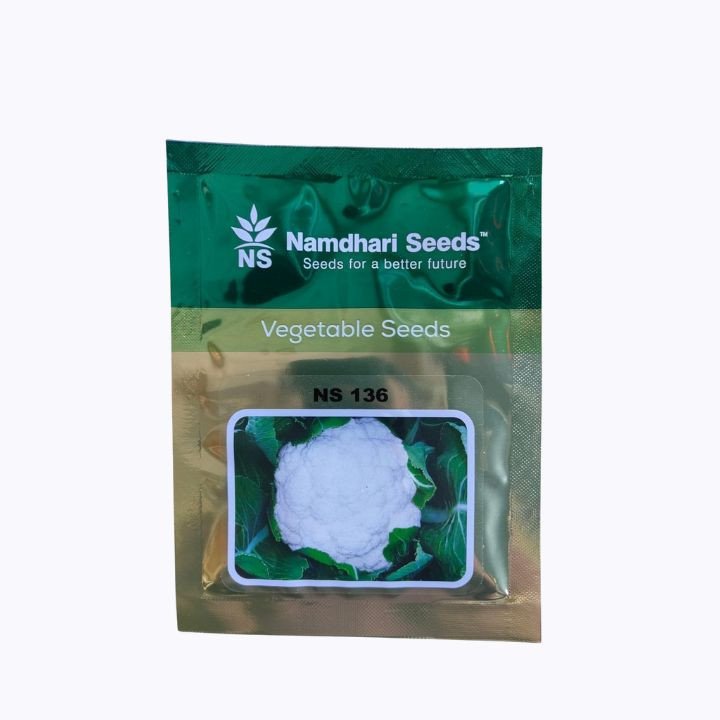
NS 136 Hybrid Cauliflower Vegetable Seeds
NS 136 Hybrid Cauliflower Vegetable Seeds – White
NS 136 is a premium hybrid cauliflower developed for main-season production, noted for its large, compact, pure-white heads. Vigorous plants with strong wrapper leaves provide natural self-blanching and reliable performance under moderate temperature conditions.
Product Specifications
| Attribute | Details |
|---|---|
| Brand | Generic |
| Variety | NS 136 (Hybrid Cauliflower) |
| Curd Colour | Pure White |
| Usage | Outdoor (field cultivation) |
| Sunlight Exposure | Full Sun |
| Item Form | Seeds |
| Special Features | Hybrid; self-blanching; tight, uniform florets |
| Sowing Window* | Spring to early Summer (region-dependent main-season) |
| Harvest Window* | Main-season harvest under moderate temperatures |
| Head Characteristics | Large, dense, well-protected curds; tight floret formation |
| Plant Traits | Vigorous growth, strong roots, good wrapper leaf coverage |
| Germination/Stand | Professional-grade lot; uniform stand with good practices |
*Indicative windows—adjust to your local climate and calendar. Always follow the directions on the seed packet/leaflet.
Key Features & Benefits
- Premium head quality: Large, compact, pure-white curds with tight florets.
- Main-season fit: Performs best in moderate temperatures.
- Self-blanching habit: Strong wrappers help maintain curd whiteness.
- Vigorous plants: Strong root and foliage architecture for stable yields.
- Reliable establishment: Consistent crop stand when good agronomy is followed.
FAQs
Q1: Which season is NS 136 best suited for?
A1: Designed for the main season; it gives best head quality under moderate temperatures. In many regions this aligns with spring–early summer sowing.
Q2: Are the heads self-blanching?
A2: Yes. Strong wrapper leaves naturally cover the curd, helping maintain whiteness.
Q3: What spacing should I keep?
A3: Typical main-season spacing is ~60 × 45 cm; for smaller heads you may use ~45 × 45 cm.
Q4: Any nutrition tips?
A4: Along with balanced NPK, pay attention to Boron and Molybdenum to reduce defects like hollow stem and whiptail.
Q5: How can I manage pests and diseases?
A5: Use clean nursery practices, maintain field sanitation, monitor with traps, and follow your local IPM advisories.
Disclaimer: The information above is intended for informational purposes. For proper application, always follow the official directions mentioned on the packaging and product leaflet.
Similar Products
Best Selling
Customer Reviews
Recent Reviews
No reviews yet.