

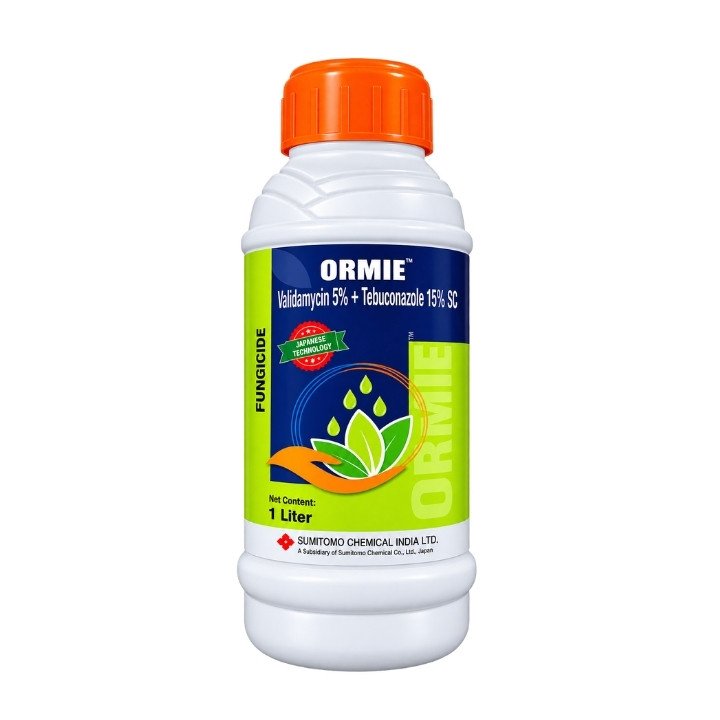
Sumitomo Ormie Fungicide – Validamycin 5% + Tebuconazole 15% SC
Sumitomo Ormie Fungicide
Sumitomo Ormie is a combination fungicide containing Validamycin 5% and Tebuconazole 15% SC. It provides contact and systemic activity for the management of sheath blight caused by Rhizoctonia solani in paddy.
The formulation acts at two important sites in the fungal-development process. It acts on fungal hyphae to help restrict penetration and also interferes with the ergosterol-synthesis pathway, affecting fungal cell-membrane formation and growth.
Ormie is recommended at 400 ml per acre in approximately 200 litres of water for paddy sheath blight. Apply only according to the current product label and accompanying leaflet.
Sumitomo Ormie Product Specifications
| Specification | Details |
|---|---|
| Product Name | Sumitomo Ormie Fungicide |
| Brand | Sumitomo Chemical India Limited |
| Technical Name | Validamycin 5% + Tebuconazole 15% SC |
| Active Ingredients | Validamycin 5% and Tebuconazole 15% |
| Formulation | SC – Suspension Concentrate |
| Product Category | Fungicide |
| Mode of Action | Contact and systemic action |
| Recommended Crop | Paddy / Rice |
| Target Disease | Sheath blight |
| Causal Organism | Rhizoctonia solani |
| Recommended Dose | 400 ml per acre |
| Water Volume | 200 litres per acre |
| Application Method | Foliar spray |
| Pack Size Shown | 1 litre |
Key Features of Sumitomo Ormie
- Two Active Ingredients: Combines Validamycin 5% with Tebuconazole 15% in an SC formulation.
- Contact and Systemic Activity: Provides protection on treated surfaces and movement within the plant.
- Dual-Site Activity: Acts on fungal hyphae and the ergosterol-synthesis pathway.
- Sheath Blight Management: Specifically recommended for sheath blight in paddy.
- Helps Restrict Fungal Penetration: Validamycin acts on fungal hyphae and helps prevent further invasion of plant tissue.
- Inhibits Fungal Growth: Tebuconazole interferes with fungal cell-membrane development.
- Crop-Vigour Support: Sumitomo describes Ormie as providing a phytotonic effect that supports a healthy green crop under proper management.
How Sumitomo Ormie Works
Ormie combines two fungicidal components with complementary activity. Validamycin acts mainly on the growth and development of fungal hyphae associated with sheath blight. This helps restrict fungal penetration and subsequent spread through infected plant tissue.
Tebuconazole interferes with ergosterol synthesis. Ergosterol is important for the formation and function of fungal cell membranes. Disruption of this pathway inhibits the normal growth and development of the target fungus.
The combination provides contact and systemic action, helping protect treated plant surfaces while supporting disease management within the crop.
Recommended Crop, Disease and Dosage
| Crop | Disease | Causal Organism | Dose per Acre | Water Volume |
|---|---|---|---|---|
| Paddy / Rice | Sheath blight | Rhizoctonia solani | 400 ml | 200 litres |
Label restriction: Do not advertise or apply Ormie for diseases or crops that are not stated on the current registered product label.
Area Covered by Different Quantities
| Product Quantity | Approximate Area at 400 ml/Acre |
|---|---|
| 100 ml | 0.25 acre |
| 250 ml | 0.625 acre |
| 400 ml | 1 acre |
| 500 ml | 1.25 acres |
| 1 litre | 2.5 acres |
Coverage note: These area calculations are based strictly on the stated dose of 400 ml per acre. Actual spray preparation must follow the current label and accurately measured field area.
Benefits for Paddy Farmers
- Helps manage sheath blight caused by Rhizoctonia solani.
- Provides both contact and systemic fungicidal action.
- Acts against fungal hyphae to help restrict disease penetration.
- Disrupts the fungal ergosterol-synthesis pathway.
- Helps reduce further development and spread of sheath-blight infection.
- Supports plant defence when used at the correct disease stage.
- Provides a clear recommended dose of 400 ml per acre.
- SC formulation supports convenient measurement and spray-tank preparation.
Identifying Sheath Blight in Paddy
Sheath blight commonly develops as lesions on leaf sheaths near the waterline or lower crop canopy. Lesions may enlarge and spread upwards under favourable conditions, particularly in dense, humid crops.
Symptoms should be correctly identified before application because nutrient disorders, insect damage and other diseases may require different management. Consult an agricultural specialist if the diagnosis is uncertain.
Application Timing
Apply Ormie when sheath-blight symptoms first appear or at the crop and disease stage specified on the current label. Early, uniform application generally offers better disease-management potential than treatment after severe infection has spread throughout the canopy.
Do not apply solely according to a calendar schedule. Inspect the crop regularly and consider disease symptoms, weather, crop density and local agricultural recommendations.
How to Apply Sumitomo Ormie
- Inspect the paddy crop and correctly identify sheath-blight symptoms.
- Read the complete Ormie label and leaflet before preparing the spray.
- Measure 400 ml of Ormie for one acre.
- Use approximately 200 litres of clean water per acre.
- Wear the protective equipment specified on the product label.
- Shake the closed container well before measuring the suspension concentrate.
- Half-fill the spray tank with clean water.
- Add the measured product slowly while agitating the tank.
- Add the remaining water and mix thoroughly.
- Spray uniformly, directing coverage towards the lower canopy and leaf sheaths where the disease develops.
- Maintain agitation during spraying for a uniform suspension.
- Use the prepared spray mixture on the same day.
Best Application Practices
- Use a properly calibrated knapsack or power sprayer.
- Ensure thorough coverage of infected and surrounding plant tissue.
- Direct the spray towards leaf sheaths and the lower crop canopy.
- Avoid spraying during strong wind or rainfall.
- Do not spray during the hottest part of the day.
- Avoid excessive runoff from the crop.
- Do not use more than the label-recommended dose.
- Observe the label-specified re-entry and pre-harvest intervals.
Integrated Sheath-Blight Management
Ormie should be used as one component of an integrated disease-management programme. Fungicide application alone may not provide satisfactory results where dense crop growth, excess nitrogen, continuous standing water and favourable weather strongly support disease development.
- Use a balanced fertilizer programme based on soil-test recommendations.
- Avoid excessive nitrogen application.
- Maintain the locally recommended plant population and spacing.
- Monitor dense and humid crop areas regularly for early symptoms.
- Manage weeds and volunteer rice plants that may increase canopy humidity.
- Use tolerant varieties where locally recommended.
- Follow appropriate water and crop-residue management practices.
Fungicide-Resistance Management
Repeated use of fungicides with the same biochemical action can increase resistance-selection pressure. Use Ormie according to the label and rotate with effective registered fungicides having a different mode of action where permitted.
- Do not apply repeated unnecessary sprays.
- Do not use a reduced or excessive dose.
- Apply at the recommended disease stage.
- Combine chemical treatment with cultural disease-management practices.
- Follow local recommendations for spray intervals and maximum applications.
Compatibility
Mix Ormie with another pesticide or fertilizer only when all product labels permit the combination. Conduct a small jar test before preparing an unfamiliar tank mixture and consult an agricultural specialist if compatibility is uncertain.
Safety Precautions
- Read the label and accompanying leaflet completely before use.
- Keep the fungicide in its original sealed and labelled container.
- Store away from children, food, animal feed and household articles.
- Wear label-specified gloves, clothing, footwear and face protection.
- Avoid contact with skin and eyes and avoid inhaling spray mist.
- Do not eat, drink, smoke or chew during mixing and spraying.
- Wash exposed skin, equipment and contaminated clothing after application.
- Do not contaminate drinking-water sources, ponds, canals or animal feed.
- Never reuse an empty fungicide container.
Why Farmers Can Choose Sumitomo Ormie
- Combination of Validamycin 5% and Tebuconazole 15% SC.
- Officially recommended for paddy sheath blight.
- Provides contact and systemic action.
- Acts on fungal hyphae and ergosterol synthesis.
- Helps restrict disease infection and further spread.
- Recommended dose of 400 ml per acre.
- One-litre pack covers approximately 2.5 acres at the stated dose.
Frequently Asked Questions
What is the technical name of Sumitomo Ormie?
Ormie contains Validamycin 5% + Tebuconazole 15% SC.
Is Ormie a contact or systemic fungicide?
It provides dual contact and systemic fungicidal action.
Which disease does Ormie control?
It is officially recommended for sheath blight caused by Rhizoctonia solani in paddy.
What is the dose of Ormie per acre?
Apply 400 ml per acre in approximately 200 litres of water, subject to the current product-label instructions.
How much area will a one-litre pack cover?
At 400 ml per acre, one litre is mathematically sufficient for approximately 2.5 acres.
Where should Ormie be sprayed in the paddy crop?
Ensure uniform coverage, particularly around the leaf sheaths and lower crop canopy where sheath-blight infection commonly develops.
Can Ormie be used for blast, brown spot or other rice diseases?
The supplied official recommendation identifies paddy sheath blight. Do not advertise or apply it for another disease unless that use appears on the current registered label.
Does Ormie guarantee better yield?
Effective disease management can help protect crop performance, but yield also depends on variety, weather, nutrition, irrigation, disease severity and overall crop management. A specific yield increase cannot be guaranteed.
Can Ormie be mixed with an insecticide or fertilizer?
Prepare a mixture only when every product label permits it. Conduct a jar test and obtain expert advice before combining unfamiliar products.
Disclaimer: The information provided is for general guidance only. Always adhere to the recommended crop, disease, dose, water volume, waiting period, protective equipment and application instructions stated on the current product label and accompanying leaflet.Similar Products




Best Selling

Customer Reviews
Recent Reviews
No reviews yet.