

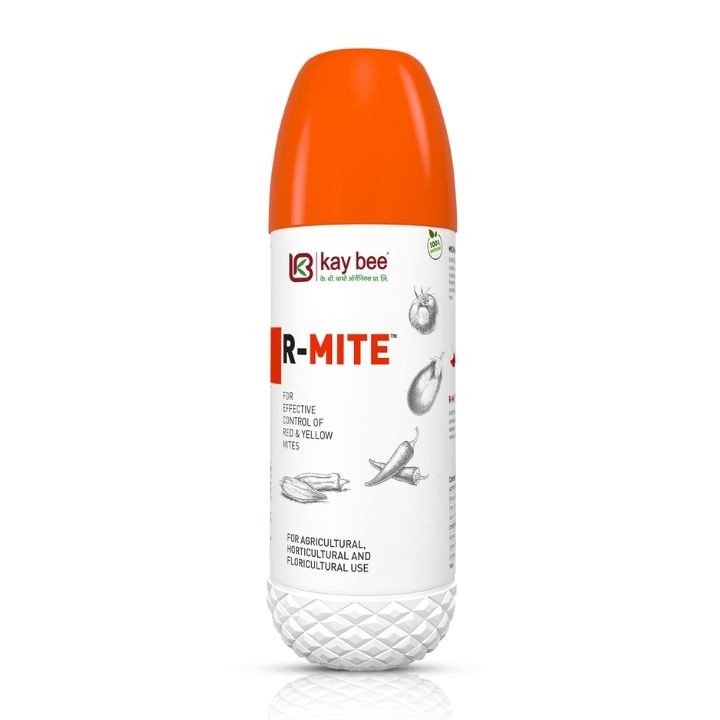
के बी आर-माइट बायो मिटीसाइड
R-Mite: The Same Multi-Level Attack Kay Bee Uses Against Thrips, Now Aimed at Mites
Mites present a recurring frustration in crop protection — they reproduce fast, and a treatment that only addresses adult populations tends to see the problem resurface within a week or two as eggs hatch and new generations mature. Kay Bee's R-Mite, developed using marker compounds from a range of plant extracts, is built around a multilevel mode of action specifically meant to interrupt this reproduction-driven resurgence pattern rather than just knocking down what's visible at spray time.
The underlying mechanism mirrors what makes several other Kay Bee bio-pesticides distinctive — rather than a single toxic pathway, R-Mite works through contact, systemic, and fumigant action simultaneously, hitting neonates and early instars through antifeedent effects, desiccation, and cytolysis, while addressing later instars through stomach poisoning, anti-molting hormonal disruption, and neurotoxicity.
Product Overview
| Detail | Specification |
|---|---|
| ब्रांड | Kay Bee Bio-Organics |
| Product Name | R-Mite |
| श्रेणी | Bio Miticide / Acaricide (Botanical Extract Based) |
| काम करने का तरीका | Contact, Systemic, and Fumigant |
| Residue Profile | Residue-free, suitable for organic and export production |
| Pack Sizes | 30 मिली, 100 ml, 250 ml, 500 ml, 1 litre, 5 litres |
Which Mite Species It's Effective Against
R-Mite's label doesn't restrict itself to a single mite type — it's positioned against red mites, yellow mites, white mites, and two-spotted mites, covering essentially the full range of mite pests commonly encountered across Indian vegetable, fruit, and flower crops. This breadth is a direct consequence of its multilevel targeting mechanism, which isn't tied to a species-specific biological vulnerability the way some conventional miticides are.
Where It's Recommended for Use
| Crop | Target Pest | Dosage (ml per Litre) |
|---|---|---|
| Chilli | All Types of Mite | 1.5–2.5 |
| Capsicum | All Types of Mite | 1.5–2.5 |
| Onion | All Types of Mite | 1.5–2.5 |
| Potato | All Types of Mite | 1.5–2.5 |
| Brinjal | All Types of Mite | 1.5–2.5 |
| Tomato | All Types of Mite | 1.5–2.5 |
| Okra | All Types of Mite | 1.5–2.5 |
| Cucurbits | All Types of Mite | 1.5–2.5 |
| Cruciferous Crops | All Types of Mite | 1.5–2.5 |
| Grape | All Types of Mite | 1.5–2.5 |
| Mango | All Types of Mite | 1.5–2.5 |
| Citrus | All Types of Mite | 1.5–2.5 |
| स्ट्रॉबेरी | All Types of Mite | 1.5–2.5 |
| Pomegranate | All Types of Mite | 1.5–2.5 |
| Rose | All Types of Mite | 1.5–2.5 |
| गेंदा | All Types of Mite | 1.5–2.5 |
| Cotton | All Types of Mite | 1.5–2.5 |
The uniform 1.5–2.5 ml/litre range across all seventeen listed crops makes R-Mite one of the simpler products to plan a spray schedule around — exact positioning within the range should reflect crop growth stage and how established the mite population already is when treatment begins.
Beyond Killing Mites: A Plant Defense Angle
An interesting secondary function noted with R-Mite is its role in stimulating secondary metabolite production within the treated plant — compounds associated with the plant's own defense activities. This is layered on top of its phytotonic effect, which is linked to enhanced crop productivity independent of direct mite control, suggesting the product's benefit isn't limited purely to pest elimination.
Timing and Frequency
For general preventive use, application at a 7–8 day interval is recommended, shifting to need-based spraying if mite population intensity in the field calls for closer attention. As with most botanical formulations, morning and evening spraying is preferred over midday application, when higher temperatures can reduce the effectiveness of the active compounds.
What Not to Combine It With
R-Mite is specifically listed as non-compatible with sulphur, copper-based fungicides, and Bordeaux mixture — a pattern consistent across several of Kay Bee's botanical extract products. Tank-mixing or applying these too close together in the spray schedule can reduce R-Mite's effectiveness, so this should be factored into a broader crop protection plan.
Frequently Asked Questions
Which spray works for mite control in chilli?
R-Mite is specifically designed for mite control across chilli, tomato, and other crops, applied at 1.5–2.5 ml per litre of water as a foliar spray.
How does R-Mite control red mites specifically?
As a botanical-based bio-insecticide, it's formulated to act on red mites across all stages of their life cycle, using its multilevel contact, systemic, and fumigant mode of action.
Is R-Mite suitable for both vegetable and ornamental flower crops?
Yes, its registered use spans vegetables like chilli and tomato as well as flower crops like rose and marigold, all at the same standard dosage range.
Can R-Mite be applied alongside a copper-based fungicide spray?
No, it's listed as non-compatible with copper-based fungicides, sulphur, and Bordeaux mixture, so these should be scheduled separately.
Disclaimer: The details provided are for informational guidance only. Always adhere to the recommended application instructions as stated on the product label and in the accompanying leaflet.
मिलते-जुलते उत्पाद



सबसे ज़्यादा बिकने वाले
ग्राहक समीक्षाएं
हाल की समीक्षाएं
अभी तक कोई समीक्षा नहीं।