

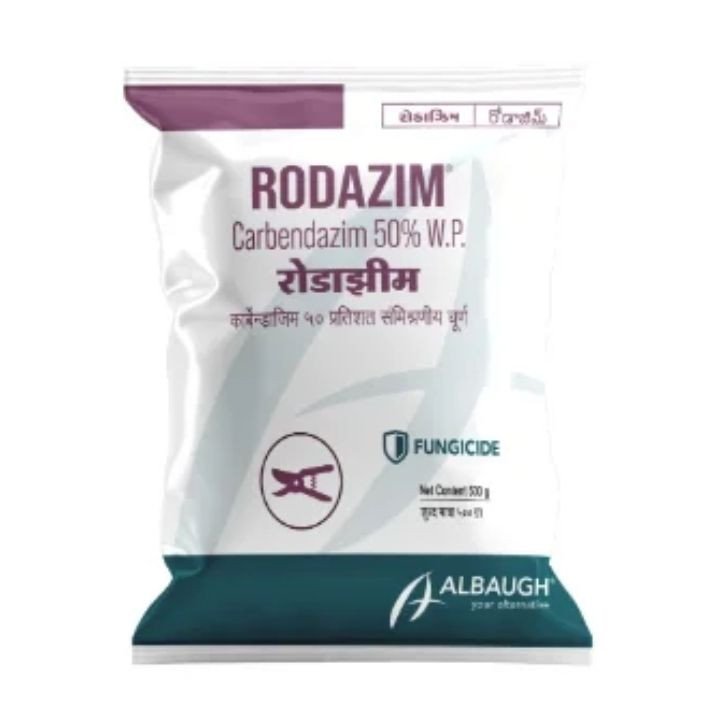
Albaugh RODAZIM Fungicide (Carbendazim 50% WP)

Systemic Fungicide for Preventive and Curative Fungal Disease Management
Albaugh RODAZIM is a broad-spectrum systemic fungicide containing Carbendazim 50% WP. It is designed for preventive and curative management of several fungal diseases in agricultural crops and vegetables.
RODAZIM can be used through foliar spraying and, for label-recommended crops, as a seed-treatment fungicide. Its systemic activity allows Carbendazim to be absorbed by treated plant tissues and act internally against susceptible fungal pathogens.
Product Specifications
| Product Name | RODAZIM |
|---|---|
| Brand | Albaugh |
| Company | Albaugh India Private Limited |
| Product Type | Systemic Fungicide |
| Technical Name | Carbendazim 50% WP |
| Formulation | WP - Wettable Powder |
| Chemical Group | Benzimidazole Fungicide |
| Activity | Preventive and Curative |
| Application Methods | Foliar Spray and Seed Treatment as per Crop Label |
Technical Composition
| Active Ingredient | Carbendazim |
|---|---|
| Concentration | 50% |
| Formulation | Wettable Powder (WP) |
| Fungicide Group | Benzimidazole |
Key Features of Albaugh RODAZIM
- Broad-Spectrum Fungicide: Helps manage several important fungal diseases across label-recommended crops.
- Systemic Action: Absorbed into treated plant tissues for internal disease-management activity.
- Preventive Activity: Helps protect healthy plant tissues against susceptible fungal infection.
- Curative Activity: Helps suppress early established infection when used at the appropriate stage.
- Foliar Application: Suitable for foliar disease-management programs according to crop recommendations.
- Seed Treatment: Recommended for treatment of seeds in specific crops against seed-borne and early-stage fungal diseases.
- Wettable Powder Formulation: Designed for dispersion in water before crop application.
Benefits of RODAZIM Fungicide
- Helps protect crops from important fungal diseases.
- Provides both preventive and curative activity.
- Works systemically after absorption by plant tissues.
- Suitable for both foliar spray and label-recommended seed treatment.
- Helps protect leaves, shoots and developing crop parts from susceptible fungal infection.
- Can support integrated fungal disease-management programs.
Recommended Crops and Diseases
| Crop | Target Disease | Application Type |
|---|---|---|
| Paddy / Rice | Blast and label-recommended fungal diseases | Foliar Spray / Seed Treatment as per Label |
| Wheat | Loose Smut | Seed Treatment |
| Barley | Loose Smut | Seed Treatment |
| Cotton | Leaf Spot | Foliar Spray |
| Groundnut | Tikka Leaf Spot | Foliar Spray |
| Sugar Beet | Leaf Spot and Powdery Mildew | Foliar Spray |
| Pea | Powdery Mildew | Foliar Spray |
| Cluster Bean | Powdery Mildew | Foliar Spray |
| Cucurbits | Powdery Mildew and Anthracnose | Foliar Spray |
| Brinjal | Leaf Spot and Fruit Rot | Foliar Spray |
| Apple | Scab | Foliar Spray |
| Grapes | Anthracnose | Foliar Spray |
| Chilli | Damping Off | Seed Treatment |
| Cowpea | Leaf Spot, Collar Rot, Anthracnose and Powdery Mildew | Foliar Spray |
| Tobacco | Frog Eye Spot and Anthracnose | Foliar Spray |
The crop and disease list may vary according to the current registered RODAZIM label. Always confirm the crop and target disease before application.
Dosage and Application
| Application Method | Albaugh Recommendation |
|---|---|
| Foliar Spray | 80–140 g per acre depending on crop and disease |
| Seed Treatment | 2–3 g per kg of seed for label-recommended crops |
Albaugh recommends RODAZIM for foliar application at approximately 80–140 g per acre across various crops and diseases, and for seed treatment at approximately 2–3 g per kg of seed. The current product label should be used for the final crop-specific dose.
Mode of Action
Carbendazim is a systemic benzimidazole fungicide. It interferes with fungal cell division by inhibiting the formation and function of microtubules required for normal mitosis.
As fungal cell division is disrupted, susceptible pathogens are unable to continue normal growth and development. This provides both preventive protection and curative activity during the early stages of infection.
Systemic Disease Protection
After application, Carbendazim is absorbed by plant tissues and provides internal fungicidal activity. This distinguishes it from purely contact fungicides that remain mainly on the treated crop surface.
Systemic activity can help protect developing tissues and manage susceptible fungal infection within treated parts of the crop.
Preventive and Curative Activity
RODAZIM can be used preventively before severe fungal disease develops and can also provide curative activity during early infection.
For best results, disease monitoring should begin early and application should be made before infection becomes severe or widespread.
RODAZIM for Paddy Diseases
Carbendazim 50% WP is commonly used in paddy disease-management programs, including for blast and certain seed- or soil-borne fungal problems according to registered recommendations.
Use the correct foliar or seed-treatment method depending on the target disease and instructions printed on the current RODAZIM label.
RODAZIM for Powdery Mildew
Carbendazim 50% WP has registered uses against powdery mildew in several crops such as peas, cluster beans, cucurbits and sugar beet.
Apply at the recommended rate when disease symptoms first appear or when conditions are favourable for infection.
RODAZIM for Anthracnose
Anthracnose can cause lesions on foliage, shoots and fruits in susceptible crops. Carbendazim 50% WP has registered uses against anthracnose in crops such as grapes, cucurbits and cowpea.
Timely application and thorough crop coverage are important for effective disease management.
RODAZIM for Seed Treatment
Albaugh recommends RODAZIM as a seed-treatment fungicide at approximately 2–3 g per kg of seed for label-recommended crops.
Seed treatment can help protect against susceptible seed-borne and early seedling fungal infections. Treated seed should be used only for sowing and should never be used for food or feed.
How to Use Albaugh RODAZIM for Foliar Spray
- Identify the crop and fungal disease correctly.
- Confirm the crop-specific dose on the current product label.
- Measure the required quantity accurately.
- Mix the wettable powder with a small amount of clean water to prepare a smooth slurry.
- Partially fill the spray tank with clean water.
- Add the prepared slurry while maintaining agitation.
- Add the remaining required water and mix thoroughly.
- Spray uniformly over the crop canopy.
- Ensure good coverage of disease-prone plant surfaces.
How to Use RODAZIM for Seed Treatment
- Use only on crops specifically recommended for Carbendazim seed treatment.
- Measure the label-recommended dose according to seed weight.
- Prepare a suitable slurry if wet-slurry treatment is recommended.
- Coat the seeds uniformly with the fungicide.
- Allow treated seed to dry in shade before sowing where directed.
- Use treated seed only for planting.
Best Time to Apply
For foliar disease management, apply RODAZIM preventively when disease risk is high or at the earliest visible symptoms of a susceptible fungal disease.
For seed-treatment uses, treat seeds before sowing according to crop-specific label instructions.
Application Tips
- Apply before fungal disease becomes severe.
- Use the crop-specific label dose.
- Ensure uniform foliar spray coverage.
- Use clean water for spray preparation.
- Maintain agitation when preparing and applying wettable powder formulations.
- Measure seed-treatment doses accurately.
- Do not use treated seed for food or animal feed.
- Follow the current label for application interval and waiting period.
Fungicide Resistance Considerations
Carbendazim belongs to the benzimidazole fungicide group and acts at a specific biochemical target. Repeated use of fungicides with the same mode of action can select resistant fungal populations over time.
Where repeated disease treatments are required, integrate RODAZIM with suitable fungicides having different modes of action and follow local disease-management recommendations.
Compatibility
Compatibility with other pesticides, fertilizers or foliar inputs should be confirmed before tank mixing.
- Read all product labels before preparing a tank mixture.
- Conduct a small compatibility test for unfamiliar combinations.
- Avoid strongly alkaline mixtures unless specifically permitted.
- Prepare fresh spray solution for immediate use.
Safety Precautions
- Wear suitable gloves, protective clothing, eye protection and a mask during mixing and application.
- Avoid inhalation of powder dust and spray mist.
- Avoid direct contact with skin and eyes.
- Do not eat, drink or smoke while handling the fungicide.
- Wash hands and exposed skin thoroughly after application.
- Keep away from children, animals, food and animal feed.
- Avoid contamination of ponds, canals and other water sources.
- Handle treated seed carefully and clearly mark it as chemically treated.
Why Farmers Can Choose Albaugh RODAZIM
- Albaugh broad-spectrum systemic fungicide.
- Contains Carbendazim 50% WP.
- Provides preventive and curative activity.
- Suitable for foliar disease management.
- Also suitable for seed treatment on label-recommended crops.
- Useful against several important crop fungal diseases.
- Systemic activity provides internal plant protection.
Frequently Asked Questions
Q1. What is Albaugh RODAZIM?
Albaugh RODAZIM is a broad-spectrum systemic fungicide containing Carbendazim 50% WP.
Q2. What is the correct product spelling?
The official Albaugh product name is RODAZIM.
Q3. What is the technical composition of RODAZIM?
RODAZIM contains Carbendazim 50% WP.
Q4. Is RODAZIM systemic?
Yes. Albaugh describes RODAZIM as a systemic fungicide.
Q5. Is RODAZIM preventive or curative?
Albaugh states that RODAZIM provides both preventive and curative fungal disease control.
Q6. What is the foliar dose of RODAZIM?
Albaugh recommends approximately 80–140 g per acre depending on crop and disease. Follow the current product label for the final crop-specific rate.
Q7. What is the seed-treatment dose?
Albaugh recommends approximately 2–3 g per kg of seed for label-recommended crops.
Q8. Can RODAZIM be used for paddy blast?
Carbendazim 50% WP has registered use against blast in paddy. Follow the current RODAZIM label for final application directions.
Q9. Can RODAZIM be used for powdery mildew?
Carbendazim 50% WP has registered uses against powdery mildew in several crops, including peas, cluster bean, cucurbits and sugar beet.
Q10. Can RODAZIM be used for anthracnose?
Yes. Carbendazim 50% WP has registered uses against anthracnose in crops such as grapes and cucurbits.
Q11. Can RODAZIM be used as a seed treatment?
Yes. Albaugh specifically recommends RODAZIM for seed treatment in various label-recommended crops.
Q12. How does Carbendazim work?
Carbendazim disrupts fungal cell division by interfering with microtubule formation required for normal mitosis.
Q13. Can treated seed be used for food or feed?
No. Fungicide-treated seed should only be used for sowing and must not be used for human food or animal feed.
Q14. Can RODAZIM be used on every crop?
No. Use it only on crops and diseases listed on the current registered RODAZIM product label.
Albaugh RODAZIM for Systemic Fungal Disease Protection
Albaugh RODAZIM Carbendazim 50% WP is a broad-spectrum systemic fungicide designed for preventive and curative disease management. Its foliar and seed-treatment uses make it suitable for managing a range of susceptible fungal diseases when used at the correct crop-specific dose and application stage.
Disclaimer: The details provided are for informational guidance only. Always adhere to the recommended application instructions as stated on the product label and in the accompanying leaflet.
Similar Products
Best Selling

Customer Reviews
Recent Reviews
No reviews yet.