

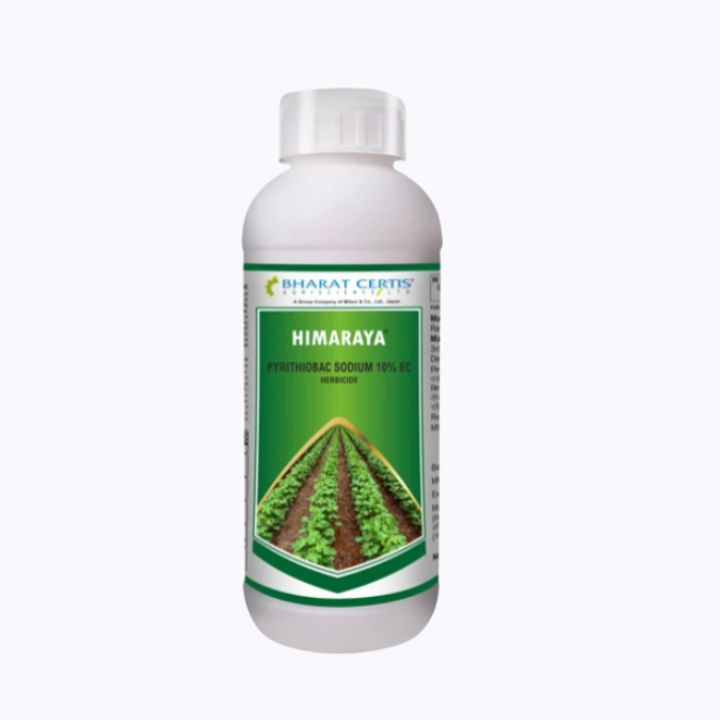
Bharat Certis Himaraya Pyrithiobac Herbicide
Bharat Certis Himaraya Pyrithiobac Sodium 10% EC Herbicide
Bharat Certis Himaraya is an advanced early post-emergence and highly selective herbicide specially designed for Cotton crops. Formulated with Pyrithiobac Sodium 10% EC, it provides effective control of broadleaf weeds that compete with cotton for nutrients, water, and sunlight. Himaraya ensures cleaner fields, stronger crop growth, and higher yields. Belonging to the Acetolactate Synthase (ALS) inhibitor group, it delivers targeted weed suppression while being safe for the crop and soil.Product Specifications
| Technical Name | Pyrithiobac Sodium 10% EC |
|---|---|
| Formulation Type | Emulsifiable Concentrate (EC) |
| Mode of Action | Acts as an Acetolactate Synthase (ALS) inhibitor, disrupting amino acid synthesis in susceptible weeds. It works as an early post-emergence and selective herbicide. |
| Crop | Cotton |
| Target Weeds | Trianthema spp., Amaranthus spp., Chenopodium spp., Digera spp., Celosia argentia, and other major broadleaf weeds. |
| Dosage | 625–750 ml per acre |
Key Features & Benefits
- Highly Selective: Specially formulated for Cotton crops, ensuring no harm to the main crop.
- Broadleaf Weed Control: Effectively manages all major broadleaf weeds found in Cotton fields.
- Crop Safety: Safe for Cotton and succeeding crops after harvest.
- Improved Growth: Provides Cotton plants with more space, light, and air for healthy development.
- Higher Yields: Encourages robust plant growth leading to better productivity and quality.
- Soil Friendly: No adverse effect on soil health; ensures sustainability of subsequent crops.
Application & Dosage
| Crop | Target Weeds | Dosage (per acre) | Stage of Application | Method of Application |
|---|---|---|---|---|
| Cotton | Trianthema spp., Amaranthus spp., Chenopodium spp., Digera spp., Celosia argentia | 625–750 ml | Early Post-Emergence (when weeds are in 2–4 leaf stage) | Apply as a uniform spray using a knapsack sprayer fitted with a flat-fan nozzle. Ensure good soil moisture during application. |
Frequently Asked Questions (FAQs)
Q1: What is Bharat Certis Himaraya used for?
It is used as an early post-emergence herbicide for controlling broadleaf weeds in Cotton fields.
Q2: How does Himaraya work?
It inhibits the Acetolactate Synthase (ALS) enzyme in weeds, blocking amino acid synthesis and leading to their death while remaining safe for Cotton plants.
Q3: What is the dosage for Himaraya herbicide?
The recommended dosage is 625–750 ml per acre applied as a foliar spray during early post-emergence stage.
Q4: Is Himaraya safe for soil and subsequent crops?
Yes, it has no residual toxicity and is completely safe for succeeding crops after Cotton harvest.
Q5: When is the best time to spray Himaraya?
Apply when weeds are in the 2–4 leaf stage and soil moisture is adequate for effective absorption.
Disclaimer: The information above is intended for reference only. Always follow the directions and safety guidelines provided on the product label and leaflet.
Similar Products
Best Selling

Customer Reviews
Recent Reviews
No reviews yet.