

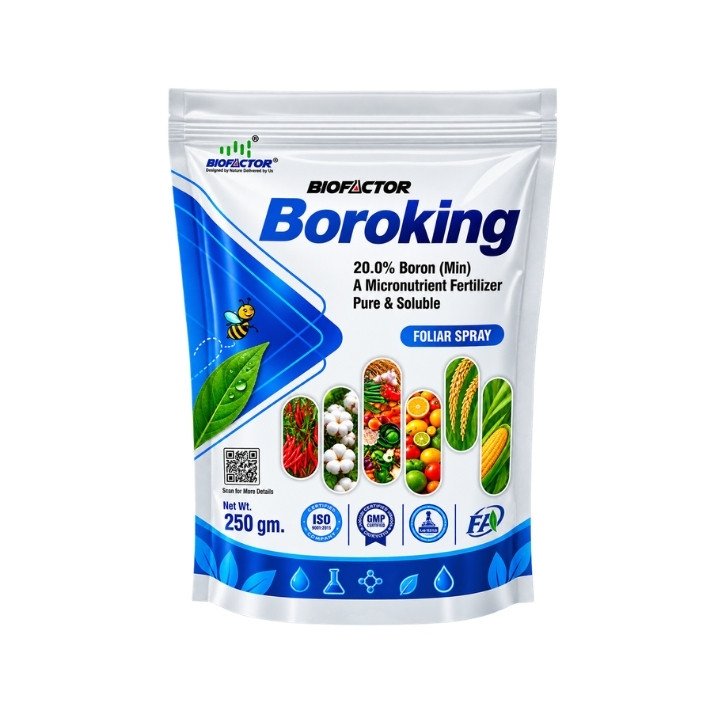
Biofactor Boroking Boron 20% Micronutrient Fertilizer

Biofactor Boroking for Boron Deficiency Management in Crops
Biofactor Boroking is a water-soluble micronutrient fertilizer containing a minimum of 20% Boron, supplied through Disodium Octaborate Tetrahydrate. It is designed to help correct boron deficiency in crops and soil when applied at the recommended dose.
Boron supports cell-wall formation, growing-point development, flowering, pollen activity and fruit setting. Correct application of Boroking may help improve reproductive crop development and produce quality where boron deficiency is confirmed or expected.
Biofactor Boroking Product Specifications
| Specification | Details |
|---|---|
| Product Name | Biofactor Boroking |
| Brand | Biofactor |
| Product Category | Boron-based micronutrient fertilizer |
| Boron Source | Disodium Octaborate Tetrahydrate |
| Boron Content | 20% minimum |
| Physical Form | Water-soluble powder |
| Solubility | Water soluble |
| Primary Purpose | Prevention and correction of boron deficiency |
| Application Methods | Foliar spray and soil application |
| Foliar Dose | 1–1.5 g per litre of water |
| Soil Application Dose | 1–1.5 kg per acre |
| Recommended Stages | Before flowering, during flowering and around fruit setting |
| Pack Size | 500 g |
Technical Composition
| Component | Guaranteed Content |
|---|---|
| Boron (B) | 20% minimum |
| Source Material | Disodium Octaborate Tetrahydrate |
| Formulation | Water-soluble micronutrient powder |
Key Features of Biofactor Boroking
- Concentrated boron source: Contains a minimum of 20% boron for crop micronutrient application.
- Water-soluble formulation: Dissolves in water for foliar spraying and other label-approved applications.
- Supports growing tissues: Boron is involved in new cell development and cell-wall formation.
- Reproductive-stage nutrition: Supports flowering, pollen function, fertilisation and fruit-setting processes.
- Multiple application methods: Can be applied through foliar spray or soil application according to crop requirements.
- Useful during critical stages: Suitable for scheduled application before and around flowering and fruit setting.
Benefits for Farmers
- Helps prevent and correct boron deficiency symptoms.
- Supports normal development of growing points and young tissues.
- Supports root and cell-wall development.
- Contributes to pollen activity, flowering and fruit setting.
- Supports carbohydrate movement and reproductive crop development.
- May help reduce deficiency-related flower or fruit shedding.
- May support fruit shape, size and quality under balanced nutrition.
- May help reduce deficiency-related cracking in susceptible crops when boron shortage is a contributing factor.
Role of Boron in Crops
| Plant Function | How Boron Supports It |
|---|---|
| Cell Development | Supports cell-wall formation and development of young tissues |
| Root Growth | Supports normal root-tip and growing-point development |
| Flowering | Contributes to flower development and pollen activity |
| Fruit Setting | Supports fertilisation and early fruit-development processes |
| Sugar Movement | Contributes to carbohydrate transport within the plant |
| Produce Quality | Supports fruit and seed development where adequate boron is required |
Common Boron Deficiency Symptoms
| Crop Part | Possible Deficiency Symptoms |
|---|---|
| Growing Points | Weak, distorted or dying terminal growth |
| Young Leaves | Thickening, brittleness, curling or abnormal development |
| Roots | Restricted root-tip growth and weak root development |
| Flowers | Poor flowering, reduced pollen viability or flower shedding |
| Fruits | Poor fruit set, misshapen fruits or cracking in some crops |
| Stems and Internal Tissues | Hollow, corky or cracked tissues in susceptible crops |
These symptoms can also result from other nutrient, water, pest or disease problems. Confirm boron deficiency through soil or plant-tissue analysis wherever practical before application.
Suitable Crop Groups
| Crop Group | Examples |
|---|---|
| Vegetable Crops | Chilli, tomato, brinjal, okra, cabbage, cauliflower and other vegetables |
| Fruit Crops | Citrus, mango, grapes, pomegranate and other fruit crops |
| Field Crops | Cotton, paddy, wheat, maize and other field crops |
| Oilseed and Pulse Crops | Groundnut, mustard, sunflower, soybean and pulses |
| Plantation Crops | Coconut, arecanut and other plantation crops |
| Flower Crops | Rose, marigold and other flowering crops |
Boroking Dosage and Application Method
| Application Method | Recommended Dose | Directions |
|---|---|---|
| Foliar Spray | 1–1.5 g per litre of water | Dissolve completely in clean water and spray uniformly on crop foliage without excessive runoff. |
| 15-Litre Spray Pump | 15–22.5 g per pump | This is a mathematical conversion of the supplied per-litre dose. Confirm crop suitability from the product label before spraying. |
| Soil Application | 1–1.5 kg per acre | Mix uniformly with sufficient dry soil, sand or compatible fertilizer and distribute evenly over the recommended area. |
Recommended Application Schedule
| Application Stage | Purpose |
|---|---|
| Before Flowering | Supports reproductive development where boron is required |
| Flowering Stage | Supports pollen activity and fertilisation processes |
| Fruit-Setting Stage | Supports early fruit and seed development |
| Repeat Application | Apply 2–3 times at intervals of approximately 15–20 days only when required and permitted by the label |
How to Apply Biofactor Boroking
- Confirm that the crop requires boron application.
- Measure the required quantity accurately using a suitable weighing scale.
- For foliar use, dissolve the measured powder in a small amount of water.
- Fill the spray tank halfway with clean water.
- Add the prepared boron solution while stirring continuously.
- Add the remaining water and mix thoroughly.
- Spray uniformly during the early morning or evening.
- Avoid spraying during high temperature, strong wind or expected rainfall.
- Do not exceed the recommended concentration or frequency.
- Use the prepared solution on the same day.
Important Dose Precaution
The difference between an adequate and excessive boron dose can be small. Overapplication may cause leaf-edge burning, yellowing, necrosis or other boron-toxicity symptoms. Measure Boroking accurately and do not apply foliar and soil doses together unless specifically recommended.
Crop sensitivity, existing soil boron, irrigation-water quality and soil pH can affect the required dose. Seek professional guidance or conduct soil and tissue analysis when repeated boron application is planned.
Why Farmers Can Choose Biofactor Boroking
- Contains a minimum of 20% boron.
- Uses Disodium Octaborate Tetrahydrate as the boron source.
- Water-soluble powder suitable for foliar application.
- Can also be applied to soil according to crop requirements.
- Supports flowering, fruit setting and growing-point development.
- Available in a convenient 500 g pack.
Frequently Asked Questions
What is Biofactor Boroking?
Biofactor Boroking is a water-soluble micronutrient fertilizer containing a minimum of 20% boron from Disodium Octaborate Tetrahydrate.
What is the foliar dose of Boroking?
The supplied foliar recommendation is 1–1.5 g per litre of water. Confirm the exact crop-specific dose from the current product label.
How much Boroking is required for a 15-litre pump?
At 1–1.5 g per litre, the calculated amount is 15–22.5 g for a 15-litre pump. Measure the product accurately and follow the label.
What is the soil-application dose?
The supplied soil dose is 1–1.5 kg per acre. Apply uniformly and avoid concentrated placement near seeds or roots.
When should Boroking be applied?
It can be applied during critical growth stages, particularly before flowering, during flowering and around fruit setting, when boron is required.
Can Boroking reduce flower and fruit dropping?
It may help reduce shedding when boron deficiency is a contributing cause. Flower or fruit drop caused by heat, moisture stress, pests, diseases or pollination problems requires separate management.
Can Boroking prevent fruit cracking?
Adequate boron supports cell-wall development and may help where cracking is linked to deficiency. Cracking caused by irregular irrigation, climate or varietal sensitivity may continue.
Can excessive boron harm crops?
Yes. Excessive boron can be toxic to plants. Never exceed the recommended dose or application frequency.
Disclaimer: The details provided are for informational guidance only. Always adhere to the recommended dosage and application instructions stated on the product label and in the accompanying leaflet.Similar Products

Best Selling
Customer Reviews
Recent Reviews
No reviews yet.