

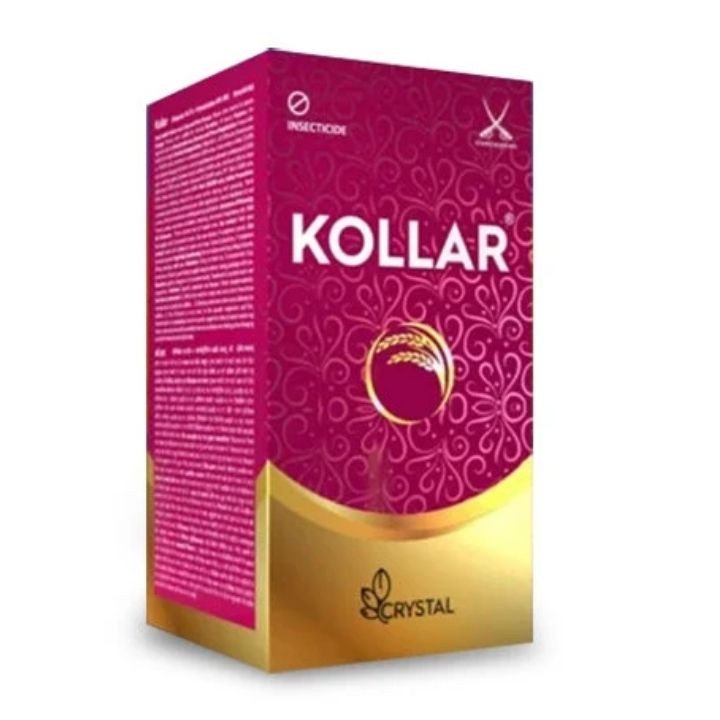
Crystal Kollar Insecticide
Crystal Kollar: A Hopper-Specific Answer for Rice's Most Persistent Pest Problem
Rice is India's largest income-generating field crop, and yet plant hoppers remain one of the most difficult recurring threats growers face season after season — they multiply fast, and populations can build tolerance to repeated chemistry surprisingly quickly. Crystal Kollar was formulated with this specific challenge in mind, combining Ethiprole 10.7% and Pymetrozine 40% in a Water Dispersible Granule (WG), a pairing that brings two distinct modes of action to bear on the same hopper population.
The logic behind combining these two actives comes down to how each interferes with hopper survival differently. Pymetrozine acts as a stylet feeding inhibitor — it doesn't kill on contact so much as it paralyzes the pest's ability to feed, leading to death by starvation while also disrupting egg-laying. Ethiprole complements this with its own distinct mode of action against the insect nervous system, giving the combination broader coverage than either active alone would provide.
Composition Overview
| Detail | Specification |
|---|---|
| Brand | Crystal Crop Protection |
| Product Name | Kollar |
| Active Ingredients | Ethiprole 10.7% + Pymetrozine 40% |
| Formulation | Water Dispersible Granule (WG) |
| Toxicity Classification | Yellow (Slightly Hazardous) |
| Available Pack Size | 170 gm |
Which Hoppers It Targets
This active ingredient combination is specifically associated with control of Brown Plant Hopper and White-Backed Plant Hopper in rice — two of the pests responsible for the most severe hopper-related yield losses in paddy fields across India. Both feed at the base of rice tillers, often going unnoticed until "hopper burn" symptoms — patches of rice turning brown and collapsing — become visible, by which point the population has usually grown substantially.
| Crop | Target Pest |
|---|---|
| Rice (Paddy) | Brown Plant Hopper |
| Rice (Paddy) | White-Backed Plant Hopper |
How It Actually Works Inside the Plant
Kollar is systemic with translaminar movement, meaning it doesn't just sit on the leaf surface where it's sprayed — it moves within plant tissue, offering more complete coverage even where hoppers are hiding low in the canopy near the plant base. The WG formulation is designed for quick dissolution in water, forming a stable, uniform spray solution that spreads and absorbs efficiently into the plant.
Getting the Application Right
Because hopper populations are notorious for building resistance quickly, timing and thoroughness matter more with this pest group than with many others. Spraying should target the base of the plant where hoppers concentrate, rather than just the upper canopy, and treatment is generally most effective when applied as soon as hopper populations are detected rather than after hopper burn symptoms have already appeared. Exact dosage should be confirmed from the current product label, since application rates for this active combination are typically set per hectare or per acre based on local field advisory.
Why This Combination Gets Chosen Over Single-Active Options
- Rice fields with a history of Brown Plant Hopper or White-Backed Plant Hopper outbreaks
- Situations where a single-active hopper product has previously shown reduced field performance
- IPM programs looking to rotate modes of action to slow resistance buildup in hopper populations
- Fields needing spray coverage that reaches hoppers concentrated near the plant base, not just upper foliage
Questions Growers Often Ask
Why combine two actives instead of just using a stronger dose of one?
Each active works through a different mechanism, so combining them broadens pest coverage and helps reduce the risk that resistance to a single mode of action compromises overall hopper control.
Do I need to spray directly at the base of the rice plant, or is general foliar coverage enough?
Since hoppers typically concentrate near the plant base, directing spray coverage toward that zone tends to give better results than treating only the upper canopy.
Is this product only useful once hopper burn symptoms are visible?
It's generally more effective when applied at the first sign of hopper buildup rather than waiting for visible hopper burn, since populations grow quickly once established.
Does Kollar affect beneficial insects in the paddy field?
Pymetrozine-based products are often noted for relative safety toward natural enemies like spiders and predatory bugs when used as per label recommendation, though exact selectivity should be confirmed from current product documentation.
Disclaimer: The details provided are for informational guidance only. Always adhere to the recommended application instructions as stated on the product label and in the accompanying leaflet.
Frequently Asked Questions about Crystal Kollar Insecticide
What is the price of Crystal Kollar Insecticide?
The price of Crystal Kollar Insecticide starts at Rs. 1,056 (170 gm) at KisanShop. Final price depends on the pack size you choose.
Which pack sizes of Crystal Kollar Insecticide are available?
170 gm, 170 gm x 2, 500 gm, 170 gm x 3, 500 gm x 2, 500 gm x 4, 500 gm x 6. Select the size you need on the product page.
Which brand makes Crystal Kollar Insecticide?
Crystal Kollar Insecticide is a product of Crystal Crop, available to buy online at KisanShop.
What payment options are available?
You can pay with UPI, debit or credit cards, or Cash on Delivery (COD, subject to availability for your pincode).
Can I return Crystal Kollar Insecticide?
Yes. KisanShop offers a 48 hours easy return. If you receive a wrong, damaged or defective product, we will replace it.
How long does delivery take?
KisanShop offers fast and reliable delivery. Exact delivery time depends on your pincode.
Similar Products
Best Selling
Customer Reviews
Recent Reviews
No reviews yet.