

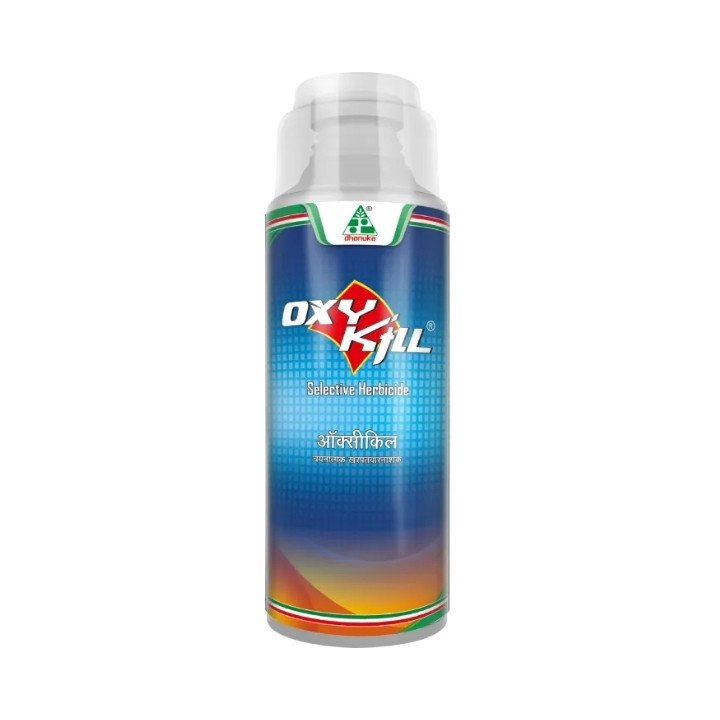
Dhanuka Oxykill Herbicide – Oxyfluorfen 23.5% EC
Dhanuka Oxykill Oxyfluorfen 23.5% EC Selective Herbicide
Dhanuka Oxykill is a selective contact herbicide containing Oxyfluorfen 23.5% EC. It belongs to the diphenyl ether group and provides pre-emergence and targeted post-emergence activity against label-listed broadleaf weeds, grasses and sedges.
When applied as a pre-emergence treatment, Oxykill forms a herbicidal layer on the soil surface and acts on susceptible weeds as they emerge. During targeted post-emergence use, it damages young weed tissue contacted by the spray.
Oxykill is recommended for direct-sown rice, tea, onion and mentha at crop-specific doses. Selectivity depends on using the correct dose, application stage, spray method and water volume; incorrect application can injure the crop.
Dhanuka Oxykill Product Specifications
| Specification | Details |
|---|---|
| Product Name | Dhanuka Oxykill |
| Brand | Dhanuka Agritech Limited |
| Technical Name | Oxyfluorfen 23.5% EC |
| Active Ingredient | Oxyfluorfen 23.5% w/w |
| Formulation | EC – Emulsifiable Concentrate |
| Product Category | Selective herbicide |
| Chemical Group | Diphenyl ether |
| Mode of Action | Contact PPO-inhibiting herbicide |
| Application Type | Pre-emergence and targeted post-emergence, depending on the crop label |
| Recommended Crops | Direct-sown rice, tea, onion and mentha |
| Pack Sizes | 50 ml, 100 ml, 250 ml and 500 ml |
Key Features of Dhanuka Oxykill
- Selective Herbicide: Controls label-listed weeds in recommended crops when used at the correct dose and stage.
- Pre-Emergence Activity: Creates a treated layer on the soil surface that acts on susceptible weeds during emergence.
- Targeted Post-Emergence Activity: Damages young, susceptible weed tissue contacted by the spray where this use is permitted.
- Broad Weed Spectrum: Controls selected annual broadleaf weeds, grasses and sedges.
- Residual Soil-Surface Action: Helps suppress fresh weed emergence when the treated layer remains undisturbed.
- Low Per-Acre Quantity: Crop-wise recommendations range from 170–400 ml per acre.
- Multi-Crop Use: Registered recommendations cover direct-sown rice, tea, onion and mentha.
Mode of Action
Oxyfluorfen inhibits protoporphyrinogen oxidase, commonly referred to as the PPO enzyme. This causes photodynamic compounds to accumulate in susceptible weed tissue.
In the presence of light, these compounds generate reactive oxygen species that damage cell membranes. The affected weed tissue develops rapid injury, desiccation and eventual death.
Sunlight is important for post-emergence activity. Since Oxykill acts mainly through contact, uniform application and correct placement are essential for satisfactory weed control.
Recommended Crops, Weeds and Dosage
| Crop | Target Weeds | Dose per Acre | Water per Acre |
|---|---|---|---|
| Direct-Sown Rice | Echinochloa species, Cyperus iria and Eclipta alba | 260–400 ml | 200 litres |
| Tea | Digitaria, Imperata, Paspalum and Borreria hispida | 260–400 ml | 200–300 litres |
| Onion | Chenopodium album and Amaranthus viridis | 170–340 ml | 200–300 litres |
| Mentha | Echinochloa colona, Cyperus species, Solanum nigrum, Amaranthus viridis, Sphenoclea species, Anagallis arvensis, Chenopodium album, Commelina benghalensis, Digitaria sanguinalis, Eclipta alba, Euphorbia species and Ludwigia parviflora | 362 ml | 200 litres |
Dose caution: Select the dose within the registered range according to the current Oxykill label, weed spectrum, soil condition and locally approved recommendation. Do not estimate the dose solely from pack size.
Crop-Wise Application Guidance
| Crop | Application Guidance |
|---|---|
| Direct-Sown Rice | Apply as a pre-emergence treatment according to the current label |
| Tea | Use only as a carefully directed treatment according to label instructions |
| Onion | Apply at the crop and weed stage specified on the current label |
| Mentha | Apply uniformly at the label-approved stage using 362 ml per acre |
Timing note: Except for direct-sown rice, which Dhanuka specifically identifies as a pre-emergence use, confirm the exact crop stage and application timing for tea, onion and mentha from the current pack leaflet.
Approximate Quantity per Spray Pump
Per-pump quantities depend on the selected crop dose and total water volume. First divide the total dose uniformly across the number of tanks required for one acre.
| Crop Recommendation | Approximate Concentration | Approximate Quantity for 15 L Water |
|---|---|---|
| 260 ml in 200 L | 1.3 ml/L | 19.5 ml |
| 400 ml in 200 L | 2 ml/L | 30 ml |
| 260 ml in 300 L | 0.87 ml/L | 13 ml |
| 400 ml in 300 L | 1.33 ml/L | 20 ml |
| 170 ml in 200 L | 0.85 ml/L | 12.75 ml |
| 340 ml in 200 L | 1.7 ml/L | 25.5 ml |
| 170 ml in 300 L | 0.57 ml/L | 8.5 ml |
| 340 ml in 300 L | 1.13 ml/L | 17 ml |
| 362 ml in 200 L | 1.81 ml/L | 27.15 ml |
Calculation warning: These are mathematical dilution examples, not independent recommendations. The full registered dose must be distributed uniformly over exactly one acre using the complete specified water volume.
How to Apply Dhanuka Oxykill
- Correctly identify the crop and dominant weed species.
- Confirm that the crop and weeds appear on the current Oxykill label.
- Measure the treated field area accurately.
- Select the registered crop-wise dose and water volume.
- Wear the protective equipment stated on the product label.
- Use a clean and properly calibrated sprayer.
- Half-fill the spray tank with clean water.
- Measure the required quantity of Oxykill accurately.
- Add the product slowly while stirring the tank.
- Add the remaining water and mix thoroughly.
- Use a flat-fan or flood-jet nozzle where recommended on the label.
- Spray the field uniformly at a constant walking speed and nozzle height.
- Avoid overlapping spray passes.
- Do not disturb the treated soil surface unnecessarily after pre-emergence application.
Benefits for Farmers
- Controls important label-listed weeds during early crop development.
- Provides pre-emergence activity in direct-sown rice.
- Controls selected broadleaf weeds, grasses and sedges.
- Helps reduce early weed competition for water, nutrients and sunlight.
- Residual surface activity helps restrict new weed emergence.
- Provides crop-specific low-volume formulation recommendations.
- Can support integrated weed-management programmes.
Pre-Emergence Application Requirements
- Prepare a fine, level and properly settled seedbed.
- Break large soil clods before application.
- Maintain suitable soil moisture according to the label.
- Apply uniformly before target weeds emerge.
- Avoid gaps, excessive overlap and spray drift.
- Do not disturb the herbicidal layer through unnecessary cultivation.
- Follow the label regarding irrigation before or after application.
Important Crop-Safety Precautions
- Crop selectivity exists only at the correct dose, timing and application method.
- Excess dose or overlapping spray can cause crop injury.
- Do not allow spray drift onto neighbouring susceptible crops.
- Do not spray a crop under severe drought, flooding, nutrient or temperature stress.
- Do not apply through an uncalibrated or leaking sprayer.
- Use only on direct-sown rice, tea, onion and mentha according to the current label.
- Do not use on potato or groundnut under the current revised recommendation.
Non-Crop and Residential-Area Use
Dhanuka’s website mentions weed control in landscapes, patios, driveways and similar residential areas. However, use in any non-crop area should be undertaken only when it is explicitly permitted by the current pack label and applicable local regulations.
Do not apply near drinking-water sources, edible garden plants, children’s play areas, animal enclosures or surfaces where runoff can enter drains or ponds.
Integrated Weed Management
- Use clean crop seed and prevent weeds from producing seed.
- Prepare the field properly before sowing or planting.
- Use locally recommended crop spacing and plant population.
- Rotate crops and herbicide modes of action where practical.
- Control escaped weeds mechanically before they set seed.
- Avoid repeated exclusive use of Oxyfluorfen in the same field.
- Maintain accurate records of dose, date, crop stage and weed response.
Herbicide-Resistance Management
Repeated use of the same herbicide mode of action can select resistant weed populations. Rotate Oxykill with registered herbicides having a different mode of action and combine chemical treatment with cultural and mechanical weed control.
Do not use a reduced dose on difficult weeds, and investigate patches that survive a correctly applied treatment instead of immediately repeating the same herbicide.
Compatibility
Mix Oxykill with another herbicide, pesticide or fertilizer only when the labels of all products permit the combination. Conduct a jar test before preparing an unfamiliar mixture and obtain crop-specific agricultural advice.
Safety and Storage
- Read the complete label and accompanying leaflet before use.
- Wear label-specified gloves, clothing, footwear and face protection.
- Avoid contact with skin and eyes and avoid inhaling spray mist.
- Do not eat, drink, smoke or chew while mixing and spraying.
- Wash exposed skin, equipment and contaminated clothing after use.
- Keep the product in its original sealed and labelled container.
- Store away from children, food, feed and household articles.
- Do not contaminate wells, canals, ponds or drinking-water sources.
- Never reuse an empty herbicide container.
Why Farmers Can Choose Dhanuka Oxykill
- Contains Oxyfluorfen 23.5% EC.
- Selective contact herbicide with residual activity.
- Provides pre- and targeted post-emergence weed control.
- Controls selected broadleaf weeds, grasses and sedges.
- Registered for direct-sown rice, tea, onion and mentha.
- Clear crop-wise dose and water-volume recommendations.
- Available in 50 ml, 100 ml, 250 ml and 500 ml packs.
Frequently Asked Questions
What is the technical name of Dhanuka Oxykill?
Oxykill contains Oxyfluorfen 23.5% EC.
Is Oxykill a selective or non-selective herbicide?
It is a selective contact herbicide when used on registered crops at the correct dose, stage and application method.
Is Oxykill a pre-emergence herbicide?
It provides pre-emergence activity and also has targeted post-emergence activity where permitted by the crop label. Direct-sown rice is specifically listed for pre-emergence use.
What is the dose for direct-sown rice?
Apply 260–400 ml per acre in 200 litres of water according to the current label.
What is the dose for onion?
The listed dose is 170–340 ml per acre in 200–300 litres of water.
What is the dose for tea?
Apply 260–400 ml per acre in 200–300 litres of water according to label guidance.
What is the dose for mentha?
The listed recommendation is 362 ml per acre in 200 litres of water.
Can Oxykill completely kill motha or Cyperus?
Oxykill is labelled against Cyperus iria in direct-sown rice and Cyperus species in mentha. Control of established perennial Cyperus rotundus may be incomplete because underground tubers can produce new shoots.
Can Oxykill be used in potato and groundnut?
No. Potato and groundnut were removed from Dhanuka’s current Oxyfluorfen 23.5% EC label claim and should not be recommended.
Does Oxykill guarantee zero crop damage?
No herbicide can guarantee zero injury under every condition. Crop safety depends on correct dose, crop stage, soil condition, spray calibration and avoidance of overlapping application.
Can Oxykill be mixed with another herbicide?
Prepare a tank mixture only when both product labels permit it. Conduct a jar test and obtain crop-specific expert advice before mixing.
Disclaimer: The information provided is for general guidance only. Always adhere to the registered crops, weeds, dose, water volume, application timing, protective equipment and safety instructions stated on the current product label and accompanying leaflet.Similar Products

Best Selling
Customer Reviews
Recent Reviews
No reviews yet.