

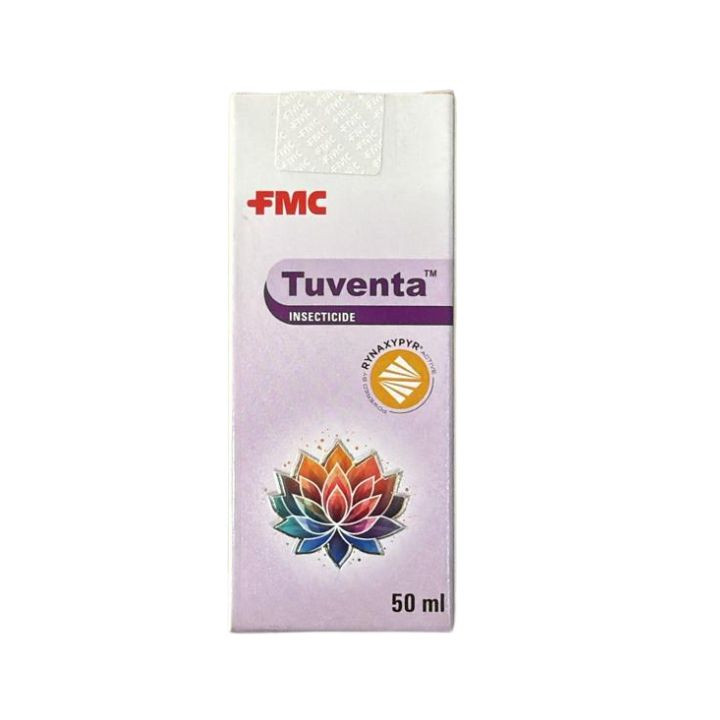
FMC Tuventa: A Concentrated Take on a Technology Millions of Farmers Already Trust
Rynaxypyr, the technology behind Chlorantraniliprole, isn't new to Indian fields — it's already familiar to growers through several existing FMC products. What sets Tuventa apart isn't the chemistry itself but the concentration: at 47.85% w/w in a suspension concentrate, it delivers meaningfully more active ingredient per unit volume than earlier formulations built on the same molecule, which changes how little product is actually needed per application.
Tuventa is classified under IRAC Group 28, and its mode of action centers specifically on egg and larval stages of Lepidopteran pests — technically described as ovi-larvicidal activity. Rather than waiting for a caterpillar to reach a damaging feeding stage, the product interferes earlier in the life cycle, which is part of why it's often positioned as a proactive rather than purely reactive spray.
Core Details
| Detail | Specification |
|---|---|
| Brand | FMC |
| Product Name | Tuventa |
| Active Ingredient | Chlorantraniliprole 47.85% w/w |
| Formulation | Suspension Concentrate (SC) |
| IRAC Classification | Group 28 (Anthranilic Diamide) |
| Technology Platform | Rynaxypyr® |
Why the High Concentration Actually Matters
A more concentrated formulation isn't just a marketing point — it typically translates into lower per-acre product volume for the same level of pest control, which can mean less packaging, easier transport, and simpler tank-mixing math for the person doing the spraying. It also means the margin for dosing error narrows slightly, so following the exact label rate matters more with a high-concentration product than with a diluted one.
What Makes This Chemistry Different From Older Insecticide Classes
Chlorantraniliprole acts on ryanodine receptors inside insect muscle cells, a mechanism unrelated to how pyrethroids, organophosphates, or carbamates work. This is significant for two reasons: first, it remains effective on Lepidopteran populations that have developed resistance to older chemistry groups; second, this particular biological pathway is largely absent or very different in beneficial insects like predatory bugs, parasitoid wasps, and pollinators — which is why Tuventa is generally considered compatible with IPM programs that rely on natural enemy populations.
Where This Fits in a Spray Program
- Crops with recurring Lepidopteran pest pressure across the season, where early intervention limits population buildup
- Farms running IPM programs that depend on preserving beneficial insect populations alongside chemical control
- Situations where growers are managing resistance concerns tied to repeated use of pyrethroid or older insecticide classes
- Crops where pollinator activity during flowering makes insect-selectivity an important consideration
Getting the Timing Right
Because Tuventa's strength lies in disrupting eggs and early larval stages, spraying after pest populations have already reached later larval instars reduces its effectiveness — the product performs best when applied at the first signs of pest activity rather than once visible crop damage has set in. Exact dosage varies by the specific crop and pest being targeted, and since FMC's registration details can be crop-specific, it's worth confirming the current label rate for the exact crop being treated rather than assuming a single blanket dose applies everywhere.
Questions Growers Commonly Ask
Is Tuventa the same as older Rynaxypyr-based products, just repackaged?
No — while it shares the same active ingredient family, Tuventa's significantly higher concentration (47.85% w/w) distinguishes it from earlier, more dilute formulations built on the same technology.
Will spraying Tuventa harm bees or beneficial predator insects in the field?
Chlorantraniliprole's mode of action is selective toward Lepidopteran pests and is generally considered low-risk to pollinators and beneficial arthropods when applied as per label recommendation.
Does Tuventa work on caterpillars that are already large and actively feeding?
It's most effective against eggs and early larval stages; applying at the first sign of pest activity gives noticeably better results than waiting until larvae are well developed.
Since the concentration is so high, does that mean less product is needed per spray?
Yes, the enhanced concentration generally allows for lower application volumes compared to older, more dilute formulations of the same active ingredient — though the exact rate should always be confirmed from the current product label for the specific crop.
Disclaimer: The details provided are for informational guidance only. Always adhere to the recommended application instructions as stated on the product label and in the accompanying leaflet.
Frequently Asked Questions about FMC Tuventa Insecticide
What is the price of FMC Tuventa Insecticide?
The price of FMC Tuventa Insecticide starts at Rs. 1,015 (50 ml) at KisanShop. Final price depends on the pack size you choose.
Which pack sizes of FMC Tuventa Insecticide are available?
50 ml, 100 ml, 100 ml x 2, 100 ml x 5. Select the size you need on the product page.
Which brand makes FMC Tuventa Insecticide?
FMC Tuventa Insecticide is a product of Chambal Fertilizers, available to buy online at KisanShop.
What payment options are available?
You can pay with UPI, debit or credit cards, or Cash on Delivery (COD, subject to availability for your pincode).
Can I return FMC Tuventa Insecticide?
Yes. KisanShop offers a 48 hours easy return. If you receive a wrong, damaged or defective product, we will replace it.
How long does delivery take?
KisanShop offers fast and reliable delivery. Exact delivery time depends on your pincode.
Similar Products




Best Selling



Customer Reviews
Recent Reviews
Bahut zyada satisfied hoon.
Support ka response quick tha.
Product reached on time without any trouble.
Product fits well with my current needs.
Delivery time par ho gayi.
Product sahi condition me deliver hua.
Delivery time par ho gayi.
Product fits well with my current needs.
Genuine product, happy with this order.
Good customer service.