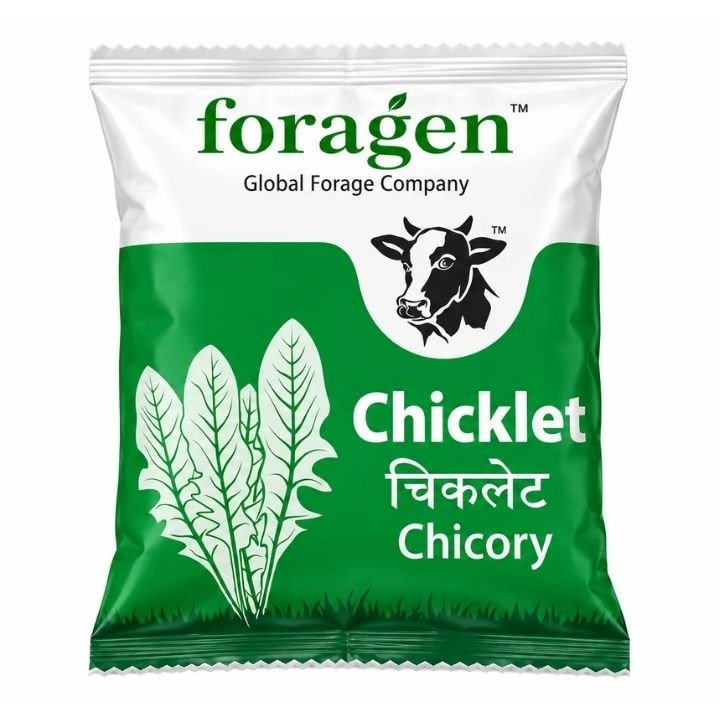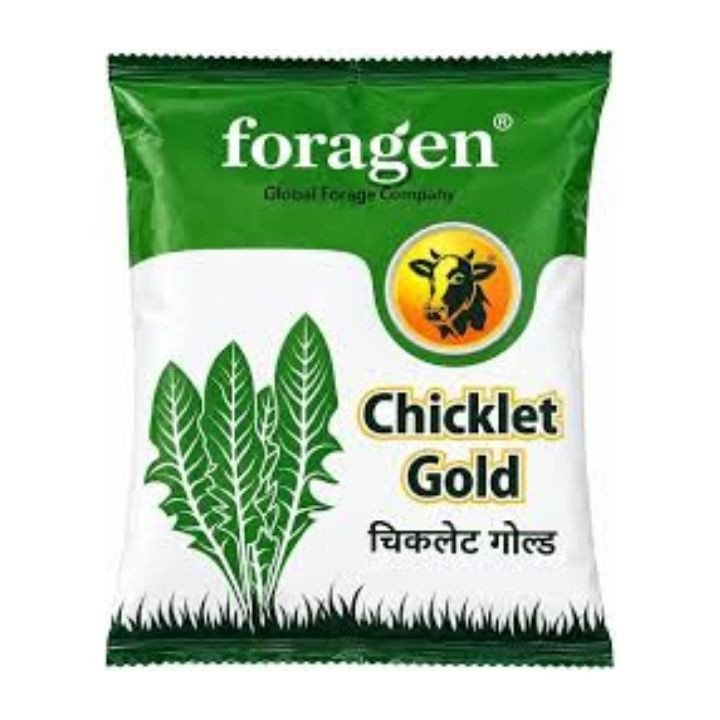

Foragen Chicklet Gold Chicory Forage Seeds are developed for farmers looking to produce nutritious, highly palatable green fodder for dairy and livestock animals. Chicklet is a perennial fodder chicory crop known for its good nutritional value, digestibility and ability to regrow after cutting under suitable crop-management conditions.
It can be cultivated as a standalone forage crop or incorporated with suitable cereal fodder crops. Its multiple-cut nature can help farmers maintain a regular supply of fresh green fodder when irrigation, fertility and harvesting practices are properly managed.
| Product Name | Chicklet Gold |
|---|---|
| Brand | Foragen |
| Company | Foragen Seeds Private Limited |
| Crop Type | Forage / Fodder Crop |
| Crop | Chicory |
| Crop Nature | Perennial Fodder Crop |
| Primary Use | Fresh Green Fodder for Dairy and Livestock Animals |
| Sowing Season | Winter / Rabi |
| Suggested Spacing | 30 × 15 cm |
| Cultivation Type | Solo Crop or Mixed with Suitable Cereal Fodder Crops |
| Characteristic | Product Reference |
|---|---|
| Protein Content | Approximately 25%–35% under suitable conditions |
| Fibre Profile | Good NDF with comparatively low ADF |
| Forage Type | Leafy, Perennial Green Fodder |
| Livestock Use | Dairy Cattle and Other Suitable Livestock |
Actual nutritional values can vary according to soil fertility, crop age, irrigation, cutting stage, climate and laboratory testing method.
| Parameter | Recommended Guidance |
|---|---|
| Seed Rate for Solo Crop | Approximately 1 kg per acre |
| Sowing Season | Winter / Rabi |
| Suggested Spacing | 30 × 15 cm |
| Mixed Cropping | Can be grown with compatible shorter cereal fodder crops |
Seed rate may need adjustment according to germination percentage, sowing method, soil condition and whether Chicklet Gold is being grown alone or as part of a mixed forage system.
Foragen Chicklet Gold is a perennial forage crop capable of regrowth after cutting. Product references indicate multiple harvest potential, with the exact number of successful cuts depending strongly on crop establishment, irrigation, soil fertility, weather and cutting management.
Under good management, commercial references indicate the crop may provide numerous harvests over its production cycle. Farmers should avoid excessively low cutting because sufficient plant growth should remain to support healthy regrowth.
Commercial cultivation references commonly suggest a cutting interval of approximately 20–25 days after an established crop begins regrowing. Actual harvesting should be based on plant growth and forage quality rather than calendar days alone.
Allow adequate regrowth between cuts so that the plant can rebuild leaf area and maintain long-term productivity.
Product references report approximately 3–4 metric tonnes of green fodder per acre per cutting/production reference under suitable management. Actual yield can vary substantially depending on climate, soil, irrigation, fertilizer management, plant population and stage of harvesting.
Yield figures should therefore be treated as agronomic guidance rather than a guaranteed output.
| Nutrient / Input | Reference per Acre |
|---|---|
| Farmyard Manure (FYM) | Approximately 5,000 kg |
| Nitrogen | Approximately 25 kg initially |
| Phosphorus | Approximately 30 kg |
| Potassium | Approximately 20 kg |
| Nitrogen after Cutting | Approximately 15 kg after each cut where agronomically appropriate |
Fertilizer requirements should ideally be adjusted according to soil-test results, local agricultural recommendations, expected yield and manure application.
Chicory performs best in well-prepared, fertile soil with adequate drainage. Avoid prolonged waterlogging because poor aeration around the root zone can negatively affect establishment and plant health.
Good soil fertility and regular irrigation are particularly important where the crop is being maintained for repeated fodder harvests.
Maintain adequate soil moisture during germination and early establishment. Once established, irrigate according to soil type, weather, crop growth and local water availability.
After each cutting, timely irrigation can support rapid regrowth. Avoid both severe moisture stress and prolonged waterlogging.
Harvest when the crop has developed sufficient leafy biomass and has reached the appropriate forage stage. Avoid allowing the crop to become excessively mature because forage quality and palatability can decline as plant tissues become older.
Leave adequate plant material above ground after cutting to support rapid recovery and continued production from subsequent harvests.
Chicklet Gold can be cultivated as a standalone forage crop where farmers want concentrated chicory production. It can also be mixed with suitable cereal fodder crops to create a more diverse forage stand.
When mixed cropping, adjust seed rate, spacing, fertilizer and cutting schedule according to the companion crop and local agronomic recommendations.
Commercial product references particularly mention successful cultivation in Rajasthan, Haryana and parts of Madhya Pradesh. However, chicory may be cultivated in other suitable areas where winter temperatures, soil conditions and irrigation support healthy growth.
Farmers outside these regions should confirm local suitability before large-scale sowing.
Chicklet Gold provides leafy green forage that can form part of a balanced livestock-feeding program. Its nutritional profile can complement other fodder sources such as sorghum, maize, millet, berseem and other suitable crops.
Livestock rations should remain nutritionally balanced. Introduce unfamiliar green fodders gradually, and consult a qualified livestock nutritionist or veterinarian when planning diets for high-producing dairy animals.
Foragen Chicklet Gold is a perennial chicory forage seed intended for producing nutritious green fodder for dairy and livestock animals.
Yes. Chicklet is described as a perennial fodder chicory crop with repeated-cutting potential.
Commercial cultivation references recommend approximately 1 kg of seed per acre when grown as a solo crop. Follow the current seed label and local agronomic guidance for final sowing rate.
Winter or Rabi season is the commonly recommended sowing period.
A spacing of approximately 30 × 15 cm is commonly recommended for Chicklet cultivation.
Commercial product information reports approximately 25%–35% protein under suitable conditions. Actual nutritional content varies with crop stage, environment and management.
Yes. It is a perennial forage crop with good regrowth and multiple-cut potential when properly maintained.
Commercial references indicate approximately 20–25 days between cuts after establishment, although actual harvesting should depend on regrowth and field conditions.
Yes. Chicklet can be grown alone or mixed with suitable shorter cereal fodder crops.
Yes. It is primarily marketed as nutritious green fodder for dairy and livestock farming.
Timely irrigation after cutting can help support healthy and rapid regrowth, depending on soil moisture and weather conditions.
Commercial references specifically mention Rajasthan, Haryana and parts of Madhya Pradesh. Suitability in other areas depends on local climate, soil and irrigation availability.
No. Fodder yield varies according to soil fertility, weather, irrigation, plant population, nutrient management and harvesting stage.
It should generally be used as part of a balanced livestock ration rather than as the sole source of nutrition. Feeding requirements vary by animal type and production level.
Foragen Chicklet Gold Chicory Forage Seeds offer farmers a perennial forage option with good nutritional value, digestibility and repeated-cutting potential. With proper establishment, irrigation, nutrient management and harvesting, Chicklet Gold can support regular production of fresh green fodder for dairy and livestock farming.
Disclaimer: The details provided are for informational guidance only. Always adhere to the recommended sowing and cultivation instructions as stated on the product label and in the accompanying leaflet.
No reviews yet.