

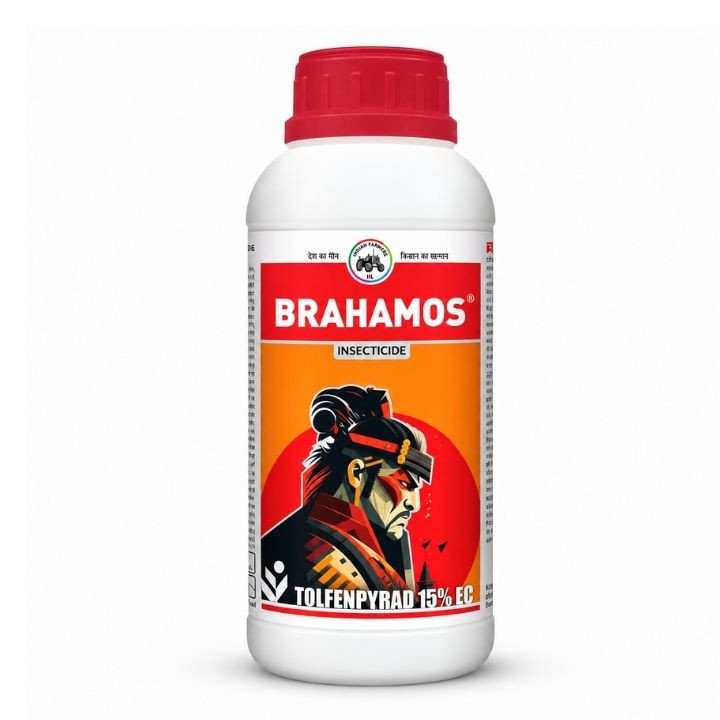


IIL Brahamos Insecticide
IIL Brahamos: A Different Mode of Action for Pests That Have Stopped Responding
Every farmer who has sprayed a field twice in one week and still seen pest damage climbing knows the frustration of resistance building up in a local pest population. It's usually the same handful of insecticide groups that have been rotated for years, and eventually the insects adapt. IIL Brahamos takes a different route entirely — its active ingredient, Tolfenpyrad, works by disrupting mitochondrial electron transport inside the insect's own cells, a mechanism unrelated to how most conventional insecticides act.
What this means practically is that Brahamos can still perform where other chemistries have started losing effectiveness. Since it interferes with the pest's basic energy production rather than nerve signaling (the target of many older insecticide classes), cross-resistance is far less likely, which is part of why it's positioned as a rotation partner in integrated pest management programs rather than a one-off spray.
Product Snapshot
| Detail | Specification |
|---|---|
| Manufacturer | Insecticides (India) Limited |
| Product Name | Brahamos |
| Active Ingredient | Tolfenpyrad 15% |
| Formulation | Emulsifiable Concentrate (EC) |
| Chemical Class | METI (Mitochondrial Electron Transport Inhibitor) |
How Tolfenpyrad Actually Works
Inside an insect's cells, mitochondria produce the energy needed for every basic function — movement, feeding, reproduction. Tolfenpyrad blocks a specific step in that energy production chain, essentially cutting off the pest's power supply at the cellular level. The result is progressive paralysis followed by death, but the pathway getting there is distinct from the nerve-signal disruption used by pyrethroids, organophosphates, or neonicotinoids — which is exactly why it remains effective against populations that have built tolerance to those older groups.
Where It's Been Registered
| Crop | Pest Pressure Addressed |
|---|---|
| Cotton | Sucking and chewing pest complex |
| Chilli | Sucking and chewing pest complex |
| Cabbage | Caterpillar and sucking pest pressure |
| Cumin | Sucking pest pressure |
| Mango | Sucking and chewing pest complex |
| Okra | Sucking and chewing pest complex |
| Onion | Sucking pest pressure |
Across every listed crop, the recommended field rate stays consistent at 400 ml per acre — one of the simpler dosage profiles in the market, since the farmer doesn't need to recalculate per crop the way many multi-crop products require.
Mixing and Spraying Notes
Brahamos is diluted in water and applied as a foliar spray, with the EC formulation making it straightforward to mix into a uniform solution. Coverage matters more than usual here — because the insecticide works through ingestion and contact rather than pure translaminar movement, thorough leaf and stem coverage during spraying directly affects how well it performs. Timing the application to early pest incidence, rather than waiting for visible crop damage, tends to give the best results.
Why It Gets Chosen Over More Familiar Options
- Farms where pyrethroids or neonicotinoids have visibly stopped working as well as they used to
- Mixed cropping situations needing one insecticide that covers both sucking and chewing pest types
- IPM programs specifically built around rotating chemistries to slow resistance development
- Crops like mango and cotton where pest pressure can span multiple insect groups in a single season
Questions Farmers Often Ask
Is Brahamos meant to replace my usual insecticide entirely, or work alongside it?
It's most useful as a rotation partner — introducing a different mode of action periodically helps slow resistance buildup rather than relying on the same chemistry season after season.
Does the dose change based on pest severity?
The recommended rate is 400 ml per acre across all listed crops; adjustments beyond this should follow current label guidance rather than field estimation.
Will it work on pests that have already stopped responding to pyrethroids?
Because Tolfenpyrad acts through a different biological pathway, it's generally still effective on pest populations resistant to pyrethroid or organophosphate chemistries.
What's the best time to spray for maximum effect?
Early pest incidence — spraying before populations build up gives noticeably better results than treating an already advanced infestation.
Disclaimer: The details provided are for informational guidance only. Always adhere to the recommended application instructions as stated on the product label and in the accompanying leaflet.
Frequently Asked Questions about IIL Brahamos Insecticide
What is the price of IIL Brahamos Insecticide?
The price of IIL Brahamos Insecticide starts at Rs. 1,050 (400 ml) at KisanShop. Final price depends on the pack size you choose.
Which pack sizes of IIL Brahamos Insecticide are available?
400 ml, 1 ltr, 400 ml x 2, 1 ltr x 2, 1 ltr x 5, 1 ltr x 10. Select the size you need on the product page.
Which brand makes IIL Brahamos Insecticide?
IIL Brahamos Insecticide is a product of IIL, available to buy online at KisanShop.
What payment options are available?
You can pay with UPI, debit or credit cards, or Cash on Delivery (COD, subject to availability for your pincode).
Can I return IIL Brahamos Insecticide?
Yes. KisanShop offers a 48 hours easy return. If you receive a wrong, damaged or defective product, we will replace it.
How long does delivery take?
KisanShop offers fast and reliable delivery. Exact delivery time depends on your pincode.
Similar Products
Best Selling
Customer Reviews
Recent Reviews
No reviews yet.