

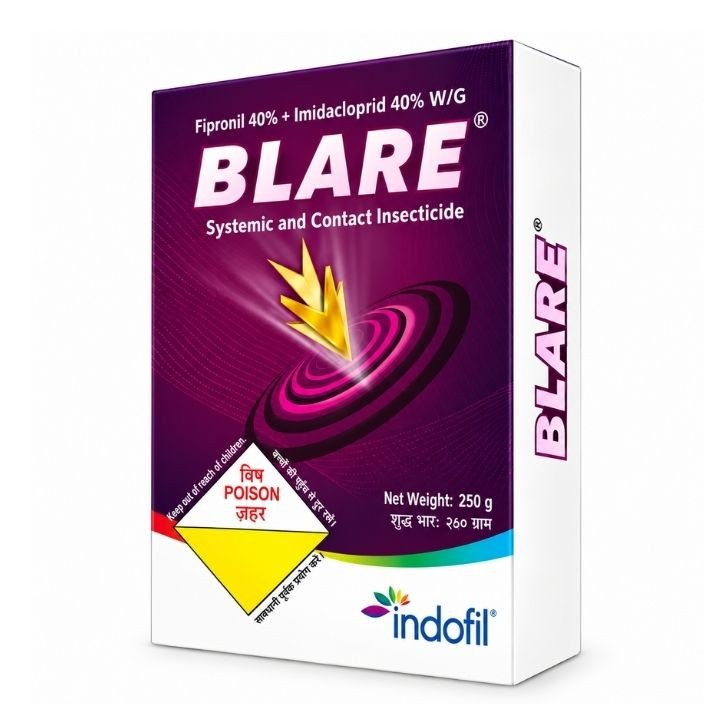
Indofil Blare Insecticide
Indofil Blare: Two Modes of Action Working the Same Pest From Different Angles
Some pests are stubborn enough that a single insecticide, no matter how well it's applied, simply doesn't cover every stage of the problem. White grub is a good example — it's a soil pest with a long larval period, and different life stages respond differently to chemical exposure. Indofil Blare approaches this by combining Imidacloprid 40% and Fipronil 40% in one WG formulation, so the crop gets two distinct attack routes instead of one.
The two actives don't overlap in how they work. Imidacloprid disrupts the insect's nicotinic acetylcholine receptor, essentially jamming a key communication pathway in the nervous system until the insect loses coordination and dies. Fipronil takes a different route — it's absorbed mainly through ingestion, interfering with nerve impulse transmission through a separate mechanism. Because the two don't rely on the same biological target, resistance to one doesn't automatically carry over to the other, which is part of why this pairing has become a common choice for hard-to-manage soil pests.
Quick Reference
| Detail | Specification |
|---|---|
| Brand | Indofil |
| Product Name | Blare |
| Technical Composition | Imidacloprid 40% + Fipronil 40% |
| Formulation | Water Dispersible Granule (WG) |
| Mode of Entry | Systemic (Imidacloprid) + Contact/Ingestion (Fipronil) |
Not a One-Pest Product
While white grub gets most of the attention with this kind of formulation, Blare's label covers a somewhat broader pest range depending on the crop. Sugarcane and groundnut both lean on it for white grub management, chilli sees dual coverage against both white grubs and termites, and cotton uses it entirely differently — against jassids and thrips, which are foliar sucking pests rather than soil dwellers.
| Crop | Target Pest |
|---|---|
| Sugarcane | White Grubs (Holotrichia consanguinea) |
| Groundnut | White Grubs (Holotrichia serrata) |
| Cotton | Jassids, Thrips |
| Chilli | White Grubs, Termites |
Application Rates Differ Sharply by Crop
What stands out looking at the label recommendation is just how much the formulation quantity swings between crops — sugarcane needs well over 400 gm per hectare, while cotton needs only 125 gm. This isn't a rounding difference; it reflects the underlying pest biology. Sugarcane's white grub pressure typically calls for a heavier soil-directed dose across a large water volume, whereas cotton's jassid and thrips control is a lighter, more targeted foliar rate.
| Crop | Formulation Quantity (per Hectare) | Water Dilution |
|---|---|---|
| Sugarcane | 437.5–500 gm | 1000–1250 litres |
| Groundnut | 250–300 gm | 1000 litres |
| Cotton | 125 gm | 500 litres |
| Chilli | 500 gm | 1000 litres |
Since the gap between the lowest and highest recommended quantity is roughly fourfold across this product's crop list, it's genuinely important to confirm the correct row before preparing a spray tank — a rate meant for sugarcane applied on cotton would be a substantial overdose, and the reverse would leave sugarcane grubs largely untreated.
Where This Combination Tends to Get Used
- Sugarcane fields with a known history of white grub infestation from previous seasons
- Groundnut crops in regions where Holotrichia species are an established soil pest
- Chilli fields facing the less common combination of both grub and termite pressure together
- Cotton crops needing jassid and thrips control where a dual-action product is preferred over a single active
Questions That Come Up Often
Since both Imidacloprid and Fipronil are already common individually, what's the actual benefit of combining them in Blare?
The two work through different mechanisms, so combining them provides broader pest coverage and reduces the chance that resistance to one active alone compromises overall control.
Why does chilli need such a high formulation rate compared to cotton?
Chilli's target includes both white grubs and termites — soil pests requiring heavier, more thorough soil-directed treatment — while cotton's target (jassids and thrips) is a lighter foliar application.
Is this product meant for soil application, foliar spray, or both?
Usage depends on the target pest — white grub and termite control generally involves soil-directed application, while jassid and thrips control in cotton is applied as a foliar spray.
Can the same water dilution rate be used across all crops?
No — water dilution volumes range from 500 to 1250 litres per hectare depending on the crop and pest, so the specific crop's recommendation should be followed rather than a general assumption.
Disclaimer: The details provided are for informational guidance only. Always adhere to the recommended application instructions as stated on the product label and in the accompanying leaflet.
Frequently Asked Questions about Indofil Blare Insecticide
What is the price of Indofil Blare Insecticide?
The price of Indofil Blare Insecticide starts at Rs. 887 (100 gm) at KisanShop. Final price depends on the pack size you choose.
Which pack sizes of Indofil Blare Insecticide are available?
100 gm, 100 gm x 2, 100 gm x 5, 100 gm x 10. Select the size you need on the product page.
Which brand makes Indofil Blare Insecticide?
Indofil Blare Insecticide is a product of Indofil Industries Limited, available to buy online at KisanShop.
What payment options are available?
You can pay with UPI, debit or credit cards, or Cash on Delivery (COD, subject to availability for your pincode).
Can I return Indofil Blare Insecticide?
Yes. KisanShop offers a 48 hours easy return. If you receive a wrong, damaged or defective product, we will replace it.
How long does delivery take?
KisanShop offers fast and reliable delivery. Exact delivery time depends on your pincode.
Similar Products
Best Selling
Customer Reviews
Recent Reviews
No reviews yet.