

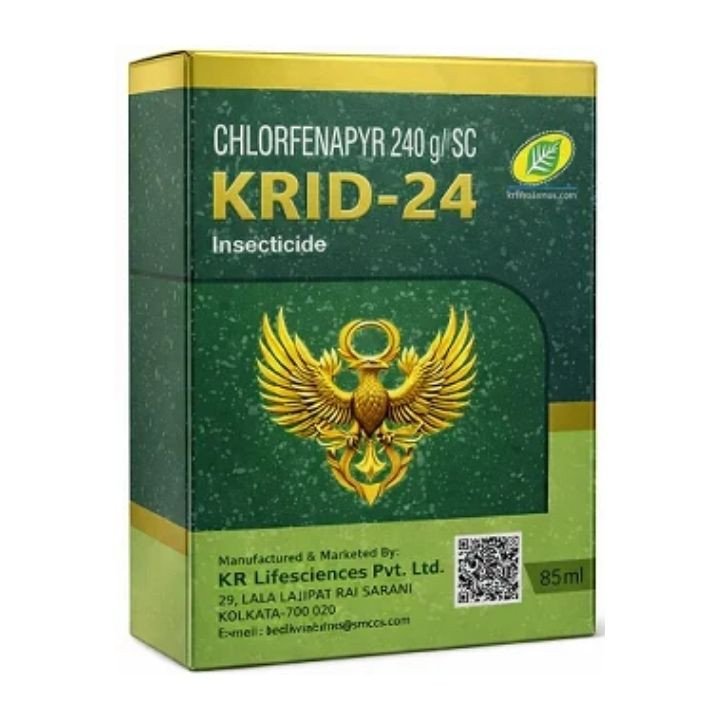
Krishi Rasayan Krid 24 Insecticide (Chlorfenapyr 240 g/L SC)
Krishi Rasayan Krid 24 Insecticide (Chlorfenapyr 240 g/L SC)
Krishi Rasayan Krid 24 Insecticide is a broad-spectrum insecticide and miticide containing Chlorfenapyr 240 g/L SC. It is useful against important sucking pests, mites and caterpillar pests in registered crops including cotton, soybean, chilli, red gram, chickpea and brinjal.
Chlorfenapyr has a distinct mode of action that disrupts cellular energy production in susceptible pests. It also provides translaminar activity, helping reach pests such as thrips and mites that often remain on the underside of leaves.
Product Specifications
| Product Name | Krid 24 |
| Brand | Krishi Rasayan |
| Company | KR Lifesciences Pvt. Ltd. |
| KisanShop Category | Insecticide |
| Product Type | Insecticide & Miticide |
| Technical Composition | Chlorfenapyr 240 g/L SC |
| Formulation | Suspension Concentrate (SC) |
| IRAC Group | Group 13 |
| Mode of Action | Uncoupler of Oxidative Phosphorylation |
| Activity | Contact, Ingestion and Translaminar Activity |
Technical Composition
Chlorfenapyr 240 g/L SC
Chlorfenapyr belongs to IRAC Group 13. It acts by disrupting oxidative phosphorylation and ATP production inside pest cells. As cellular energy production is interrupted, susceptible insects and mites stop functioning normally and are ultimately controlled.
Key Features
- Broad-spectrum insecticide and miticide.
- Contains Chlorfenapyr 240 g/L SC.
- Effective against selected thrips, mites and caterpillar pests.
- Useful against Spodoptera and Helicoverpa species.
- Provides translaminar activity within treated foliage.
- Helps reach pests feeding on the underside of leaves.
- Distinct IRAC Group 13 mode of action.
- Useful as part of a resistance-management programme when rotated appropriately.
Benefits of Krishi Rasayan Krid 24
- Broad Pest Management: Helps manage important sucking pests, mites and lepidopteran caterpillars.
- Translaminar Activity: Helps provide activity against pests hiding or feeding on the lower leaf surface.
- Unique Mode of Action: Disrupts pest cellular energy production rather than acting through conventional nerve-target pathways.
- Resistance Management: Group 13 chemistry provides another mode-of-action option for rotation programmes.
- Multiple Crop Uses: Registered same-technical uses cover important field, pulse and vegetable crops.
Recommended Crops, Target Pests & Dosage
| Crop | Target Pests | Formulation Dose | Water Volume | Waiting Period |
|---|---|---|---|---|
| Cotton | Spodoptera litura and Thrips | 312.5–425 ml/ha | 500 L/ha | 48 Days |
| Soybean | Spodoptera litura and Green Semilooper | 312.5–425 ml/ha | 500 L/ha | 21 Days |
| Chilli | Mites, Thrips and Spodoptera litura | 312.5–425 ml/ha | 500 L/ha | 7 Days |
| Chilli | Helicoverpa armigera | 800–1000 ml/ha | 500 L/ha | 7 Days |
| Red Gram | Helicoverpa armigera and Maruca vitrata | 800–1000 ml/ha | 500 L/ha | 41 Days |
| Chickpea | Pod Borer (Helicoverpa armigera) | 800–1000 ml/ha | 500 L/ha | 49 Days |
| Brinjal | Fruit & Shoot Borer and Mites | 800–1000 ml/ha | 500 L/ha | 10 Days |
The above crop, pest, dose and waiting-period information is based on registered Chlorfenapyr 240 g/L SC recommendations. Always follow the current Krid 24 physical label as the final authority.
Crop-Wise Uses
Cotton
Chlorfenapyr 240 g/L SC is registered in cotton for management of Spodoptera litura and thrips. Good foliar coverage is important, especially where thrips are feeding on protected leaf surfaces.
Soybean
In soybean, registered targets include Spodoptera litura and green semilooper. Timely application during the early stages of larval infestation can help reduce foliage damage.
Chilli
In chilli, Chlorfenapyr 240 g/L SC is registered against mites, thrips, Spodoptera litura and Helicoverpa armigera. Use the correct pest-specific dose because the registered formulation rate differs between pest groups.
Red Gram
Registered use in red gram includes Helicoverpa armigera and Maruca vitrata, important pod-feeding pests capable of causing significant reproductive damage.
Chickpea
In chickpea, Chlorfenapyr 240 g/L SC is registered against pod borer, Helicoverpa armigera.
Brinjal
In brinjal, registered targets include fruit and shoot borer and mites. Thorough coverage of actively growing plant parts is important for effective pest management.
Mode of Action
Chlorfenapyr belongs to IRAC Group 13 and acts as an uncoupler of oxidative phosphorylation. It interferes with the process by which pest cells generate adenosine triphosphate (ATP), the energy needed for normal cellular activity.
When energy production is disrupted, susceptible insects and mites lose normal physiological function and are ultimately controlled.
Translaminar Activity
Chlorfenapyr provides translaminar activity after application to foliage. This means the active ingredient can move into treated leaf tissue and help control susceptible pests feeding on the opposite side of the leaf.
This property is particularly useful against mites and thrips that commonly remain in protected locations on the plant.
How to Use Krishi Rasayan Krid 24
- Identify the crop and target pest correctly.
- Select the correct pest-specific dose from the current product label.
- Shake the product container before measuring.
- Partially fill the spray tank with clean water.
- Add the measured quantity of Krid 24 while maintaining agitation.
- Add the remaining required water and mix thoroughly.
- Spray uniformly over the crop canopy using properly calibrated equipment.
- Ensure good coverage of upper and lower leaf surfaces.
- Observe the crop-specific waiting period before harvesting.
Best Time to Apply
Apply when the registered pest is present and treatment is justified based on field scouting. Early treatment during developing infestations generally provides better protection than waiting until severe crop damage has occurred.
For mites and thrips, inspect the underside of leaves carefully because significant pest populations can remain hidden from direct view.
Application Tips
- Use clean water for spray preparation.
- Maintain continuous agitation while preparing and applying the spray mixture.
- Ensure thorough coverage of crop foliage.
- Pay particular attention to the underside of leaves for mites and thrips.
- Avoid spraying during strong winds.
- Avoid unnecessary spray drift onto neighbouring crops.
- Follow the crop-specific waiting period before harvest.
- Do not repeatedly use Group 13 insecticides without rotation.
Resistance Management
Chlorfenapyr belongs to IRAC Group 13. Although it has a distinct mode of action, repeated use can still select resistant pest populations.
Where more than one insecticide treatment is required, rotate Krid 24 with registered products from different effective IRAC groups and combine chemical control with cultural, mechanical and biological pest-management methods wherever practical.
Safety Precautions
- Read the current product label and accompanying leaflet before use.
- Wear suitable gloves, protective clothing, footwear, eye protection and mask while handling and spraying.
- Avoid inhaling spray mist.
- Avoid direct contact with skin and eyes.
- Do not eat, drink or smoke during application.
- Avoid contamination of ponds, streams and other water sources.
- Keep children and animals away from the pesticide and treated area according to label instructions.
- Wash exposed skin and spraying equipment thoroughly after application.
- Observe the crop-specific pre-harvest interval.
Why Choose Krishi Rasayan Krid 24?
Krishi Rasayan Krid 24 Insecticide with Chlorfenapyr 240 g/L SC offers a distinct Group 13 mode of action with translaminar activity against important mites, thrips and caterpillar pests. Registered same-technical recommendations cover cotton, soybean, chilli, red gram, chickpea and brinjal, making it useful within carefully planned pest-management and resistance-management programmes.
Frequently Asked Questions
Q1. What is Krishi Rasayan Krid 24?
Krid 24 is an insecticide and miticide containing Chlorfenapyr 240 g/L SC.
Q2. What is the technical composition of Krid 24?
It contains Chlorfenapyr 240 g/L SC.
Q3. What is the IRAC group of Chlorfenapyr?
Chlorfenapyr belongs to IRAC Group 13.
Q4. Which pests does it control in cotton?
Registered Chlorfenapyr 240 g/L SC use in cotton includes Spodoptera litura and thrips.
Q5. Which pests does it control in chilli?
Registered targets include mites, thrips, Spodoptera litura and Helicoverpa armigera.
Q6. Is Chlorfenapyr useful against mites?
Yes. Mites are included among registered targets in crops such as chilli and brinjal.
Q7. Does Krid 24 have translaminar activity?
Chlorfenapyr provides translaminar activity, which helps reach susceptible pests feeding on protected leaf surfaces.
Q8. How does Chlorfenapyr work?
It disrupts oxidative phosphorylation and ATP production, interfering with cellular energy generation in susceptible pests.
Q9. Is the dose the same for every crop and pest?
No. The registered formulation rate varies according to crop and target pest, so the current Krid 24 label should be followed carefully.
Q10. Can Krid 24 be repeatedly sprayed throughout the season?
Repeated use of the same mode of action can encourage resistance. Rotate with appropriately registered insecticides from other effective IRAC groups.
Krishi Rasayan Krid 24 Chlorfenapyr Insecticide for Thrips, Mites and Caterpillars
Krishi Rasayan Krid 24 with Chlorfenapyr 240 g/L SC provides Group 13 insecticidal and miticidal action against important thrips, mites, Spodoptera, Helicoverpa, semiloopers and fruit, shoot and pod borers in registered crops.
Disclaimer: The details provided are for informational guidance only. Always adhere to the recommended application instructions as stated on the product label and in the accompanying leaflet.
Similar Products


Best Selling
Customer Reviews
Recent Reviews
No reviews yet.