

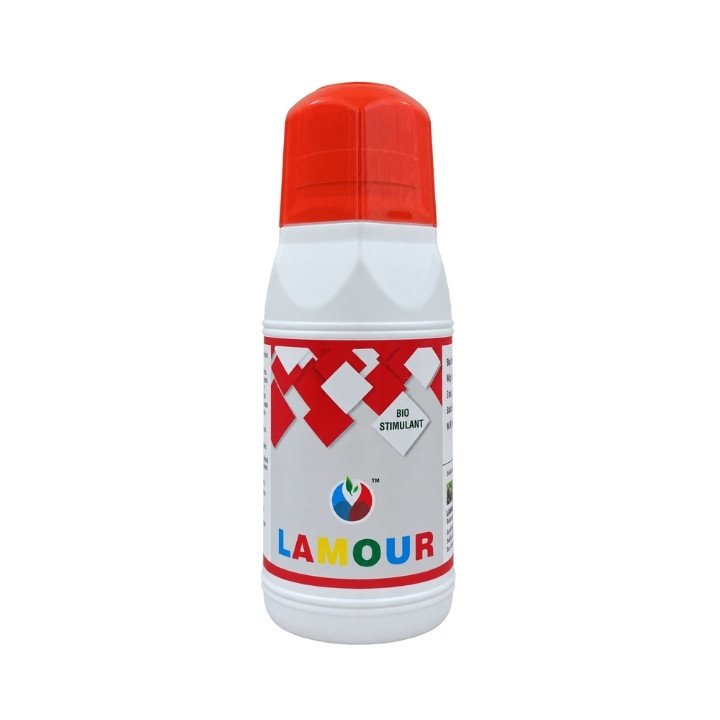


Lacgene Lamour Botanical Thrips and Aphid Repellent
LACGENE Lamour Botanical Repellent for Thrips and Aphids
LACGENE Lamour is a botanical bio-stimulant and crop-care formulation developed to help repel thrips and aphids. These sucking pests can damage tender leaves, shoots, flowers and developing fruits by extracting plant sap and interfering with healthy crop development.
Lamour contains 10% fermented botanical extract and 10% seaweed extract. Its botanical component supports pest-deterrence, while seaweed extract helps maintain plant vigour under manageable pest and environmental stress.
One pack is stated to cover approximately 0.8–1 acre. Actual coverage depends on the crop canopy, planting density, spray volume, equipment calibration and directions printed on the current product label.
LACGENE Lamour Product Specifications
| Specification | Details |
|---|---|
| Product Name | Lamour |
| Brand | LACGENE |
| Product Category | Botanical pest repellent and bio-stimulant |
| Form | Liquid |
| Fermented Extract | 10% |
| Seaweed Extract | 10% |
| Target Pests | Thrips and aphids |
| Declared Coverage | Approximately 0.8–1 acre per pack |
| Suitable Crops | Multiple field, vegetable, fruit, plantation, flower, medicinal and fodder crops |
| Application Environment | Open fields and protected cultivation, subject to product-label directions |
| Application Method | Apply according to the current LACGENE product label |
| Dosage | Follow the crop-specific dosage and water volume stated on the label |
Composition and Functional Role
| Component | Declared Content | Functional Role |
|---|---|---|
| Fermented Botanical Extract | 10% | Provides botanical compounds intended to help deter thrips and aphids |
| Seaweed Extract | 10% | Supports plant vigour, physiological activity and recovery from manageable stress |
| Other Formulation Ingredients | Not specified | Refer to the current product label for the complete composition |
Composition note: The individual botanical ingredients and remaining formulation components have not been specified in the supplied information. Refer to the sealed pack or manufacturer’s technical literature before making additional composition claims.
Key Features of LACGENE Lamour
- Targeted Pest Deterrence: Developed to help repel thrips and aphids from treated crops.
- Botanical Formulation: Contains 10% fermented botanical extract for crop-care applications.
- Seaweed Support: Contains 10% seaweed extract to support crop vigour.
- Multi-Crop Application: Intended for numerous agricultural and horticultural crop groups.
- Useful Coverage: One pack is stated to cover approximately 0.8–1 acre.
- Protected-Cultivation Use: May be used in greenhouse crops when permitted by the label.
- IPM Support: Can form part of an integrated sucking-pest management programme.
Potential Benefits
- Helps discourage thrips and aphids from feeding on treated crop surfaces.
- May help reduce damage to tender leaves, shoots, flowers and developing produce.
- Seaweed extract supports healthy plant growth and physiological activity.
- Helps crops cope with manageable stress when used as part of proper crop care.
- Can complement pest monitoring and other integrated management practices.
- Suitable for open-field and protected cultivation where label directions permit.
Target Pests and Typical Damage
| Target Pest | Typical Crop Damage | Product Support |
|---|---|---|
| Thrips | Scraping and sucking damage, leaf distortion, silvering and injury to flowers or fruits | Helps deter thrips from feeding on treated crop surfaces |
| Aphids | Sap loss, curling, weakened growth, honeydew and sooty-mould development | Helps repel aphids as part of an integrated pest-management programme |
Botanical repellents may help deter pest feeding but should not be represented as guaranteed pest elimination. Severe infestations may require additional registered crop-protection measures.
Recommended Crop Groups
| Crop Group | Example Crops |
|---|---|
| Field Crops | Rice, wheat, maize, sorghum, millets, soybean, sunflower, mustard, groundnut, cotton, sugarcane, pulses and tobacco |
| Vegetables | Tomato, brinjal, chilli, capsicum, onion, garlic, potato, okra, cabbage, cauliflower, beans, peas, carrot and cucumber |
| Leafy Vegetables and Spices | Spinach, fenugreek, cumin, turmeric and ginger |
| Fruit Crops | Mango, banana, apple, grapes, citrus, guava, papaya, pineapple, pomegranate, strawberry, watermelon, muskmelon, avocado and peach |
| Plantation Crops | Tea, coffee, rubber, oil palm, coconut, arecanut, cashew, cardamom, cocoa and betel vine |
| Flowers and Foliage Plants | Rose, marigold, jasmine, chrysanthemum, gladiolus, carnation, tuberose and orchids |
| Fibre Crops | Jute, hemp, kenaf and flax |
| Medicinal and Aromatic Crops | Neem, aloe vera, tulsi, ashwagandha, mint, lemongrass, vetiver, stevia and senna |
| Forage and Fodder Crops | Berseem, lucerne, Napier grass, Guinea grass, stylo, cowpea, fodder maize and fodder sorghum |
Crop-use note: The above crop groups are based on the supplied information. Apply Lamour only to crops and situations permitted by the current product label.
How to Apply LACGENE Lamour
- Inspect the crop regularly, particularly tender leaves, growing points and flowers.
- Begin label-approved application when early thrips or aphid activity is observed.
- Measure the product according to the dosage printed on the current label.
- Half-fill the spray tank with clean water.
- Add the measured Lamour while continuously agitating the water.
- Add the remaining required water and mix thoroughly.
- Spray uniformly over the crop, including the underside of leaves and hidden pest locations.
- Use the prepared spray mixture promptly and do not store diluted material.
Application Guidance
| Parameter | Recommendation |
|---|---|
| Application Timing | Apply at the early stage of thrips or aphid activity according to label directions |
| Declared Coverage | Approximately 0.8–1 acre per pack |
| Dosage | Use only the crop-specific dosage stated on the current product label |
| Spray Coverage | Provide uniform coverage, particularly on young leaves, growing points and leaf undersides |
| Preferred Spray Time | Early morning or late evening under suitable weather conditions |
| Weather | Avoid application during strong wind, extreme heat or immediately before rainfall |
| Repeat Application | Repeat only at the interval permitted by the label and according to pest monitoring |
| Tank Mixing | Mix with other inputs only when all relevant labels permit it and compatibility is confirmed |
Integrated Thrips and Aphid Management
- Inspect young foliage, flowers and leaf undersides regularly.
- Begin management when pest populations are still low.
- Remove heavily infested shoots or leaves when practical.
- Control weeds and alternate host plants around the crop.
- Use yellow or blue sticky traps where recommended.
- Avoid excessive nitrogen application, which may encourage tender growth and sucking-pest activity.
- Preserve ladybird beetles, lacewings and other beneficial organisms.
- Use registered insecticides if the infestation exceeds locally recommended economic thresholds.
Safety Precautions
- Read and follow the complete product label before use.
- Wear gloves, protective clothing, eye protection and a suitable mask while mixing and spraying.
- Avoid inhaling spray mist or allowing the concentrate to contact skin and eyes.
- Do not eat, drink or smoke while handling the product.
- Do not apply directly to open water or contaminate drinking-water sources.
- Keep children, animals and unprotected persons away from the application area.
- Follow all label-specified re-entry and pre-harvest instructions.
Environmental Guidance
Lamour is presented as a botanical formulation, but “organic” or plant-derived ingredients should not be interpreted as completely risk-free. Apply only at the recommended dose and prevent spray drift, unnecessary exposure and contamination of water sources.
Storage Instructions
- Store in the original and properly closed container.
- Keep in a cool, dry and well-ventilated location.
- Protect the product from direct sunlight, excessive heat and freezing.
- Keep away from food, beverages, animal feed and medicines.
- Keep securely out of reach of children and animals.
Frequently Asked Questions
What is LACGENE Lamour used for?
Lamour is a botanical bio-stimulant and pest repellent intended to help manage thrips and aphids across multiple crops.
What is the composition of Lamour?
The supplied information declares 10% fermented extract and 10% seaweed extract. Refer to the current label for the complete guaranteed composition.
How much area does one pack cover?
One pack is stated to cover approximately 0.8–1 acre. Actual coverage depends on crop canopy, spray volume, equipment and label directions.
What is the recommended dosage?
A verified numerical dosage has not been supplied. Follow the crop-specific dose and water requirement printed on the current LACGENE product label.
When should Lamour be applied?
Apply according to label directions when early thrips or aphid activity is observed. Proper coverage of young leaves, flowers and leaf undersides is important.
Can Lamour be used on all crops?
It is promoted for numerous crop groups, but it should only be applied to crops and situations permitted by the current label.
Is it completely non-toxic?
No agricultural input should be described as completely risk-free without supporting regulatory evidence. Handle Lamour carefully and follow all label precautions even though it is presented as a botanical formulation.
Does Lamour completely eliminate thrips and aphids?
It is a repellent rather than a guaranteed pest-eradication treatment. Performance depends on pest pressure, crop condition, timing, coverage and weather. Severe infestations may require additional registered control measures.
Can it be mixed with pesticides or fertilizers?
Prepare a tank mixture only when the labels of all products permit it. Conduct a small compatibility test before combining unfamiliar products.
Disclaimer: This information is provided for general guidance only. Always follow the approved uses, dosage, safety precautions and application directions printed on the current product label and accompanying leaflet.Similar Products
Best Selling

Customer Reviews
Recent Reviews
No reviews yet.