

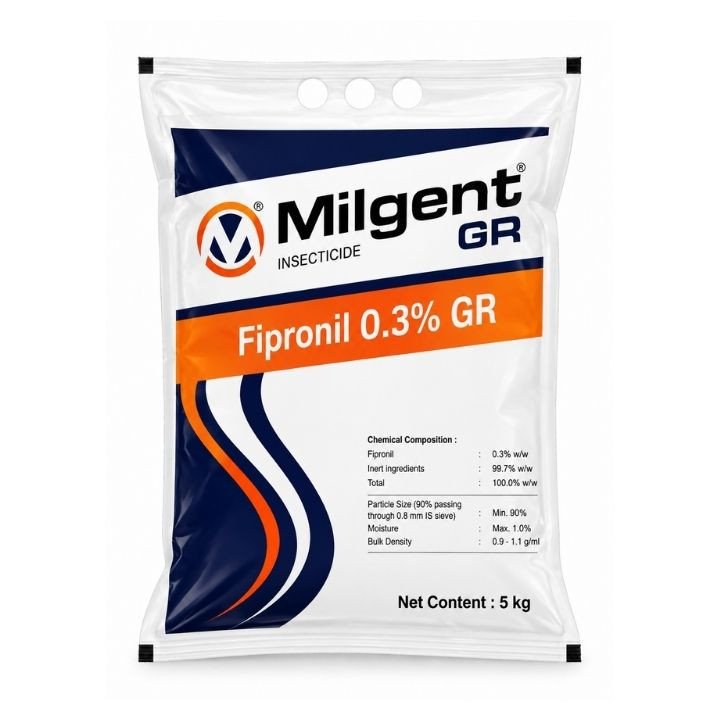
Moti Milgent GR Insecticide
Moti Milgent GR: Skipping the Sprayer Entirely for Pests That Live Below the Surface
Stem borers, root borers, and termites share one thing in common that makes them notoriously hard to manage with a standard foliar spray — they spend most of their damaging life stage hidden inside plant tissue or underground, well out of reach of anything applied to the leaf surface. Moti Milgent GR sidesteps this problem entirely by working as a ready-to-use granular formulation of Fipronil 0.3%, broadcast directly onto soil rather than sprayed onto foliage, delivering the active ingredient exactly where these hidden pests are actually operating.
Being a GR (granular) product also changes the practical work involved — there's no mixing, no water dilution calculations, and no sprayer required. Granules are simply broadcast onto standing crop or moist soil, where they gradually dissolve and release the active ingredient into the root zone.
Formulation Overview
| Detail | Specification |
|---|---|
| Brand | Moti |
| Product Name | Milgent GR |
| Technical Name | Fipronil 0.3% |
| Formulation Type | Granules (GR) |
| Net Weight | 2 kg |
| Application Method | Soil Broadcast (No Mixing Required) |
What Happens After the Granules Hit the Field
Once broadcast onto moist soil or standing water in a paddy field, the granules release Fipronil gradually rather than all at once, which is part of why this formulation type tends to offer extended residual protection compared to a one-time foliar spray. Plant roots take up the active ingredient, and it moves systemically within the plant, reaching pests feeding inside stems or on roots where a surface spray simply couldn't follow.
The Pest Range This Composition Typically Addresses
| Crop | Target Pests |
|---|---|
| Rice (Paddy) | Stem Borer, Leaf Folder, Gall Midge, Brown Plant Hopper, White-Backed Plant Hopper, Green Leaf Hopper, Whorl Maggot |
| Sugarcane | Early Shoot Borer, Root Borer, Termite |
| Groundnut | White Grub |
| Wheat | Termite |
Why the Same Product Handles Both Borers and Termites
Fipronil's mode of action explains why it works across such a mixed pest list. It blocks GABA-gated chloride channels in the target insect's nervous system, disrupting normal chloride ion regulation and causing excessive neural stimulation that leads to paralysis and death. This mechanism doesn't distinguish much between a stem-boring caterpillar and a soil-dwelling termite — both are vulnerable through the same underlying nervous system disruption, whether exposure comes through contact or ingestion.
Application Rate and Method
| Crop | Recommended Rate | Method |
|---|---|---|
| Rice, Sugarcane, Groundnut, Wheat | 8–10 kg per acre | Broadcast onto moist soil or standing field water |
Since this is a granular broadcast product, there's no dilution or water-mixing step involved — the recommended quantity is simply spread evenly across the field. Even distribution matters more than it might seem, since patchy broadcasting leaves gaps in soil coverage where hidden pests can continue feeding undisturbed. Always confirm the exact per-acre rate from the current product label for the specific crop being treated, as regional recommendations can vary slightly.
A Secondary Benefit Beyond Direct Pest Kill
Beyond its core insecticidal function, Fipronil-based granular products are commonly associated with a supportive plant growth effect — particularly enhanced root development and a higher number of productive tillers, especially in paddy. This isn't the primary reason to choose the product, but it's a frequently reported secondary benefit alongside pest control performance.
Practical Notes Before Application
- Broadcast onto moist soil or standing paddy water for the granules to dissolve and release properly
- Avoid application on flowering crops, since Fipronil carries some toxicity risk to pollinators like bees
- Follow the pre-harvest interval specified on the label — this can extend to several weeks depending on the crop
- Wear gloves and a mask while handling and broadcasting the granules
- Store away from food, animal feed, and water sources in a cool, dry location
Frequently Asked Questions
Do I need to mix Milgent GR with water before applying it?
No — as a granular formulation, it's broadcast directly onto moist soil or standing field water without any mixing or dilution step.
Can this product be used on a flowering crop?
Fipronil-based products carry some toxicity risk to bees and pollinators, so application on actively flowering crops should generally be avoided; soil or pre-flowering application is the safer approach.
Why does the same product work on both rice stem borer and sugarcane termite?
Fipronil's mode of action disrupts the nervous system through GABA channel blocking in a way that affects a broad range of insects, whether they're boring pests inside stems or soil-dwelling termites, rather than being limited to one specific pest biology.
How long does protection last after a single broadcast application?
Granular Fipronil formulations are generally associated with extended residual protection lasting several weeks from a single application, though exact duration can vary with soil and field conditions.
Disclaimer: The details provided are for informational guidance only. Always adhere to the recommended application instructions as stated on the product label and in the accompanying leaflet.
Similar Products

Best Selling
Customer Reviews
Recent Reviews
No reviews yet.