

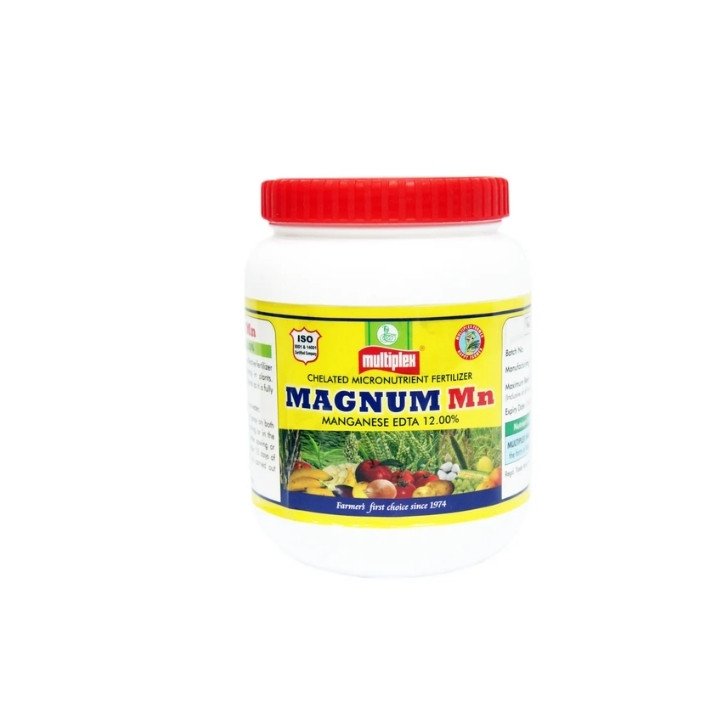


Multiplex Magnum Mn Chelated Micronutrient Fertilizer – Manganese EDTA 12%
Multiplex Magnum Mn for Manganese Deficiency Management in Crops
Multiplex Magnum Mn is a chelated micronutrient fertilizer containing Manganese EDTA 12% in the supplied product variant. It is formulated to help correct manganese deficiency and provide manganese in a chelated form suitable for foliar application.
Manganese plays an important role in chlorophyll formation, photosynthesis, carbohydrate metabolism and nitrogen assimilation. Proper use of Multiplex Magnum Mn helps support greener foliage, healthy crop growth and efficient nutrient utilisation under manganese-deficient conditions.
Multiplex Magnum Mn Product Specifications
| Specification | Details |
|---|---|
| Product Name | Multiplex Magnum Mn |
| Brand | Multiplex |
| Product Category | Chelated micronutrient fertilizer |
| Technical Composition | Manganese EDTA 12% |
| Nutrient Supplied | Manganese (Mn) |
| Chelating Agent | EDTA – Ethylene Diamine Tetra Acetic Acid |
| Form | Water-soluble powder |
| Recommended Crops | Field and horticultural crops |
| Application Method | Foliar spray |
| Recommended Dose | Follow the dose printed on the supplied product label |
| Suitable Application Time | Early morning or evening |
| Available Pack Sizes | 100 g, 250 g, 500 g and 1 kg |
Technical Composition
| Component | Concentration | Function |
|---|---|---|
| Manganese chelated with EDTA | 12% | Supplies chelated manganese for foliar nutrition |
Composition note: The attached pack states Manganese EDTA 12.00%. Multiplex currently also lists a 10.0% formulation on its official website. Check the composition printed on the physical pack before sale or application because the recommended dose may differ between formulations.
Key Features of Multiplex Magnum Mn
- Chelated formulation: Provides manganese chelated with EDTA for efficient nutrient availability through foliar application.
- Deficiency correction: Helps correct manganese deficiency when applied according to crop need and label directions.
- Supports chlorophyll: Manganese contributes to chlorophyll formation and healthy leaf greenness.
- Supports photosynthesis: Manganese is involved in the water-splitting process during photosynthesis.
- Supports nutrient metabolism: Plays a role in carbohydrate metabolism, nitrogen metabolism and assimilation.
- Wide crop suitability: Useful for field crops, vegetables, fruit crops, plantations, pulses and oilseeds.
Benefits for Farmers
- Helps manage interveinal chlorosis associated with manganese deficiency.
- Supports chlorophyll formation and healthy green foliage.
- Helps maintain natural photosynthetic activity in plants.
- Supports carbohydrate breakdown and nitrogen assimilation.
- Helps activate enzyme systems involved in normal plant metabolism.
- Supports movement and utilisation of nutrient ions within plant cells.
- Promotes healthy vegetative growth under manganese-deficient conditions.
- Supports crop quality and yield potential as part of balanced nutrition.
Recommended Crops and Uses
| Crop Group | Example Crops | Primary Nutritional Use |
|---|---|---|
| Field crops | Paddy, maize, wheat and sugarcane | Supports chlorophyll formation, photosynthesis and crop vigour |
| Vegetable crops | Tomato, chilli, onion and potato | Helps manage manganese deficiency and supports healthy growth |
| Fruit crops | Grapes, banana, pomegranate and citrus | Supports foliage health, nutrient metabolism and fruit development |
| Plantation crops | Coconut, tea and coffee | Helps maintain leaf greenness and photosynthetic activity |
| Pulses and oilseeds | Groundnut and soybean | Supports enzyme activity, nitrogen metabolism and crop growth |
Crop recommendations are general nutritional guidance. Application should be based on visible deficiency symptoms, soil or leaf analysis, crop stage and local agricultural recommendations.
Manganese Deficiency Symptoms
| Deficiency Indicator | What Farmers May Observe |
|---|---|
| Interveinal chlorosis | Yellowing between veins while the veins may remain relatively green |
| Young leaves affected | Symptoms commonly become visible on younger or recently developed leaves |
| Yellow mottling | Yellow mottled areas or spots may develop on leaves |
| Poor leaf greenness | Leaves may appear pale because manganese supports chlorophyll formation |
| Weak crop growth | Persistent deficiency may affect photosynthesis and normal crop development |
Suitable Crop Stages
| Crop Stage | Purpose of Application |
|---|---|
| Active vegetative stage | Supports leaf development, chlorophyll formation and crop vigour |
| Pre-flowering stage | Helps maintain plant strength and nutrient metabolism before flowering |
| Fruit-development stage | Supports continued photosynthesis and crop-quality development |
| Deficiency-correction stage | Apply when confirmed manganese-deficiency symptoms become visible |
Dosage and Application Method
| Application Method | Recommended Dose | Directions |
|---|---|---|
| Foliar spray | 0.5 g per litre of water or as stated on the supplied pack | Spray uniformly on both leaf surfaces |
| Repeat application | Based on deficiency and label guidance | Repeat only when required after monitoring the crop response |
Dose note: Multiplex's current official recommendation is 0.5 g per litre for its listed Magnum Mn formulation. Because the attached pack shows a different 12% concentration, confirm the exact dose from that pack before use. Do not automatically apply 1–2 g per litre unless this dose is specifically printed on the supplied product label.
How to Use Multiplex Magnum Mn
- Confirm manganese deficiency through visible symptoms or professional crop analysis.
- Read the composition and dose printed on the physical product pack.
- Measure the required quantity according to the label recommendation.
- Dissolve it separately in a small quantity of clean water.
- Fill the spray tank halfway with water and add the prepared nutrient solution.
- Add the remaining water and mix thoroughly.
- Spray uniformly on both the upper and lower surfaces of the leaves.
- Apply preferably during the early morning or evening.
- Avoid spraying during intense sunlight, high temperature, strong wind or rainfall.
- Use the prepared spray solution on the same day.
Role of Manganese in Plants
Manganese is involved in photosynthesis and is particularly important for the water-splitting reaction that supports the photosynthetic process. It also contributes to chlorophyll formation, carbohydrate metabolism and nitrogen assimilation.
Manganese helps activate several plant enzyme systems, including decarboxylase, dehydrogenase and oxidase enzymes. Adequate manganese nutrition therefore supports normal metabolic activity and healthy crop development.
Why Farmers Can Choose Multiplex Magnum Mn
- Supplies manganese in an EDTA-chelated form.
- Helps correct confirmed manganese deficiency.
- Supports chlorophyll formation and photosynthesis.
- Useful for both field and horticultural crops.
- Suitable for foliar application at the recommended concentration.
- Available in multiple pack sizes for different crop areas.
- Can be included in a balanced crop-nutrition programme.
Frequently Asked Questions
What is Multiplex Magnum Mn?
Multiplex Magnum Mn is a chelated micronutrient fertilizer developed to supply manganese and help correct manganese deficiency in field and horticultural crops.
Does Magnum Mn contain 10% or 12% Manganese EDTA?
The attached product image states Manganese EDTA 12.00%, while the current official Multiplex page lists Manganese EDTA 10.0%. Use the composition printed on the physical pack supplied to the customer and do not combine the specifications of the two variants.
What is the recommended dose of Multiplex Magnum Mn?
Multiplex's current official recommendation is 0.5 g per litre of water for foliar spraying. Confirm the exact dose from the supplied 12% product label before application.
Which crops can be treated with Magnum Mn?
It is suitable for field and horticultural crops, including paddy, maize, wheat, sugarcane, tomato, chilli, onion, potato, grapes, banana, citrus, tea, coffee, groundnut and soybean.
What are the common symptoms of manganese deficiency?
Common symptoms include interveinal chlorosis and yellow mottled areas or spots, particularly on young leaves. Similar symptoms may have other causes, so proper diagnosis is recommended before application.
What is the best time to spray Magnum Mn?
Foliar application should preferably be completed during the early morning or evening. Avoid spraying during strong sunlight, high temperature, rainfall or strong wind.
Can Magnum Mn be mixed with other fertilizers or pesticides?
Do not mix it with unfamiliar fertilizers or crop-protection products without confirming compatibility. Follow the label and conduct a small jar test before preparing a combined spray solution.
How frequently should Magnum Mn be applied?
Repeat application should depend on deficiency severity, crop response and label guidance. Avoid unnecessary or excessive application of manganese.
Disclaimer: The details provided are for informational guidance only. Always adhere to the recommended application instructions as stated on the product label and in the accompanying leaflet.Similar Products


Best Selling



Customer Reviews
Recent Reviews
No reviews yet.