

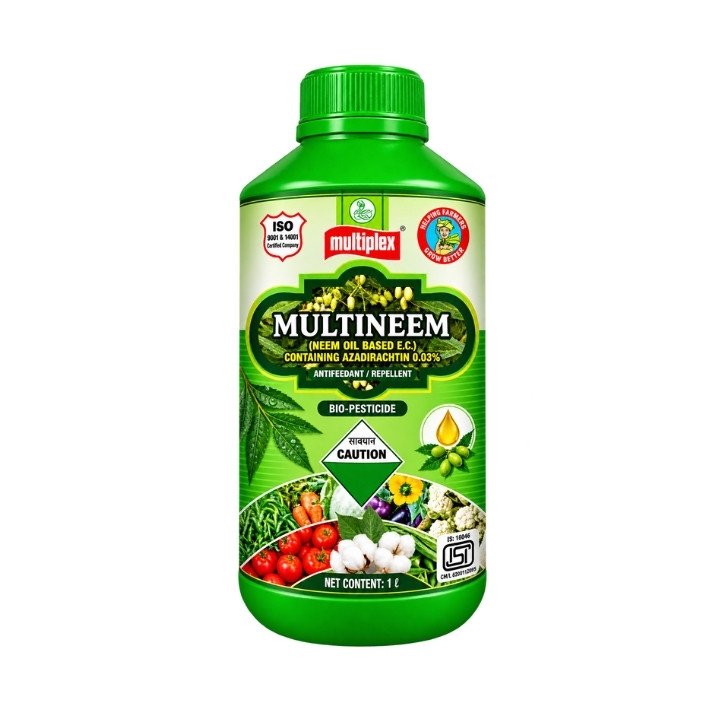


Multiplex Multineem Bio Insecticide – Azadirachtin 0.03% EC
Multiplex Multineem Neem-Based Bio Insecticide for Sustainable Pest Management
Multiplex Multineem is a neem oil-based botanical bio-pesticide containing Azadirachtin 0.03% EC w/w minimum. It helps manage susceptible sucking, chewing, boring and foliage-feeding insect pests through antifeedant, repellent and insect growth-regulating activity.
Multineem is useful for preventive and early-stage pest management in field, vegetable, fruit, pulse, oilseed, plantation and horticultural crops. It can be included in an Integrated Pest Management programme to help reduce continuous dependence on a single conventional insecticide chemistry.
Multiplex Multineem Product Specifications
| Specification | Details |
|---|---|
| Product Name | Multiplex Multineem |
| Brand | Multiplex |
| Product Category | Botanical bio-pesticide / bio insecticide |
| Active Ingredient | Azadirachtin 0.03% EC w/w minimum |
| Active Ingredient Source | Neem oil-based formulation |
| Formulation Type | EC – Emulsifiable Concentrate |
| Primary Actions | Antifeedant, repellent, growth regulator, oviposition deterrent and sterilant activity |
| Target Pest Groups | Sucking pests, chewing pests, borers, flies, bugs and other label-listed insects |
| Application Method | Foliar spray |
| Recommended Dose | 3–5 ml per litre of water |
| Recommended Use Pattern | Preventive or at the early stage of pest infestation |
| Available Pack Sizes | 100 ml, 250 ml, 500 ml, 1 litre and 5 litre |
Technical Composition
| Component | Concentration | Function |
|---|---|---|
| Azadirachtin | 0.03% EC w/w minimum | Botanical active ingredient with antifeedant, repellent and insect growth-regulating effects |
| Neem oil-based formulation ingredients | As required | Support stability, dilution and foliar application |
Key Features of Multiplex Multineem
- Neem-based formulation: Contains Azadirachtin obtained through a neem oil-based bio-pesticide formulation.
- Antifeedant activity: Helps reduce feeding by susceptible insects after contact with or exposure to treated plant surfaces.
- Repellent effect: Neem's bitter taste and characteristic odour help discourage insect settlement and feeding.
- Growth regulation: Interferes with moulting, pupation and normal development of susceptible immature insects.
- Life-cycle disruption: May affect egg laying, egg viability, mating activity and adult reproduction.
- Broad pest spectrum: Useful against several label-listed sucking, chewing and boring pests.
- IPM suitability: Can be incorporated into an Integrated Pest Management programme under proper application practices.
Benefits for Farmers
- Helps manage both sucking and chewing insect pests.
- Supports early-stage control before pest populations become severe.
- Reduces feeding damage to leaves, shoots, flowers, pods and fruits.
- Uses several behavioural and developmental effects against susceptible pests.
- Supports rotation away from repeated use of a single conventional insecticide chemistry.
- The manufacturer describes the formulation as readily degradable.
- Suitable for preventive spray programmes and early pest intervention.
- Can support sustainable pest-management practices when used according to the label.
Target Pest Spectrum
| Pest Group | Example Target Pests | General Type of Damage |
|---|---|---|
| Sucking pests | Aphids, whiteflies, thrips, leafhoppers, plant hoppers and psyllids | Sap feeding, leaf curling, yellowing and weakening of tender plant parts |
| Chewing pests | Caterpillars, beetles and grasshoppers | Feeding damage to leaves, shoots and developing crop parts |
| Borers | Pod borers, stem borers and fruit borers | Larval feeding inside stems, pods, fruits or other protected crop parts |
| Moths and larvae | Diamondback moth and other label-listed moth pests | Larval feeding on leaves and tender tissues |
| Flies and bugs | Fruit flies, plant bugs and gall midges | Feeding, egg-laying or larval damage to tender and reproductive parts |
| Other insect pests | Locusts and other label-listed susceptible insects | Foliage consumption and crop injury |
Recommended Crops and Uses
| Crop Group | Example Crops | Potential Target Pests |
|---|---|---|
| Vegetable crops | Tomato, chilli, brinjal, okra and cabbage | Aphids, whiteflies, thrips, caterpillars, borers and diamondback moth |
| Fruit crops | Mango, banana, grapes, pomegranate and citrus | Hoppers, thrips, aphids, fruit flies, caterpillars and other label-listed pests |
| Field crops | Cotton, paddy, wheat, maize and sugarcane | Jassids, whiteflies, caterpillars, stem borers and other susceptible pests |
| Pulses and oilseeds | Groundnut, soybean and red gram | Aphids, leafhoppers, caterpillars, pod borers and plant bugs |
| Plantation crops | Coconut, tea and coffee | Thrips, hoppers, caterpillars and other label-listed pests |
| Flowers and horticultural crops | Label-approved ornamental and horticultural crops | Aphids, thrips, whiteflies, caterpillars and plant bugs |
Crop and pest suitability can vary according to the product registration and local recommendations. Always confirm the selected crop and target pest from the current product label before application.
Dosage and Application Method
| Application | Recommended Dose | Method |
|---|---|---|
| General foliar spray | 3–5 ml per litre of water | Spray uniformly on upper and lower leaf surfaces |
| 15-litre spray pump | 45–75 ml | Based on the official dose of 3–5 ml per litre |
| 16-litre spray pump | 48–80 ml | Based on the official dose of 3–5 ml per litre |
| 200-litre spray solution | 600–1000 ml | Adjust total quantity according to the actual spray-water volume |
Dose note: The official Multiplex recommendation for Multineem is 3–5 ml per litre of water. Select the exact dose within this range according to the product label, crop, pest and infestation level.
How to Use Multiplex Multineem
- Inspect the crop and identify the target insect pest correctly.
- Shake the Multineem container thoroughly before measuring.
- Measure 3–5 ml of Multineem for every litre of required spray water.
- Fill the spray tank halfway with clean water.
- Dilute the measured product separately in a small quantity of water.
- Add the diluted mixture to the spray tank while stirring continuously.
- Add the remaining water and mix until a uniform spray solution is formed.
- Spray uniformly on both the upper and lower surfaces of the leaves.
- Cover tender shoots, growing points and other pest-active crop parts.
- Use the prepared spray solution on the same day.
Best Time and Frequency of Application
- Apply preventively or when the target pest is first observed.
- Early-stage application is preferable to spraying after severe infestation.
- Spray during the early morning or evening for improved coverage.
- Avoid application during strong wind, rainfall or very hot afternoon conditions.
- The manufacturer recommends regular preventive sprays at approximately 20–25-day intervals for better results.
- Use shorter intervals only when specifically supported by the product label or local expert advice.
Mode of Action
Azadirachtin primarily produces an antifeeding response through chemoreception, discouraging susceptible insects from feeding on treated plant material. Reduced food consumption can limit further crop damage and affect normal insect development.
Exposure during the larval stage may interfere with moulting and pupation, resulting in incomplete development or deformed adults. Azadirachtin may also disrupt mating communication, discourage females from laying eggs and affect egg viability and adult reproductive activity.
Role in Integrated Pest Management
Multiplex Multineem can be used as one component of an Integrated Pest Management programme involving crop monitoring, sanitation, biological control, pheromone traps and need-based application of registered insecticides.
Botanical origin does not mean that careless application is harmless. Avoid unnecessary spraying, protect pollinators, follow the label and prevent contamination of water bodies and non-target areas.
Why Farmers Can Choose Multiplex Multineem
- Neem oil-based botanical bio-pesticide.
- Contains Azadirachtin 0.03% EC w/w minimum.
- Acts through antifeedant, repellent and growth-regulating effects.
- Targets several sucking, chewing and boring pests.
- Useful for preventive and early pest-management programmes.
- Suitable for a wide range of crops as per label recommendation.
- Can be included in Integrated Pest Management programmes.
- Available in multiple pack sizes for different farm requirements.
Frequently Asked Questions
What is Multiplex Multineem?
Multiplex Multineem is a neem oil-based botanical bio-pesticide containing Azadirachtin 0.03% EC w/w minimum. It is used against several label-listed sucking, chewing and boring insect pests.
What is the Multineem dose per litre?
The official recommended dose is 3–5 ml per litre of water. This equals 45–75 ml for a 15-litre spray pump.
Which pests can Multineem help manage?
It is useful against label-listed pests such as aphids, whiteflies, thrips, leafhoppers, plant hoppers, caterpillars, pod borers, stem borers, fruit borers, diamondback moth, beetles, fruit flies and plant bugs.
How does Azadirachtin work?
Azadirachtin discourages insect feeding, repels susceptible pests and interferes with moulting, pupation, egg laying, mating and normal insect development.
How frequently should Multineem be sprayed?
The manufacturer recommends regular preventive sprays at intervals of approximately 20–25 days. Actual frequency should follow the product label and local pest pressure.
Can Multineem be used in organic farming?
Multineem is neem-based, but suitability for certified organic production depends on the certification standard and the product's current approval. Confirm acceptance with the relevant organic certification body before use.
Is Multineem completely safe for beneficial insects?
No pesticide should be described as completely safe for every beneficial organism. Apply only when required, avoid direct spraying on bees and natural enemies, and spray outside peak pollinator-foraging hours.
Does Multineem leave no residue?
The manufacturer describes the product as readily degradable and states that it leaves no toxic residue. However, all application, waiting-period and harvest instructions printed on the label must still be followed.
Can Multineem be mixed with chemical pesticides?
Do not prepare an unfamiliar tank mixture without checking both product labels. Conduct a jar test and seek qualified agricultural advice before combining it with another pesticide, fungicide or fertilizer.
Disclaimer: The details provided are for informational guidance only. Always adhere to the recommended application instructions as stated on the product label and in the accompanying leaflet.Similar Products
Best Selling

Customer Reviews
Recent Reviews
No reviews yet.