

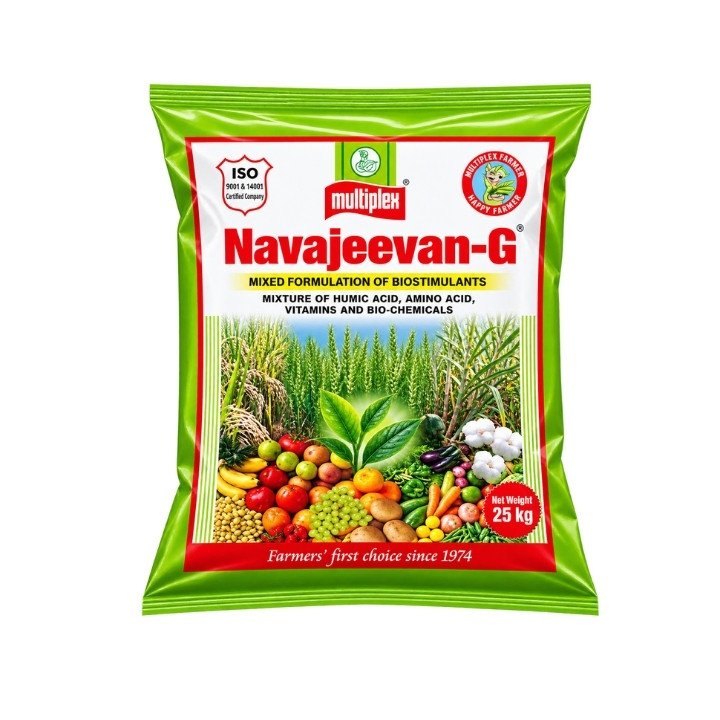
Multiplex Navajeevan-G Granulated Biostimulant
Multiplex Navajeevan-G Granulated Biostimulant for Soil and Crop Health
Multiplex Navajeevan-G is a mixed granular biostimulant containing seaweed, humic acid, amino acids and triacontanol. It is developed for soil application to support crop establishment, root and shoot development, nutrient utilisation and overall plant health.
Navajeevan-G can be applied to all crops. Its organic and biologically active components support soil structure, nutrient retention, root-zone activity and physiological growth under balanced crop-management practices.
The general recommendation is 5–10 kg per acre. It may be mixed with farmyard manure or compost at sowing or combined with top-dressing fertilizers approximately 20–25 days after transplanting. The granules should be incorporated properly into the soil for maximum root-zone contact.
Multiplex Navajeevan-G Product Specifications
| Specification | Details |
|---|---|
| Product Name | Multiplex Navajeevan-G |
| Brand | Multiplex |
| Product Type | Mixed granular biostimulant |
| Form | Granules |
| Composition | Seaweed, humic acid, amino acids and triacontanol |
| Recommended Crops | All crops |
| General Dose | 5–10 kg per acre |
| Application Method | Soil application |
| Application Timing | At sowing or approximately 20–25 days after transplanting |
| Pack Size Shown | 25 kg |
| Available Pack Sizes | 1 kg, 5 kg, 10 kg, 25 kg, 50 kg and 100 kg |
Composition and Functional Components
| Component | Role in Soil and Crop Development |
|---|---|
| Seaweed | Provides naturally occurring organic compounds associated with crop establishment and physiological growth |
| Humic Acid | Supports soil structure, microbial activity, nutrient retention and root-zone development |
| Amino Acids | Provide building blocks involved in protein formation and plant metabolic processes |
| Triacontanol | Supports cell division, cell elongation, root and shoot development and photosynthetic activity |
Composition note: Exact percentages of seaweed, humic acid, amino acids and triacontanol are not stated in the supplied information. Refer to the current product label for the guaranteed composition.
Key Features of Multiplex Navajeevan-G
- Mixed Biostimulant Formulation: Combines seaweed, humic acid, amino acids and triacontanol.
- Granular Soil Application: Designed for convenient placement within the active crop-root zone.
- Crop-Establishment Support: Supports germination, seedling development and early crop establishment.
- Transplant-Shock Support: Helps transplanted crops recover from manageable establishment stress.
- Soil-Health Support: Helps improve soil texture and its capacity to retain available water and nutrients.
- Root and Shoot Development: Supports stronger root systems, shoots, tillers and branches.
- All-Crop Utility: Multiplex recommends Navajeevan-G for all crops.
Benefits for Farmers
- Supports initial plant establishment and seedling development.
- Helps reduce manageable transplantation shock.
- Supports faster root and shoot development.
- Helps improve soil texture and root-zone condition.
- Supports water and nutrient retention in the soil.
- Helps plants utilise available and applied nutrients more efficiently.
- Supports photosynthetic and metabolic activity.
- May support tillering, branching, flowering and fruit setting under proper management.
- Supports produce quality and yield potential.
- Suitable for field, vegetable, fruit, plantation, nursery, medicinal and aromatic crops.
Nutrient and Growth-Promoter Support
Multiplex states that Navajeevan-G supplies naturally available NPK and secondary or trace elements, including calcium, magnesium, sulphur, boron, molybdenum, copper, zinc, manganese, iron, silicon and cobalt.
The company also describes naturally occurring growth-promoting substances such as auxins, gibberellins and cytokinins. However, exact nutrient and hormone percentages are not published in the supplied composition, so Navajeevan-G should not be treated as a replacement for a soil-test-based fertilizer programme.
General Dosage and Application
| Application Stage | Dose | Method |
|---|---|---|
| At Sowing | 5–10 kg per acre | Mix with FYM or compost and incorporate uniformly into the soil |
| After Transplanting | 5–10 kg per acre | Apply approximately 20–25 days after transplanting with top-dressing fertilizers |
| Plantation Crops | 50–100 g per plant | Apply around the active root zone and mix properly with soil |
Dose note: Crop-specific Multiplex recommendations may differ from the general dose. Follow the current product leaflet for the intended crop.
Crop-Wise Application Guidance
| Crop | Application Timing | Recommended Rate |
|---|---|---|
| Paddy | At planting or 10–15 days after transplanting | 10 kg per acre |
| Wheat | On or before 30–35 days after sowing | 10 kg per acre |
| Sugarcane | First application at 30–60 days and second application around 90 days after planting | 7.5–10 kg per acre per application |
| Banana | First application at 30–35 days and second application at 60–75 days after planting | 25 g per plant per application |
| Potato | Approximately 30 days after planting | 15 kg per acre |
| Strawberry | First application at new-leaf stage and second after 25 days or at green-fruit stage | 15 kg per acre per application |
| Tea Nursery | According to nursery crop stage | 5–10 g per plant |
| Young Tea Plantation | Once every three months according to crop condition | 10–25 g per plant |
| Vegetables | At transplanting or 10–15 days after transplanting | 15 kg per acre |
| Nursery Crops | Before seed sowing or after preparing nursery beds | 0.5–1 kg distributed across nursery beds required for one acre of main-field transplanting |
| Medicinal and Aromatic Crops | At sowing or planting, followed by a second application after 20–30 days | 10–15 kg per acre per application |
| Vanilla | At planting or approximately one month after planting | 50 g per plant per year |
Vegetable examples: Multiplex’s crop guidance includes cabbage, tomato, cauliflower, chilli, capsicum, okra and brinjal.
How to Apply at Sowing
- Measure the recommended quantity according to the crop and treated area.
- Mix Navajeevan-G thoroughly with well-decomposed FYM or compost.
- Broadcast the mixture uniformly over the field or place it in the crop-root zone.
- Incorporate the granules lightly into the soil.
- Complete sowing according to the recommended crop practice.
- Provide irrigation where required to activate the root zone.
How to Apply After Transplanting
- Confirm the crop-specific application time from the current label.
- Measure the required quantity for the treated area.
- Mix Navajeevan-G uniformly with the scheduled top-dressing fertilizer.
- Apply the mixture evenly near the active crop-root zone.
- Avoid placing concentrated granules directly against tender stems.
- Mix the applied granules lightly into moist soil.
- Irrigate after application where recommended.
How to Apply to Plantation Crops
- Remove weeds and loose debris from the application area.
- Apply the crop-specific quantity in a circular band around the active feeder-root zone.
- Keep the granules away from direct contact with the trunk.
- Mix the granules lightly into the upper soil layer.
- Cover with soil or organic mulch where appropriate.
- Provide sufficient irrigation after application.
Why Proper Soil Mixing Is Important
Navajeevan-G is intended for root-zone application. Proper incorporation places its active organic components near the developing roots and reduces losses from surface movement.
Leaving all granules exposed on a dry soil surface may reduce their contact with moisture and active roots. Apply to suitably moist soil and mix according to label directions.
How Navajeevan-G Supports Soil and Plants
Humic acid acts as a soil conditioner and natural chelating agent. It supports soil aggregation, nutrient retention and the availability of certain nutrients within the root zone.
Seaweed contains naturally occurring organic compounds, amino acids, chelating agents, alginic acid and mannitol. These components support plant establishment and physiological activity.
Amino acids participate in protein formation and multiple metabolic processes. Triacontanol supports cell division, cell elongation, mineral uptake, photosynthetic activity and plant growth under suitable conditions.
Crop-Management Tips
- Apply to adequately moist but well-drained soil.
- Use only well-decomposed FYM or compost.
- Distribute the granules uniformly rather than leaving concentrated piles.
- Follow soil-test-based fertilizer recommendations.
- Maintain adequate irrigation after application without waterlogging.
- Correct drainage, salinity and soil-compaction problems separately.
- Monitor the crop for nutrient deficiencies, insects and diseases.
- Use Navajeevan-G as one component of a complete crop-management programme.
Heavy-Metal and Chemical-Residue Claim
Multiplex states that Navajeevan-G may help detoxify some chemical residues and heavy metals to a limited extent. This should be understood as a soil-support claim rather than guaranteed remediation.
Contaminated soil, irrigation water or produce requires laboratory testing and an expert-led remediation programme. Navajeevan-G should not be represented as a product that completely removes heavy metals or pesticide residues.
Important Product Clarifications
- Navajeevan-G is a biostimulant and soil-support product.
- It is not a substitute for the crop’s complete NPK and micronutrient requirements.
- It is not an insecticide, fungicide or herbicide.
- It does not guarantee complete detoxification of contaminated soil.
- It cannot correct waterlogging, severe salinity or major nutrient deficiencies by itself.
- Crop response varies with soil, climate, variety, nutrition and management.
Compatibility
Navajeevan-G may be mixed with FYM, compost or top-dressing fertilizers according to Multiplex directions. When combining it with another soil input, check all product labels and prepare only a recommended combination.
Do not combine concentrated granules with incompatible pesticides or strongly reactive materials without qualified agricultural advice.
Safety and Storage
- Read the current product label before application.
- Wear gloves and suitable protective clothing during handling.
- Avoid inhaling granule dust and prevent contact with eyes.
- Wash hands and exposed skin after use.
- Keep the product in its original sealed package.
- Store in a cool, dry area protected from moisture and direct sunlight.
- Keep away from children, food, animal feed and household materials.
- Close partially used packs securely to prevent moisture absorption.
Why Farmers Can Choose Multiplex Navajeevan-G
- Granular mixed formulation of biostimulants.
- Contains seaweed, humic acid, amino acids and triacontanol.
- Suitable for all crops according to Multiplex.
- Supports soil condition and root-zone activity.
- Helps reduce manageable transplant shock.
- Supports nutrient uptake, photosynthesis and plant establishment.
- Can be applied at sowing or after transplanting.
- Available in a 25 kg pack as shown.
Frequently Asked Questions
What is Multiplex Navajeevan-G?
It is a granular mixed biostimulant containing seaweed, humic acid, amino acids and triacontanol for supporting soil and plant health.
What is the general dose per acre?
Apply 5–10 kg per acre according to crop requirements and the current label.
When should Navajeevan-G be applied?
It can be mixed with FYM or compost at sowing or applied with top-dressing fertilizer approximately 20–25 days after transplanting. Crop-specific timing may differ.
Can it be used in all crops?
Yes. Multiplex officially lists Navajeevan-G for all crops.
What is the dose for plantation crops?
The general leaflet recommendation is 50–100 g per plant. Some crops have more specific rates, so follow the crop-wise label guidance.
Does Navajeevan-G replace NPK fertilizer?
No. Although it supplies naturally available nutrients, the exact NPK percentages are not stated. Continue a balanced fertilizer programme based on soil and crop requirements.
Can Navajeevan-G completely remove heavy metals?
No. Multiplex states that it may help detoxify residues and heavy metals to some extent, but it is not a guaranteed remediation treatment.
Can it be applied through foliar spray or drip irrigation?
The official directions describe soil application of the granules. Do not use it as a foliar spray or through drip unless the current product label specifically permits that method.
Does it control pests and diseases?
No. It is not a pesticide. Use registered crop-protection products where insect, disease or weed control is required.
How much area will a 25 kg pack cover?
At the general dose of 5–10 kg per acre, a 25 kg pack is mathematically sufficient for approximately 2.5–5 acres. Crop-specific recommendations may require a different quantity.
Disclaimer: The information provided is for general guidance only. Always follow the composition, crop, dose, application timing, method and safety instructions printed on the current product label.Similar Products


Best Selling


Customer Reviews
Recent Reviews
No reviews yet.