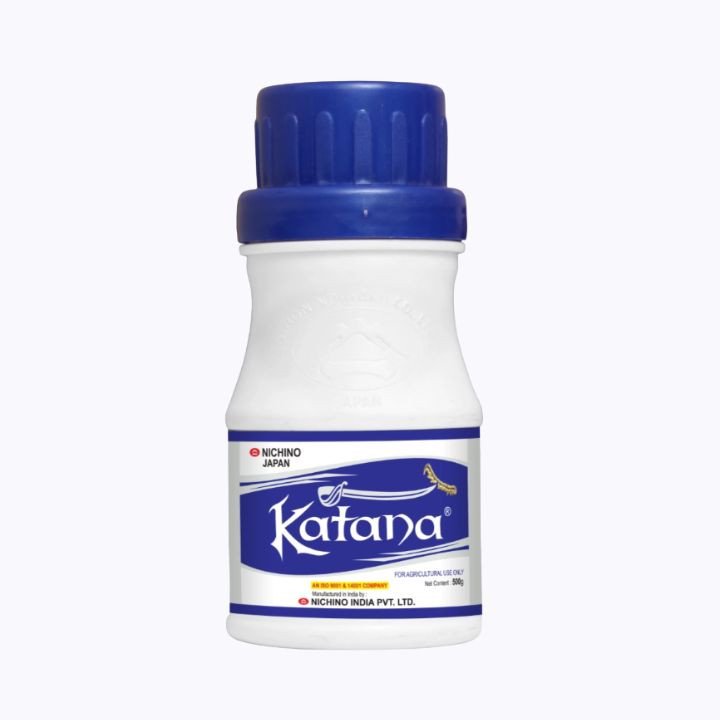
Nichino Katana is an advanced next-generation insecticide containing Flubendiamide 20% WG. It provides powerful control of major lepidopteran pests across a variety of crops. Katana acts through both stomach and contact poison, targeting the insect's Ryanodine Receptors to disrupt muscle function, causing paralysis and death. Featuring quick knockdown action and long-lasting residual effect, Katana delivers unmatched protection. Manufactured using Japanese granulation technology, it ensures uniform spray coverage, superior rain fastness, and is compatible with Integrated Pest Management (IPM) systems for sustainable agriculture.
| Technical Name | Flubendiamide 20% WG |
|---|---|
| Formulation Type | Water Dispersible Granule (WG) |
| Mode of Action | Acts on Ryanodine Receptors in insect muscle cells, causing unregulated calcium release, continuous muscle contraction, paralysis, and death. Works through both stomach and contact action, ensuring fast feeding cessation and mortality. |
| Target Pests | Lepidopteran larvae such as Helicoverpa, Spodoptera, Leaf Folder, Diamond Back Moth, and Pod Borer. |
| Target Crops | Paddy, Cotton, Tomato, Cabbage, Redgram, Chilli, Tea, Soybean, Groundnut, Black Gram, Bengal Gram, Sugarcane. |
| Crop | Target Pest | Dosage (g/acre) |
|---|---|---|
| Paddy | Leaf Folder (Cnaphalocrocis medinalis) | 70 |
| Cotton | Helicoverpa, Spodoptera | 100 |
| Tomato | Helicoverpa, Spodoptera | 40–100 |
| Cabbage | Diamond Back Moth | 25 |
| Redgram | Helicoverpa, Spodoptera | 100 |
| Chilli | Helicoverpa, Spodoptera | 100–120 |
| Tea | Semilooper | 60 |
| Soybean | Spodoptera litura, Semilooper | 100–120 |
| Groundnut | Spodoptera litura | 120 |
| Black Gram | Spodoptera litura, Maruca spp. | 120 |
| Bengal Gram | Pod Borer | 100 |
| Sugarcane | Early Shoot Borer | 150 |
Q1: What is Nichino Katana used for?
Nichino Katana is used for the control of lepidopteran pests like Spodoptera, Helicoverpa, Leaf Folder, and Diamond Back Moth across multiple crops.
Q2: How does Katana Insecticide work?
It targets Ryanodine Receptors in insect muscles, causing unregulated calcium release that leads to paralysis and death. It works through both stomach and contact action.
Q3: What is the recommended dosage for Katana?
The dosage ranges from 25 to 150 g per acre depending on the crop and pest type. Refer to the dosage table for details.
Q4: Is Katana safe for beneficial insects?
Yes, Katana is safe for beneficial insects and natural enemies, making it suitable for Integrated Pest Management (IPM).
Q5: Does rain affect the performance of Katana?
No, Katana has excellent rain-fastness due to its advanced granulation technology and remains effective even after light rainfall.
Disclaimer: The information above is intended for reference only. Always follow the directions and safety guidelines provided on the product label and leaflet.
No reviews yet.