

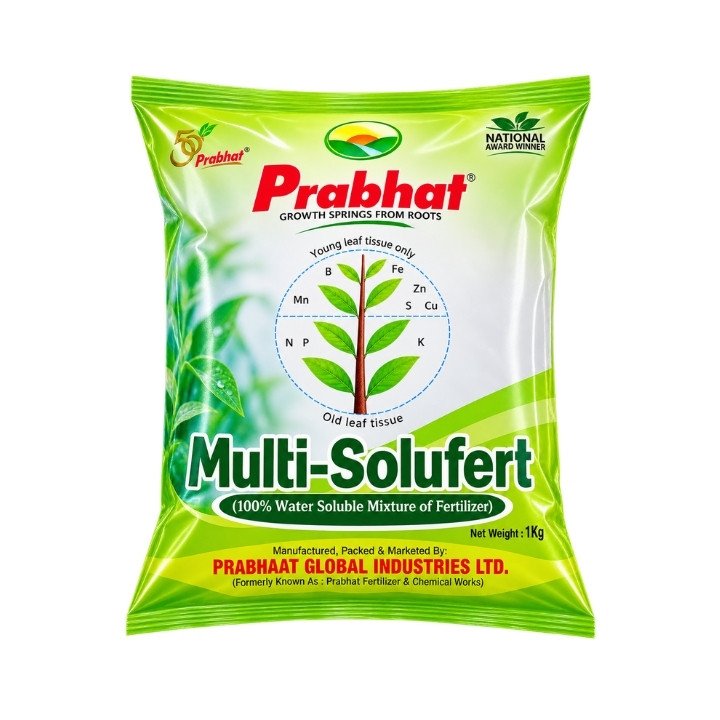
Prabhat Multi-Solufert 100% Water-Soluble Fertilizer
Prabhat Multi-Solufert 100% Water-Soluble Fertilizer
Prabhat Multi-Solufert is a 100% water-soluble mixture of fertilizers containing primary nutrients, secondary nutrients and micronutrients. It is formulated to support plant growth, root development, chlorophyll formation, flowering and overall crop nutrition.
Its supplied nutrient profile includes nitrogen, phosphorus, potassium, sulphur, iron, zinc, manganese, copper and boron. When applied according to the current product label, these nutrients can support several essential plant processes and help correct or prevent diagnosed nutritional deficiencies.
Multi-Solufert can be used for garden plants, houseplants and other label-approved crops through the recommended soil or foliar method. The dosage should be adjusted according to the plant type, growth stage and directions printed on the current pack.
Product Specifications
| Specification | Details |
|---|---|
| Product Name | Multi-Solufert |
| Brand | Prabhat |
| Manufacturer, Packer and Marketer | Prabhaat Global Industries Ltd. |
| Former Company Name | Prabhat Fertilizer & Chemical Works |
| Product Category | Water-soluble mixture of fertilizers |
| Product Type | NPK fertilizer with secondary and micronutrients |
| Solubility | 100% water soluble, as displayed on the pack |
| Form | Solid water-soluble formulation |
| Application Methods | Soil application and foliar spray as directed |
| Primary Uses | Plant growth, root development and nutritional support |
| Net Weight | 1 kg |
Supplied Nutrient Composition
| Nutrient / Parameter | Supplied Value | Declared Limit |
|---|---|---|
| Nitrogen (N) | 10% | Minimum |
| Phosphorus (P) | 15% | Minimum |
| Potassium (K) | 10% | Minimum |
| Zinc (Zn) | 5% | Minimum |
| Sulphur (S) | 5% | Minimum |
| Iron (Fe) | 2% | Minimum |
| Manganese (Mn) | 2% | Minimum |
| Copper (Cu) | 2% | Minimum |
| Boron (B) | 1% | Minimum |
| Chloride / CL | 1.5% | Supplied as Minimum; verify from current label |
| Sodium Chloride (NaCl) | 0.5% | Maximum |
| Lead (Pb) | 0.003% | Maximum |
| Cadmium (Cd) | 0.0025% | Maximum |
| Arsenic (As) | 0.01% | Supplied as Minimum; verify because contaminant limits are normally stated as Maximum |
Composition verification required: The nutrient values above reproduce the information supplied for the product. The entries for chloride and arsenic appear unusual, particularly “As 0.01% Minimum.” Confirm these values and whether they should read “Maximum” from the current back label, certificate of analysis or official technical literature before publishing them as guaranteed specifications.
Role of Primary Nutrients
| Nutrient | Role in Plant Growth |
|---|---|
| Nitrogen (N) | Supports chlorophyll formation, green foliage, amino acids, proteins and vegetative growth. |
| Phosphorus (P) | Supports root development, energy transfer, flowering and reproductive processes. |
| Potassium (K) | Supports stomatal regulation, water balance, enzyme activity, plant strength and produce development. |
Role of Secondary and Micronutrients
| Nutrient | Functional Role |
|---|---|
| Sulphur (S) | Supports the formation of sulphur-containing amino acids, proteins, enzymes and chlorophyll-related plant functions. |
| Zinc (Zn) | Supports enzyme activity, protein metabolism and the regulation of auxin-related plant processes. |
| Manganese (Mn) | Supports photosynthetic reactions, chloroplast function and the activation of several plant enzymes. |
| Copper (Cu) | Participates in enzyme systems, respiration, photosynthesis and lignin-related plant processes. |
| Boron (B) | Supports cell-wall development, sugar transport, cell division, pollen function and reproductive development. |
| Iron (Fe) | Supports chlorophyll synthesis, respiration and several enzymatic reactions in plants. |
Key Features
- Multi-Nutrient Formulation: Contains NPK along with sulphur and multiple micronutrients.
- Water-Soluble Product: Designed to dissolve in water for convenient nutrient application.
- Root and Shoot Support: Supplies nutrients associated with healthy root, leaf and shoot development.
- Chlorophyll Support: Includes nitrogen, iron, magnesium- independent micronutrient support and sulphur-related plant functions.
- Flowering Support: Phosphorus, boron and other nutrients support reproductive plant processes.
- Multiple Application Options: The supplied instructions mention soil application and foliar spraying.
- Garden-Use Potential: Can be used for suitable indoor and outdoor plants according to label directions.
Potential Benefits
- Supports healthy vegetative growth and green foliage.
- Supports the development of new roots and shoots.
- Helps maintain chlorophyll formation and photosynthetic activity.
- Supports flowering and reproductive development.
- May help reduce nutrient-related flower shedding.
- Supports enzyme activity and nutrient metabolism.
- Helps provide multiple nutrients through one formulation.
- Useful during early growth when applied according to plant requirements.
Benefit note: Multi-Solufert can support plants affected by nutrients contained in its formulation, but visible symptoms may also be caused by unsuitable pH, root damage, excess salts, pests, diseases or environmental stress.
Dosage and Application
| Application | Supplied Dosage | General Method |
|---|---|---|
| Indoor Plants | 2–3 g per plant | Mix uniformly into the soil according to the current label |
| Larger Plants | 3–4 g per litre of water | Prepare a solution and apply as a foliar spray if approved on the label |
Dosage caution: The correct quantity can vary substantially with plant size, container volume, existing soil fertility and species sensitivity. Confirm the dosage, frequency and application method from the current pack before use.
How to Prepare for Foliar Application
- Confirm that foliar application is suitable for the selected plant.
- Use clean water and a clean sprayer.
- Measure only the recommended quantity of Multi-Solufert.
- Dissolve the fertilizer first in a small quantity of water.
- Stir until the material is completely dissolved.
- Add the concentrate to the spray tank containing clean water.
- Add the remaining water and mix thoroughly.
- Spray uniformly over the foliage without excessive runoff.
- Use the prepared solution promptly.
How to Apply to Soil
- Check that the soil is slightly moist before application.
- Measure the plant-specific recommended quantity.
- Apply evenly around the active root zone without touching the stem.
- Mix lightly into the upper soil only when directed on the label.
- Water appropriately after application where required.
- Avoid concentrating the entire dose at one point.
Best Application Practices
- Use a lower label-approved dose on young or sensitive plants.
- Do not apply to severely wilted or heat-stressed plants.
- Apply foliar sprays during the cooler morning or evening hours.
- Avoid spraying immediately before rainfall.
- Do not exceed the recommended concentration or frequency.
- Avoid applying to dry soil followed by inadequate irrigation.
- Monitor plant response before repeating the treatment.
Important Information About Water-Soluble Fertilizers
Water-soluble fertilizers dissolve in water, allowing nutrients to become available for plant uptake through suitable application methods. They can help distribute nutrients uniformly when dissolved and applied correctly.
A water-soluble fertilizer is not automatically a slow-release fertilizer. Its nutrients may become available relatively quickly, so excessive concentration or frequent application can cause salt injury, leaf burn or root damage.
Compatibility Guidance
Do not mix Multi-Solufert with pesticides, calcium fertilizers, high-phosphate products or other nutrient formulations until compatibility has been confirmed. Concentrated mixtures can form sediment or increase the risk of plant injury.
Conduct a small jar test and a limited plant-safety test before broad application of an unfamiliar mixture. A clear solution does not by itself confirm biological compatibility.
Safety Precautions
- Read and follow the complete product label before use.
- Wear gloves, protective clothing, eye protection and a suitable mask.
- Avoid inhaling fertilizer dust or spray mist.
- Avoid contact with skin and eyes.
- Do not eat, drink or smoke while mixing or applying the product.
- Wash hands and exposed skin thoroughly after handling.
- Keep children and animals away during application.
- Do not contaminate drinking-water sources, ponds or streams.
Storage Instructions
- Store Multi-Solufert in its original, properly sealed pack.
- Keep the product in a cool, dry and well-ventilated location.
- Protect it from moisture, direct sunlight and excessive heat.
- Close the pack immediately after removing the required quantity.
- Keep away from food, beverages, medicines and animal feed.
- Keep securely out of reach of children and animals.
- Use before the expiry date printed on the pack.
Frequently Asked Questions
What is Prabhat Multi-Solufert?
It is a 100% water-soluble mixture of fertilizers containing NPK, sulphur and multiple micronutrients.
What nutrients does it contain?
The supplied information lists nitrogen, phosphorus, potassium, sulphur, zinc, iron, manganese, copper and boron. Confirm the guaranteed analysis from the current pack.
Can it be used for indoor plants?
The supplied instructions recommend 2–3 g per indoor plant through soil application. Confirm suitability and frequency for the selected plant before use.
What is the foliar-spray dosage?
The supplied dosage for larger plants is 3–4 g per litre of water. Use this concentration only when foliar application is approved on the current label.
Can it be used on all plants?
Not automatically. Plant tolerance and nutrient requirements vary. Use it only on plants or crops permitted by the current label.
Can it replace all regular fertilizers?
No. The complete fertilizer programme should be based on the crop, substrate, soil test, growth stage and nutrient requirements.
Is Multi-Solufert a slow-release fertilizer?
No such claim has been confirmed. Water-soluble nutrients generally become available relatively quickly and may require carefully scheduled repeat applications.
What is the pack size?
The supplied Prabhat Multi-Solufert pack has a net weight of 1 kg.
Does it prevent flower drop?
It may support plants where flower drop is linked to nutrients contained in the formulation. Flower drop can also result from heat, poor pollination, moisture stress, pests, diseases or other nutritional problems.
Disclaimer: This information is provided for general guidance only. Verify the guaranteed nutrient analysis—especially the supplied chloride and arsenic entries—from the current product label before publication or use. Always follow the label-approved dosage, application method, compatibility and safety instructions.```
Similar Products






Best Selling



Customer Reviews
Recent Reviews
No reviews yet.