

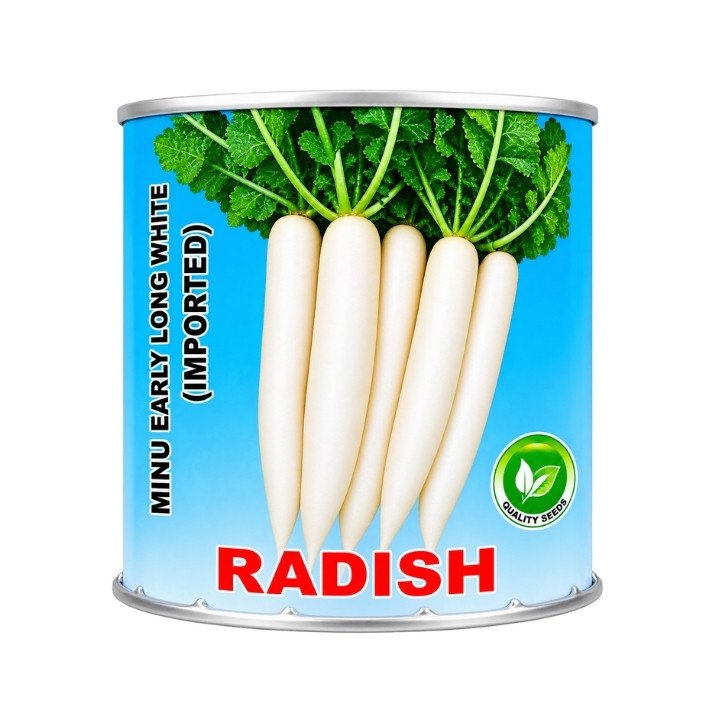
Shulabh Minu Early Long White Imported Radish Seeds
Shulabh Minu Early Long White Imported Radish Seeds
Shulabh Minu Early Long White is an imported radish seed variety intended for producing elongated white roots. The product presentation shows smooth, tapering white radishes with healthy green foliage.
Radish is generally established through direct sowing because transplanting can disturb root development. Correct season selection, loose soil, suitable spacing and uniform moisture are important for producing straight and marketable roots.
The exact maturity period, root length, average weight, seed rate and regional sowing window have not been provided. Confirm these variety-specific details from the current seed pack before cultivation.
Shulabh Imported Radish Seed Specifications
| Specification | Details |
|---|---|
| Product Name | Shulabh Minu Early Long White Imported Radish Seeds |
| Brand | Shulabh Seeds |
| Variety Name | Minu Early Long White |
| Crop | Radish |
| Product Type | Vegetable seed |
| Seed Classification | Imported radish seed; hybrid status not confirmed |
| Root Type | Long and tapering, based on the product presentation |
| Root Colour | White |
| Root Length | Not specified |
| Maturity | Not confirmed in the supplied information |
| Sowing Method | Direct sowing |
| Recommended Season | Follow the regional sowing window printed on the current pack |
| Seed Rate | Follow the current Shulabh seed-pack recommendation |
| Pack Size | Check the selected pack and printed label |
| Primary Use | Fresh-market and suitable garden-scale radish production |
Key Product Features
- Imported Variety: Identified on the product presentation as an imported radish selection.
- Long White Roots: Pack presentation shows elongated, tapering white radishes.
- Early-Type Name: Marketed under the name Miinu Early Long White.
- Direct-Sown Crop: Suitable for direct field or garden-bed sowing.
- Fresh-Market Type: Long white roots are suitable for fresh vegetable markets and household consumption.
- Multiple Cultivation Scales: Can be grown commercially or in suitable kitchen gardens.
Important Variety Information
The supplied product image does not confirm the variety’s exact root length, diameter, maturity, pungency, bolting tolerance, disease resistance, seed rate or suitable temperature range. These characteristics should not be advertised unless stated on the current Shulabh seed pack or official technical literature.
General Growing Information
| Growing Parameter | General Recommendation |
|---|---|
| Sowing Method | Direct sowing in prepared beds or rows |
| Sowing Depth | Sow shallowly according to the instructions printed on the seed pack |
| Planting Season | Follow the regional season recommended for this variety |
| Soil | Deep, loose, fertile and well-drained soil free from stones and hard clods |
| Spacing | Follow regional recommendations based on the variety’s root size |
| Thinning | Thin crowded seedlings early to support uniform root development |
| Irrigation | Maintain uniform soil moisture while avoiding prolonged waterlogging |
| Nutrition | Use a soil-test-based fertilizer programme and avoid excessive nitrogen |
| Harvesting | Harvest when roots reach the preferred size and remain tender |
Growing note: The recommendations above are general radish-cultivation guidance rather than confirmed Miinu Early Long White variety specifications. Give priority to the current seed-pack instructions.
Soil and Field Preparation
- Select deep and well-drained soil suitable for long-rooted radish.
- Remove stones, undecomposed crop residues and hard soil clods.
- Prepare a fine and loose seedbed to support straight root development.
- Avoid compacted soil, which may cause short, forked or misshapen roots.
- Use only well-decomposed organic manure.
- Form raised beds or ridges where drainage is a concern.
- Level the sowing area to support uniform irrigation and emergence.
Direct-Sowing Method
- Select an unopened and properly labelled Shulabh seed pack.
- Prepare loose, fine and sufficiently deep soil.
- Mark rows according to the recommended spacing.
- Sow the seeds directly at the depth stated on the pack.
- Cover the seeds lightly with fine soil.
- Irrigate gently to avoid washing away or exposing the seeds.
- Maintain suitable moisture until seedlings emerge.
- Thin crowded seedlings while they are young.
- Retain healthy plants at the recommended spacing.
Crop-Management Tips
- Maintain consistent soil moisture throughout root development.
- Avoid alternating severe dryness with heavy irrigation.
- Remove weeds early to reduce competition and root disturbance.
- Carry out shallow weeding to avoid injuring developing radish roots.
- Avoid excessive nitrogen, which may encourage foliage at the expense of roots.
- Do not apply fresh or undecomposed manure immediately before sowing.
- Harvest at the correct stage to maintain tenderness and market quality.
Common Causes of Poor Root Development
| Problem | Possible Cause | Preventive Measure |
|---|---|---|
| Forked Roots | Stones, compacted soil, fresh manure or root injury | Prepare deep, loose soil and use well-decomposed manure |
| Small Roots | Crowding, poor fertility, unsuitable season or moisture stress | Thin seedlings and maintain balanced nutrition and irrigation |
| Spongy or Pithy Roots | Delayed harvesting, high temperature or excessive maturity | Harvest promptly at the recommended stage |
| Cracked Roots | Irregular irrigation or sudden moisture changes | Maintain uniform soil moisture |
| Excessive Leaf Growth | Too much nitrogen or unsuitable growing conditions | Use balanced fertilizers and the correct seasonal window |
Pest and Disease Monitoring
- Monitor seedlings and leaves for flea beetles and other chewing pests.
- Inspect tender foliage for aphids and sucking insects.
- Check roots for soil insects and locally important root pests.
- Observe the crop for damping-off, leaf spots and root diseases.
- Avoid excessive irrigation and prolonged waterlogging.
- Maintain field sanitation and remove severely affected plants.
- Use only registered crop-protection products according to their labels.
Harvesting and Post-Harvest Guidance
Harvest radishes when the roots reach the preferred market size and remain tender. Delayed harvesting can lead to pithiness, excessive pungency, cracking or deterioration in eating quality.
Loosen the soil before pulling long roots to reduce breakage. Remove damaged roots, clean the produce carefully and keep it shaded after harvesting. Market or cool the roots promptly to preserve freshness.
Why Choose Shulabh Miinu Early Long White?
- Imported long white radish seed selection.
- Distinct Miinu Early Long White variety identity.
- Pack presentation shows attractive elongated white roots.
- Suitable for direct-sown radish cultivation.
- Can be used for commercial fresh-market production during the recommended season.
- Suitable for kitchen gardens where adequate soil depth is available.
Frequently Asked Questions
What type of radish does this variety produce?
The product presentation shows long, tapering white radish roots.
Is Miinu Early Long White an imported variety?
Yes. The product presentation identifies it as “Miinu Early Long White (Imported).”
Is it an F1 hybrid?
The supplied image does not confirm F1 hybrid status. Do not describe it as a hybrid unless this is stated on the current seed pack.
How many days does it take to mature?
A variety-specific maturity period has not been supplied. Confirm the expected maturity from the current Shulabh seed pack.
What is the average root length?
The exact root length has not been confirmed. Root development also depends on soil depth, spacing, season, irrigation and crop management.
Should radish be transplanted?
Direct sowing is generally recommended because transplanting can disturb the taproot and lead to forked or misshapen roots.
What is the recommended seed rate?
Use the seed rate printed on the current seed pack. The required quantity depends on germination, row spacing and desired plant population.
Which season is suitable for sowing?
Follow the regional sowing window printed on the current product pack. Temperature influences root development, pungency, pithiness and bolting.
Does this variety have disease resistance?
No specific disease-resistance claim has been confirmed. Do not advertise resistance unless it appears on the current pack or official technical literature.
Disclaimer: The information provided is for general guidance only. Crop performance depends on seed quality, soil, season, irrigation and cultivation practices. Always follow the instructions stated on the current seed pack.Similar Products
Best Selling
Customer Reviews
Recent Reviews
No reviews yet.