

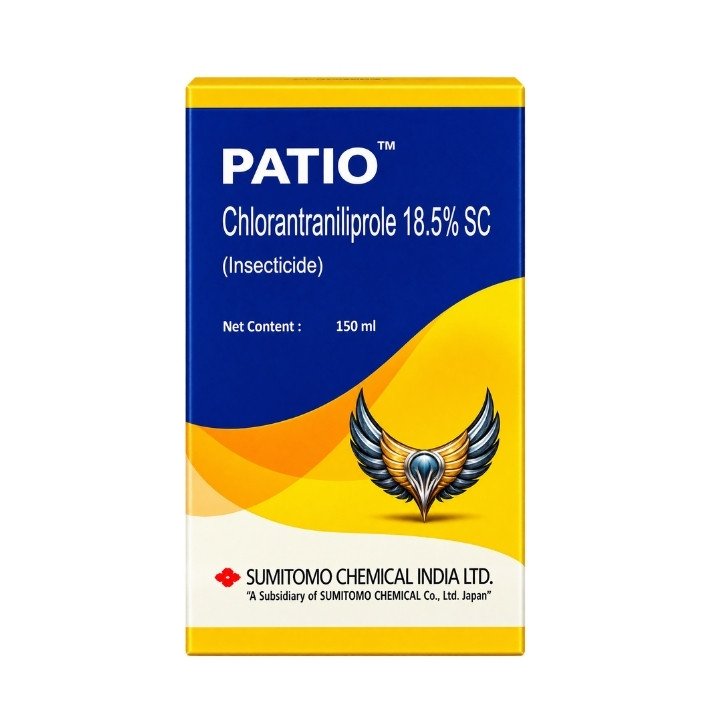
Sumitomo Patio Insecticide - Chlorantraniliprole 18.5% SC
Sumitomo Patio Chlorantraniliprole 18.5% SC Insecticide
Sumitomo Patio is an anthranilic-diamide insecticide containing Chlorantraniliprole 18.5% SC. It is formulated for the management of labelled caterpillars, stem borers, fruit borers, leaf folders and other lepidopteran pests in agricultural crops.
Patio acts mainly through ingestion and contact activity. It causes rapid feeding cessation in susceptible larvae, helping limit further crop damage. Its translaminar movement supports protection of treated leaf surfaces when the spray is applied thoroughly and at the correct pest stage.
Important: The product image shows a net content of 150 ml. Pack size, crop registrations and application directions should always be confirmed from the label on the supplied pack.
Sumitomo Patio Product Specifications
| Specification | Details |
|---|---|
| Product Name | Sumitomo Patio Insecticide |
| Brand | Sumitomo Chemical |
| Manufacturer | Sumitomo Chemical India Ltd. |
| Technical Name | Chlorantraniliprole 18.5% SC |
| Formulation | Suspension Concentrate (SC) |
| Product Type | Agricultural insecticide |
| Chemical Group | Anthranilic diamide |
| IRAC Classification | Group 28 – Ryanodine receptor modulator |
| Activity | Contact and stomach action with translaminar movement |
| Primary Pest Group | Caterpillars, borers and other labelled lepidopteran larvae |
| Application Method | Foliar spray; crop-specific soil application only when stated on the label |
| Pack Size Shown | 150 ml |
Technical Composition
| Component | Concentration |
|---|---|
| Chlorantraniliprole active ingredient | 18.5% w/w |
| Formulation ingredients | Quantity sufficient to make the suspension concentrate formulation |
How Sumitomo Patio Works
Chlorantraniliprole activates ryanodine receptors in the muscle cells of susceptible insects. This disturbs the regulated release of calcium within the muscles, resulting in rapid feeding cessation, lethargy, paralysis and eventual death of the target insect.
Larvae normally stop feeding before they die. Therefore, reduced feeding damage may be observed before dead insects become clearly visible on the crop. Application against eggs or young larvae generally provides better protection than spraying after mature borers have entered stems, shoots or fruits.
Key Features and Benefits
- Rapid feeding cessation: Susceptible larvae stop damaging the crop soon after receiving an effective exposure.
- Borer and caterpillar management: Controls labelled stem borers, fruit borers, bollworms, pod borers and leaf-feeding larvae.
- Translaminar movement: Helps the active ingredient move across treated leaf tissue for improved coverage.
- Effective at low application rates: Crop-specific doses are generally measured in millilitres per acre.
- SC formulation: A liquid suspension concentrate that can be measured and dispersed in water.
- Residual protection: Supports continued protection for a period influenced by crop growth, pest pressure, weather and spray quality.
- Crop protection: Timely control helps preserve foliage, shoots, flowers, fruits, pods and other economically important crop parts.
Crop, Target Pest and Reference Dose
The following table presents commonly registered recommendations for Chlorantraniliprole 18.5% SC in India. Use a recommendation only when the same crop, pest and dose appear on the current Patio pack label.
| Crop | Target Pest | Reference Dose per Acre |
|---|---|---|
| Rice | Stem borer and leaf folder | 60 ml |
| Cabbage | Diamondback moth | 20 ml |
| Cotton | American bollworm, spotted bollworm and tobacco caterpillar | 60 ml |
| Tomato | Fruit borer | 60 ml |
| Chilli | Fruit borer | 60 ml |
| Brinjal | Shoot and fruit borer | 80 ml |
| Pigeon Pea | Pod borer | 60 ml |
| Soybean | Green semilooper and stem fly | 60 ml |
| Bengal Gram | Pod borers | 50 ml |
| Sugarcane | Early shoot borer and top borer | 150 ml |
| Sugarcane | Termite | 200 ml; follow the label-specified application method |
Dosage warning: Do not advertise or apply a universal dose of 60–80 ml per acre. The dose differs significantly by crop, pest and application method. For example, the reference rate ranges from 20 ml per acre in cabbage to 150–200 ml per acre in particular sugarcane uses.
Crops such as maize, okra, cauliflower, black gram, bitter gourd or groundnut should be included only when their use is specifically printed on the current Patio label. Do not extrapolate a dose from another crop.
Application Time
- Begin application when the target pest reaches the locally recommended economic threshold.
- For caterpillars, spray during egg hatching or the early larval stage.
- For borers, apply before larvae enter shoots, stems, fruits, pods or bolls.
- Inspect the lower leaf surface, growing points, flowers and fruiting parts before spraying.
- Spray during early morning or late evening when wind speed is low.
- Avoid spraying immediately before rainfall or during very hot afternoon conditions.
Water Volume and Spray Coverage
Use the water volume printed on the Patio label for the selected crop and application method. Water requirement varies according to crop canopy, equipment, crop stage and method of treatment.
For foliar application, use sufficient clean water to cover the target foliage and pest-harbouring parts uniformly without excessive runoff. A general water volume must not replace the crop-specific label direction.
How to Use Sumitomo Patio
- Confirm that the crop and target pest are listed on the current Patio label.
- Inspect the field and identify the pest and its development stage correctly.
- Calculate the required product quantity according to the labelled dose and treated area.
- Wear the protective clothing and equipment prescribed on the product label.
- Half-fill the spray tank with clean water.
- Measure the required quantity of Patio accurately.
- Add the measured product to the tank while maintaining agitation.
- Add the remaining label-recommended quantity of water.
- Mix thoroughly to obtain a uniform suspension.
- Spray the crop evenly, paying attention to foliage and pest-harbouring areas.
- Maintain agitation during spraying and avoid excessive runoff.
- Use the prepared spray mixture on the same day.
Resistance Management
Chlorantraniliprole belongs to IRAC Group 28. Repeated use of insecticides from the same group can select resistant pest populations. Patio should therefore be used as part of an integrated pest-management and resistance-management programme.
- Do not make more consecutive Group 28 applications than the label permits.
- Rotate with effective insecticides having a different IRAC mode-of-action group.
- Do not use a tank-mix partner merely to compensate for an ineffective or resistant treatment.
- Use the recommended dose; reduced doses may contribute to poor control and resistance selection.
- Combine chemical control with field monitoring, sanitation and suitable biological or cultural practices.
Compatibility and Tank Mixing
Mix Patio with another pesticide or fertilizer only when the labels of all products permit the combination. Conduct a small jar test before preparing an unfamiliar mixture. Avoid combining products that form flakes, sediment, excessive foam, heat or separation.
Safety Precautions
- Read the complete label and leaflet before opening or using the product.
- Wear suitable gloves, protective clothing, footwear and face or eye protection.
- Do not eat, drink, smoke or chew while mixing or spraying.
- Avoid breathing spray mist and prevent contact with skin and eyes.
- Do not spray against the wind.
- Keep people and animals away from the treated field until the label permits re-entry.
- Prevent spray drift or runoff into ponds, streams and other water bodies.
- Avoid direct spray on flowering weeds or crops when bees are actively foraging.
- Observe the crop-specific waiting period stated on the Patio label before harvesting.
- Wash hands, exposed skin, clothing and spraying equipment after use.
Storage and Disposal
- Store in the original container with the cap tightly closed.
- Keep in a cool, dry, locked and well-ventilated pesticide-storage area.
- Protect from direct sunlight, excessive heat and freezing conditions.
- Keep away from children, animals, food, beverages, seed and animal feed.
- Do not transfer the insecticide into food or beverage containers.
- Do not reuse an empty pesticide container for any household purpose.
- Dispose of empty packaging and leftover material according to the label and applicable regulations.
Why Farmers Can Choose Sumitomo Patio
- Contains Chlorantraniliprole 18.5% SC.
- Belongs to the anthranilic-diamide insecticide group.
- Provides rapid feeding cessation in susceptible larvae.
- Useful against several economically important caterpillars and borers.
- Offers contact, ingestion and translaminar activity.
- Suitable for resistance-management programmes when rotated correctly.
- Available in the 150 ml pack shown in the supplied product image.
Frequently Asked Questions
What is Sumitomo Patio used for?
Patio is used to control label-approved caterpillars and borers such as rice stem borer, leaf folder, diamondback moth, fruit borer, shoot and fruit borer, pod borer and bollworms.
What is the technical content of Patio?
It contains Chlorantraniliprole 18.5% SC, an anthranilic-diamide insecticide classified under IRAC Group 28.
What is the dose of Patio per acre?
Patio does not have one universal dose for every crop. Reference rates for Chlorantraniliprole 18.5% SC range from 20 ml per acre in cabbage to 150–200 ml per acre for particular sugarcane uses. Follow the crop-and-pest recommendation printed on the supplied Patio label.
What is the Patio dose for rice?
The commonly registered reference rate for Chlorantraniliprole 18.5% SC against rice stem borer and leaf folder is 60 ml per acre. Confirm the recommendation and water volume on the Patio pack before application.
What is the Patio dose for tomato and chilli?
The reference rate against fruit borer in tomato or chilli is 60 ml per acre. Use it only when the crop, pest and dose appear on the current label.
What is the Patio dose for brinjal?
The reference rate against brinjal shoot and fruit borer is 80 ml per acre. Apply against young larvae before extensive shoot or fruit penetration.
How quickly does Patio work?
Susceptible insects generally stop feeding soon after effective exposure. Visible death may take longer, but feeding cessation helps limit additional crop injury.
Is Patio a systemic insecticide?
Chlorantraniliprole 18.5% SC provides contact and stomach activity with translaminar movement through treated leaf tissue. Its movement and performance depend on the application method, crop and coverage, so it should not be described as fully systemic in every use situation.
Can Patio be used against adult insects or sucking pests?
Patio is primarily intended for the labelled larval stages of caterpillars and borers. Do not use it as a general treatment for unrelated sucking pests unless the target pest is specifically included on the label.
Can Patio be mixed with fertilizers or fungicides?
Tank mixing should be done only when all relevant product labels permit it. Conduct a small compatibility test and obtain expert advice before combining unfamiliar products.
What is the waiting period after application?
The pre-harvest interval differs by crop and registered use. Follow the waiting period printed on the current Patio label rather than applying one general interval to every crop.
Regulatory disclaimer: The information provided here is for general product guidance. Pesticide registrations, approved crops, doses, application methods and waiting periods may be updated or may differ between marketed labels. Always follow the current container label and accompanying leaflet. Use pesticides only for approved crops and target pests and under the guidance of a qualified agricultural professional.
Similar Products

Best Selling

Customer Reviews
Recent Reviews
No reviews yet.