

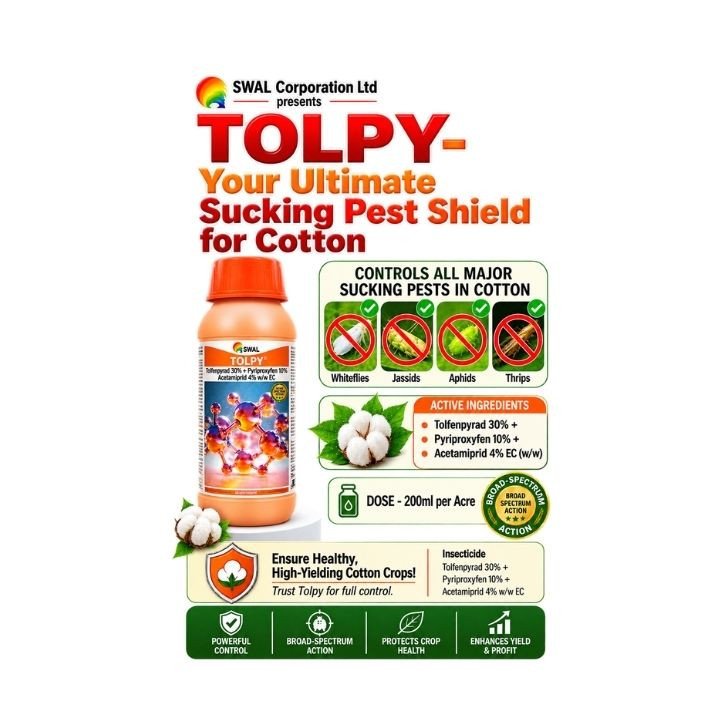
Swal Tolpy Insecticide - Tolfenpyrad 30% + Pyriproxyfen 10% + Acetamiprid 4% EC
SWAL TOLPY Insecticide
SWAL TOLPY is a multi-active agricultural insecticide formulated with Tolfenpyrad 30% + Pyriproxyfen 10% + Acetamiprid 4% EC (w/w). It is designed to provide broad-spectrum management of important sucking insect pests in cotton.
According to the supplied product information, TOLPY targets major cotton sucking pests including Whitefly, Jassids, Aphids and Thrips. Its combination of three insecticidal active ingredients provides multiple modes of action against different stages and physiological systems of susceptible insect pests.
The supplied product graphic recommends a dose of 200 ml per acre for the stated cotton application. Always verify the latest registered product label and leaflet before spraying.
Product Specifications
| Brand | SWAL |
| Product Name | TOLPY |
| Product Category | Insecticide |
| Formulation | EC – Emulsifiable Concentrate |
| Active Ingredient 1 | Tolfenpyrad 30% |
| Active Ingredient 2 | Pyriproxyfen 10% |
| Active Ingredient 3 | Acetamiprid 4% |
| Complete Composition | Tolfenpyrad 30% + Pyriproxyfen 10% + Acetamiprid 4% EC (w/w) |
| Primary Crop | Cotton – As shown in supplied product information |
| Target Pests | Whitefly, Jassids, Aphids & Thrips |
| Recommended Dose | 200 ml/Acre – As shown in supplied product information |
| Application | Foliar Spray |
| Manufacturer / Brand Owner | SWAL Corporation Ltd. |
Key Features & Benefits
- Three Active Ingredients: Combines Tolfenpyrad, Pyriproxyfen and Acetamiprid in a single insecticide formulation.
- Broad-Spectrum Sucking Pest Control: Designed for management of important sucking pests such as whitefly, jassids, aphids and thrips in cotton.
- Multiple Modes of Action: The three active ingredients affect insects through different biological target sites.
- Different Life-Stage Activity: Pyriproxyfen acts as an insect growth regulator, complementing the adult and feeding-stage activity provided by the other active ingredients.
- Strong Cotton Protection: Helps protect crop foliage and developing cotton plants from damage caused by sucking insects when used at the correct pest stage.
- Resistance-Management Advantage: A premix containing different modes of action can form part of a properly designed resistance-management program when used according to the label.
- Single-Spray Convenience: Provides multiple insecticidal mechanisms in one formulated product.
- Commercial Cotton Application: Designed for crop-protection programs where major sucking pest complexes occur.
Target Pests in Cotton
| Target Pest | Crop |
|---|---|
| Whitefly | Cotton |
| Jassids | Cotton |
| Aphids | Cotton |
| Thrips | Cotton |
How TOLPY Works
TOLPY combines three insecticidal active ingredients with different modes of action:
1. Tolfenpyrad
Tolfenpyrad belongs to IRAC Group 21A. It acts as a mitochondrial complex-I electron transport inhibitor. By interfering with cellular energy production in susceptible insects, it disrupts normal physiological activity and results in insect mortality.
2. Pyriproxyfen
Pyriproxyfen belongs to IRAC Group 7C and functions as a juvenile hormone receptor modulator. It interferes with normal insect growth and development, making it particularly useful as part of a program targeting immature pest stages.
3. Acetamiprid
Acetamiprid belongs to the neonicotinoid Group 4A. It acts on nicotinic acetylcholine receptors in the insect nervous system. It has systemic/translaminar characteristics and contact and ingestion activity.
Triple Mode of Action
The combination of these three active ingredients provides complementary activity:
- Tolfenpyrad: Disrupts cellular energy production.
- Pyriproxyfen: Interferes with insect growth and development.
- Acetamiprid: Acts on the insect nervous system.
This multi-site approach provides broad activity against susceptible sucking pests when the product is used according to the approved label.
Benefits Against Whitefly
Whiteflies can damage cotton by removing plant sap and weakening crop growth. Heavy infestations may also lead to honeydew deposition and related crop-quality problems.
TOLPY combines adult/feeding-stage insecticidal activity with an insect growth regulator component, providing a multi-active approach for whitefly management.
Benefits Against Jassids
Jassids feed by sucking plant sap from cotton foliage. High populations can cause leaf yellowing, curling and reduced plant vigour. Timely insecticide application helps prevent sucking-pest populations from causing severe crop stress.
Benefits Against Aphids
Aphids commonly colonize tender plant growth and remove sap from the crop. TOLPY is promoted for aphid management in cotton as part of its broad sucking-pest spectrum.
Benefits Against Thrips
Thrips feed on tender plant tissues and can affect early crop development. Regular scouting is important so that applications are made according to economic pest pressure and current label recommendations.
Recommended Dose
| Crop | Target Pests | Dose |
|---|---|---|
| Cotton | Whitefly, Jassids, Aphids & Thrips | 200 ml/Acre* |
*The 200 ml/acre dose is stated on the supplied TOLPY promotional image. Always verify the current original bottle label and leaflet before application because registered recommendations can be updated.
Method of Application
- Inspect the cotton crop and confirm the target sucking pest.
- Measure the recommended amount of TOLPY according to the current label.
- Fill the spray tank partly with clean water.
- Add the measured insecticide to the tank.
- Agitate or mix thoroughly.
- Add the remaining required quantity of water.
- Apply uniformly over the crop using suitable spraying equipment.
- Ensure sufficient coverage of foliage where sucking pests are present.
Best Time for Application
- Monitor the crop regularly for sucking pest populations.
- Apply when the target pest reaches the action threshold recommended for the crop.
- Avoid waiting until severe pest damage has already occurred.
- Apply during suitable weather conditions.
- Avoid spraying during strong winds.
- Follow the current product label regarding rain, re-entry and harvest interval requirements.
Resistance Management
TOLPY contains active ingredients from different insecticide mode-of-action groups. However, resistance-management practices are still important to maintain long-term product effectiveness.
- Do not make unnecessary insecticide applications.
- Follow the maximum number of applications stated on the product label.
- Rotate subsequent sprays with effective insecticides from appropriate different mode-of-action groups.
- Avoid repeated reliance on the same active ingredient groups throughout the crop season.
- Combine chemical control with cultural and biological pest-management practices.
- Monitor pest populations after treatment.
Integrated Pest Management
TOLPY should be used as one component of an Integrated Pest Management program wherever practical.
- Regularly scout cotton fields.
- Monitor whitefly, jassid, aphid and thrips populations.
- Maintain field sanitation.
- Control alternate weed hosts where appropriate.
- Avoid unnecessary insecticide sprays.
- Conserve beneficial insects wherever possible.
- Rotate insecticide modes of action.
- Follow local economic-threshold recommendations.
Advantages of a Three-Way Combination
- Combines three insect-control mechanisms.
- Targets a broad sucking-pest complex.
- Includes an insect growth regulator component.
- Includes nervous-system and energy-metabolism insecticidal activity.
- Reduces the need to separately tank-mix three individual active ingredients.
- Provides a convenient premixed formulation.
Safety Precautions
- For agricultural use only.
- Read the complete original product label before use.
- Wear suitable protective clothing, gloves and other recommended PPE during mixing and spraying.
- Avoid inhaling spray mist.
- Avoid contact with skin and eyes.
- Do not eat, drink or smoke while handling pesticides.
- Wash hands and exposed skin thoroughly after use.
- Keep children and animals away from the pesticide.
- Do not contaminate food, animal feed or drinking-water sources.
Environmental Precautions
- Prevent pesticide spray or concentrate from entering ponds, canals and other water bodies.
- Avoid unnecessary spray drift.
- Follow all pollinator and beneficial-insect precautions printed on the label.
- Do not reuse empty pesticide containers.
- Dispose of empty containers according to applicable pesticide regulations.
Storage Instructions
- Store in the original labelled container.
- Keep the container tightly closed.
- Store in a cool, dry and well-ventilated place.
- Protect from direct sunlight and excessive heat.
- Keep away from food and animal feed.
- Keep out of reach of children and animals.
Why Choose SWAL TOLPY?
- Three Active Ingredients: Tolfenpyrad + Pyriproxyfen + Acetamiprid.
- Sucking Pest Shield: Promoted for major cotton sucking pests.
- Whitefly Control: Targets one of the important sucking pests of cotton.
- Jassid Control: Helps manage damaging jassid populations.
- Aphid Control: Suitable for aphid management according to the supplied label information.
- Thrips Control: Provides activity against thrips in the labelled cotton application.
- Multiple Modes of Action: Combines insect growth, respiration and nervous-system target sites.
- Convenient Premix: Three active ingredients supplied in a single EC formulation.
Frequently Asked Questions
What is SWAL TOLPY?
SWAL TOLPY is a multi-active insecticide formulated for control of major sucking insect pests in cotton.
What is the technical composition of TOLPY?
TOLPY contains Tolfenpyrad 30% + Pyriproxyfen 10% + Acetamiprid 4% EC (w/w).
Which crop is shown for TOLPY?
The supplied product promotional information specifically identifies cotton.
Which pests does TOLPY control?
The supplied product information lists Whitefly, Jassids, Aphids and Thrips as target sucking pests in cotton.
What is the dose of TOLPY per acre?
The supplied product image states a dose of 200 ml per acre. Always verify this against the current registered bottle label before spraying.
What is the role of Tolfenpyrad in TOLPY?
Tolfenpyrad belongs to IRAC Group 21A and interferes with mitochondrial energy production in susceptible insects.
What is the role of Pyriproxyfen?
Pyriproxyfen is an insect growth regulator classified in IRAC Group 7C. It interferes with normal insect development.
What is the role of Acetamiprid?
Acetamiprid is a Group 4A neonicotinoid insecticide that acts on the insect nervous system and has systemic/translaminar properties.
Is TOLPY suitable for whitefly?
Yes. Whitefly is specifically shown as one of the target pests on the supplied TOLPY promotional material.
Can TOLPY control jassids?
Yes. Jassids are listed among the cotton sucking pests targeted by TOLPY.
Can TOLPY control aphids and thrips?
Yes. Both aphids and thrips are listed on the supplied product information.
Is TOLPY a systemic insecticide?
The formulation contains Acetamiprid, which has systemic and translaminar characteristics. The complete product should nevertheless be described and used according to its registered label.
What does EC mean?
EC means Emulsifiable Concentrate, a liquid pesticide formulation that is diluted with water before spraying according to label instructions.
Disclaimer
The above information is based on the supplied SWAL TOLPY product material and technical mode-of-action references. Crop registrations, pest claims, dosage, spray-water volume, application interval, pre-harvest interval and safety requirements must always be confirmed from the latest original SWAL TOLPY label and leaflet before application. Use pesticides only on registered crops and target pests.
Similar Products
Best Selling
Customer Reviews
Recent Reviews
Happy with this item, planning to reorder later.
Good experience for home delivery.
Genuine product, happy with this order.
Happy with delivery speed and quality.
Delivery fast thi.
Service best thi.
Product expected time ke andar pahunch gaya.