

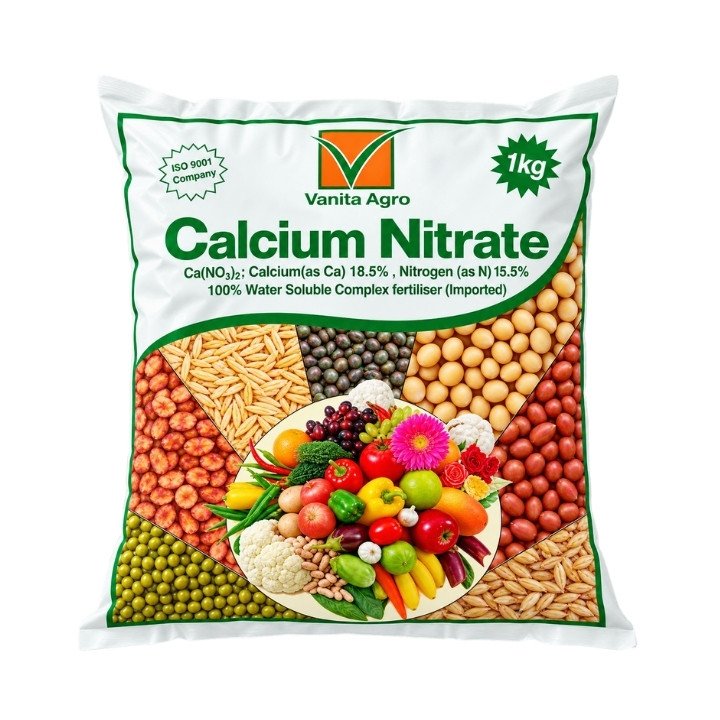
Vanita Agro Calcium Nitrate Water-Soluble Fertilizer
Vanita Agro Calcium Nitrate is a 100% water-soluble complex fertilizer containing 18.5% calcium and 15.5% nitrogen. It supplies readily usable nitrate nitrogen together with calcium for balanced vegetative growth, cell-wall development and crop-quality support.
Calcium is important for the formation and stability of plant cell walls and membranes. Nitrogen supports chlorophyll formation, protein synthesis and active vegetative growth. Their combined supply is particularly useful during periods of rapid crop development.
The displayed imported fertilizer is supplied in a 1 kg pack. Use it through only the crops, application methods and doses approved on the current product label or recommended by a qualified agronomist.
Vanita Agro Calcium Nitrate Specifications
| Specification | Details |
|---|---|
| Product Name | Vanita Agro Calcium Nitrate |
| Brand | Vanita Agro |
| Product Category | Water-soluble fertilizer |
| Chemical Name | Calcium nitrate |
| Chemical Formula | Ca(NO3)2 |
| Calcium Content | 18.5% as Ca |
| Nitrogen Content | 15.5% as N |
| Nitrogen Form | Primarily nitrate nitrogen associated with calcium nitrate |
| Solubility | 100% water soluble, as stated on the pack |
| Product Origin | Imported fertilizer |
| Pack Size | 1 kg |
| Suitable Crops | Use on crops permitted by the current product label |
| Application Methods | Fertigation, soil application or foliar spray only according to label directions |
| Recommended Dose | Follow crop stage, water quality and agronomist or label recommendation |
Guaranteed Nutrient Composition
| Nutrient | Declared Content | Role in Crops |
|---|---|---|
| Calcium (Ca) | 18.5% | Supports cell-wall strength, membrane stability, root tips and developing plant tissues |
| Nitrogen (N) | 15.5% | Supports chlorophyll formation, proteins, enzymes and active vegetative growth |
Importance of Calcium in Plants
- Supports the development and strength of plant cell walls.
- Contributes to cell-membrane stability.
- Supports active root tips and newly developing tissues.
- Helps maintain fruit firmness and structural quality.
- Supports uniform crop development during rapid growth.
- Helps reduce calcium-related physiological disorders when calcium deficiency is the underlying cause.
Importance of Nitrate Nitrogen
- Provides a readily available nitrogen source.
- Supports healthy foliage and vegetative development.
- Contributes to chlorophyll and protein formation.
- Supports active metabolic and enzymatic processes.
- Complements balanced crop-nutrition programmes.
Key Features
- Dual Nutrient Supply: Provides calcium and nitrogen in one fertilizer.
- High Calcium Content: Contains 18.5% calcium as Ca.
- Nitrogen Nutrition: Contains 15.5% nitrogen as N.
- Water-Soluble Formulation: Suitable for approved water-based application methods.
- Crop-Quality Support: Helps maintain tissue strength, fruit firmness and produce quality.
- Rapid-Growth Support: Supplies nutrients required by actively developing plant tissues.
- Fertigation Suitability: May be applied through compatible irrigation systems according to label directions.
Potential Benefits
- Supports strong and healthy plant tissues.
- Helps promote active root and shoot development.
- Supports fruit firmness and keeping quality.
- Helps improve crop response where calcium and nitrogen are deficient.
- Supports uniform fruit and vegetable development.
- May help reduce nutritionally related fruit cracking and physiological disorders.
- Supports crop yield and quality potential under balanced nutrition.
Benefit note: Calcium nitrate cannot correct disorders caused by pathogens, insects, salinity, unsuitable temperature, moisture fluctuations or poor pollination. Correct diagnosis is important before application.
Calcium-Deficiency Symptoms
- Death or distortion of young growing points
- Weak, poorly developed new leaves
- Restricted root-tip growth
- Blossom-end rot in susceptible fruiting vegetables
- Tip burn in susceptible leafy vegetables
- Poor fruit firmness or nutritionally related cracking
- Internal tissue breakdown in susceptible crops
Similar symptoms may also result from moisture stress, high salinity, root damage or uneven calcium transport. Soil and plant-tissue analysis is recommended whenever practical.
Suitable Crop Groups
| Crop Group | Example Crops | Expected Nutritional Support |
|---|---|---|
| Vegetables | Tomato, chilli, capsicum, brinjal, okra, cabbage and cauliflower | Supports active growth, fruit firmness and calcium nutrition |
| Cucurbits | Cucumber, watermelon, muskmelon, gourds and pumpkin | Supports developing tissues and fruit-quality potential |
| Fruit Crops | Apple, grapes, citrus, mango, banana, guava and pomegranate | Supports fruit development, firmness and keeping-quality potential |
| Leafy Vegetables | Lettuce, spinach and other compatible leafy crops | Supports young tissue development and calcium nutrition |
| Flowers | Rose, marigold, chrysanthemum and other ornamentals | Supports stem, leaf and flower development |
| Field and Plantation Crops | Use according to crop-specific label or agronomist recommendations | Provides supplementary calcium and nitrate nitrogen |
Crop-use note: The crops above are general examples of calcium-nitrate use rather than confirmed product-label recommendations. Give priority to the current Vanita Agro label.
Recommended Crop Stages
| Crop Stage | Expected Support |
|---|---|
| Early Vegetative Growth | Supports roots, leaves and rapidly dividing tissues |
| After Transplanting | Supports establishment when roots are active and moisture is adequate |
| Pre-Flowering | Supports healthy crop development before the reproductive stage |
| Fruit Setting | Supports developing fruit tissues and calcium supply |
| Fruit Development | Supports firmness, structure and produce-quality potential |
Application Methods
| Method | General Guidance |
|---|---|
| Drip Fertigation | Dissolve separately and inject through a compatible, properly filtered system |
| Soil Application | Apply through a crop-specific irrigation or soil programme as recommended |
| Foliar Spray | Use only at the crop-specific concentration printed on the label |
| Hydroponic Nutrition | Use only as part of a professionally formulated nutrient solution |
General Fertigation Procedure
- Test the irrigation water for pH, bicarbonates and hardness where practical.
- Measure the required calcium nitrate according to the crop recommendation.
- Dissolve the fertilizer completely in a clean stock-solution tank.
- Do not prepare the concentrated stock solution with phosphate- or sulphate-containing fertilizers.
- Filter the solution before injection into the drip system.
- Begin irrigation with clean water to wet the root zone.
- Inject the fertilizer uniformly during the middle part of irrigation.
- Flush the irrigation lines with clean water after application.
General Foliar-Spray Procedure
- Use foliar application only when it is recommended for the crop.
- Measure the exact label-approved concentration.
- Dissolve the fertilizer completely in clean water.
- Test the solution on a small crop area before large-scale application.
- Spray during the early morning or late evening.
- Avoid application during extreme heat, strong wind or moisture stress.
- Apply a fine, uniform spray without excessive runoff.
Critical Compatibility Information
Calcium nitrate can react with sulphates and phosphates in concentrated solutions, forming insoluble precipitates. These deposits can reduce nutrient availability and block filters, emitters or spray nozzles.
| Input Group | Compatibility Guidance |
|---|---|
| Phosphate Fertilizers | Keep concentrated stock solutions separate |
| Sulphate Fertilizers | Keep concentrated stock solutions separate |
| MKP or MAP | Do not combine directly in the same concentrated stock tank |
| Magnesium Sulphate | Apply through a separate stock tank or separate fertigation event |
| Potassium Sulphate | Avoid direct concentrated mixing with calcium nitrate |
| Pesticides | Mix only when label compatibility is confirmed and a jar test is satisfactory |
In professional fertigation systems, calcium nitrate is commonly placed in a separate “A” stock tank, while phosphates and sulphates are kept in a separate “B” tank.
Best Crop-Nutrition Practices
- Base the dose on crop stage, water quality and soil or tissue analysis.
- Split applications may provide a steadier nutrient supply than one excessive dose.
- Maintain consistent irrigation because calcium movement depends heavily on water flow.
- Avoid prolonged waterlogging and severe root-zone drying.
- Balance calcium nitrate with potassium, phosphorus, magnesium and micronutrients.
- Account for the 15.5% nitrogen when calculating the total nitrogen programme.
- Do not use calcium nitrate as the sole fertilizer for the crop.
Safety Precautions
- Read and follow the complete product label before use.
- Wear gloves, protective clothing, eye protection and a dust mask while handling.
- Avoid inhaling fertilizer dust.
- Avoid contact with the skin and eyes.
- Do not eat, drink or smoke during handling and application.
- Wash hands and exposed skin thoroughly after use.
- Keep the fertilizer away from combustible materials and incompatible chemicals.
- Keep children and animals away from the product and application area.
Storage Instructions
- Store in the original, tightly sealed and properly labelled pack.
- Keep in a cool, dry and well-ventilated location.
- Protect the fertilizer from moisture because it can absorb water from the air.
- Keep away from heat, direct sunlight and incompatible chemicals.
- Store separately from food, medicines and animal feed.
- Close the pack immediately after removing the required quantity.
- Keep securely out of reach of children and animals.
Frequently Asked Questions
What is the composition of Vanita Agro Calcium Nitrate?
It contains 18.5% calcium as Ca and 15.5% nitrogen as N.
What is the pack size?
The displayed pack contains 1 kg.
Is it completely water soluble?
Yes. The product pack describes it as a 100% water-soluble complex fertilizer.
What is the recommended dose?
A verified numerical dose has not been supplied. Follow the crop stage, application method and dosage printed on the current label or recommended by an agronomist.
Can calcium nitrate prevent blossom-end rot?
It supports calcium nutrition and may help where calcium deficiency is the cause. Blossom-end rot can still occur because of irregular irrigation, salinity, root damage or poor calcium transport.
Can calcium nitrate be used as a foliar spray?
It may be applied foliarly only at a crop-safe and label-approved concentration. Excessive concentration can scorch leaves.
Can it be mixed with MKP or MAP?
Do not mix calcium nitrate directly with MKP, MAP or other phosphate fertilizers in the same concentrated stock solution because precipitation may occur.
Can it be mixed with magnesium sulphate?
Keep calcium nitrate and magnesium sulphate in separate concentrated stock tanks or apply them separately because calcium can react with sulphate.
Does it replace all NPK fertilizers?
No. It supplies calcium and nitrogen but does not supply the crop’s complete requirement for phosphorus, potassium and other nutrients.
Does it guarantee that fruits will not crack?
No. Calcium supports fruit structure, but cracking can also result from irregular irrigation, variety, weather, salinity, pests or disease.
Disclaimer: This information is provided for general guidance only. Always follow the guaranteed composition, dosage, approved application methods, compatibility precautions and safety instructions printed on the current product label.Similar Products



Best Selling






Customer Reviews
Recent Reviews
Product ne satisfying results diye.
Order quickly aur efficiently process ho gaya.
Good experience for a first-time buyer.