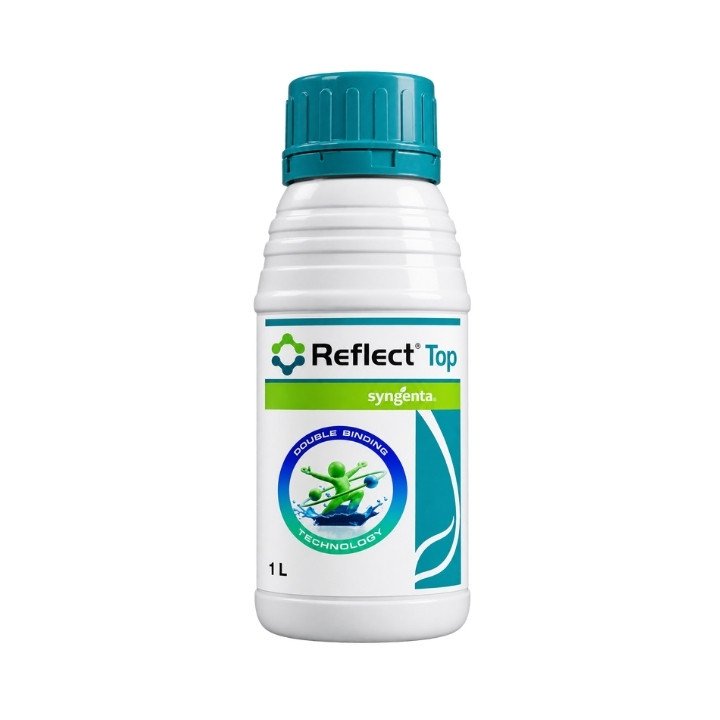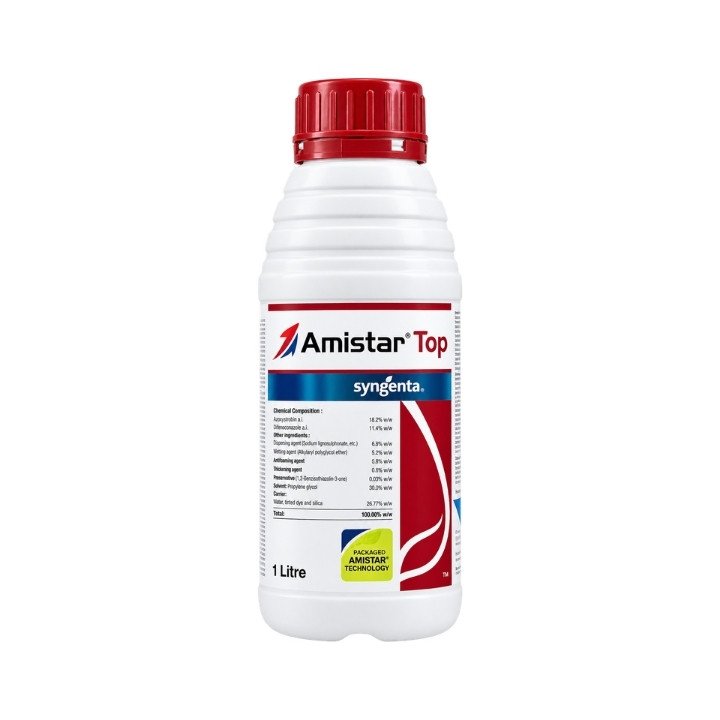
Few fungicides carry a registration list as extensive as Amistar Top's — chilli, tomato, paddy, maize, wheat, cotton, turmeric, onion, sugarcane, groundnut, black gram, soybean, coffee, and banana all appear on Syngenta's official label. Built on Azoxystrobin 18.2% and Difenoconazole 11.4% in a systemic SC formulation, powered by what Syngenta calls Proven Amistar technology, the product's real complexity isn't in its chemistry alone — it's in how differently the same dose behaves depending on which crop it's applied to.
That complexity shows up most clearly in the pre-harvest waiting periods. Chilli and tomato clear in just 5 days, while sugarcane requires a striking 265-day wait before harvest — a gap that reflects how differently residue clears across crop types with vastly different growth cycles, not any inconsistency in the product itself.
| Detail | Specification |
|---|---|
| Brand | Syngenta |
| Product Name | Amistar Top |
| Technical Content | Azoxystrobin 18.2% + Difenoconazole 11.4% w/w SC |
| Mode of Entry | Systemic |
| Toxicity Classification | Blue (Caution) |
| Technology Platform | Proven Amistar Technology |
Amistar Top's label spans an unusually wide disease category range — blights, mildews, rusts, leaf spots, rots, smut, and blast, which together account for most of the yield-limiting fungal pressure Indian farmers deal with across field crops, vegetables, spices, and even plantation crops like coffee and banana.
| Disease Category | Specific Diseases |
|---|---|
| Blights | Early Blight, Late Blight, Blight, Stemphylium Blight |
| Mildews | Powdery Mildew, Downy Mildew, Grey Mildew |
| Rusts | Rust |
| Rots | Red Rot, Rhizome Rot |
| Other Diseases | Anthracnose, Blast, Sheath Blight, Leaf Spot, Leaf Blotch, Purple Blotch, Smut, Tikka Leaf Spot, Yellow Sigatoka |
What's immediately noticeable is that the per-acre formulation quantity stays fixed at 200 ml for nearly every crop — the real variation lies in dilution water volume and, more importantly, the waiting period before harvest.
| Crop | Target Disease | Dose per Acre | Water Dilution | Per Litre Rate | Waiting Period |
|---|---|---|---|---|---|
| Chilli | Anthracnose, Powdery Mildew | 200 ml | 200 L | 1 ml | 5 days |
| Tomato | Early Blight, Late Blight | 200 ml | 200 L | 1 ml | 5 days |
| Onion | Purple Blotch, Stemphylium Blight, Downy Mildew | 200 ml | 200 L | 1 ml | 7 days |
| Cotton | Leaf Spot, Grey Mildew | 200 ml | 200 L | 1 ml | 12 days |
| Soybean | Leaf Spot, Rust | 200 ml | 200 L | 1 ml | 16 days |
| Black Gram | Leaf Spot, Powdery Mildew | 200 ml | 200 L | 1 ml | 23 days |
| Maize | Blight, Downy Mildew | 200 ml | 200 L | 1 ml | 26 days |
| Paddy (Rice) | Blast, Sheath Blight | 200 ml | 200 L | 1 ml | 31 days |
| Wheat | Rust, Powdery Mildew | 200 ml | 200 L | 1 ml | 35 days |
| Groundnut | Tikka Leaf Spot, Rust | 200 ml | 200 L | 1 ml | 46 days |
| Banana | Yellow Sigatoka Disease | 400 ml | 200 L | 2 ml | 57 days |
| Turmeric | Leaf Blotch, Leaf Spot, Rhizome Rot | 200 ml | 200 L | 1 ml | 60 days |
| Coffee | Rust Disease | 200 ml | 400 L | 0.5 ml | 62 days |
| Sugarcane | Red Rot, Smut, Rust | 200 ml | 160 L | 1.25 ml | 265 days |
Two crops break the standard pattern worth flagging specifically: banana doubles the formulation quantity to 400 ml per acre for yellow Sigatoka management, while coffee uses double the water dilution (400 L instead of 200 L), which halves its effective per-litre concentration to just 0.5 ml. Sugarcane's near year-long waiting period is by far the outlier in this table and needs to be planned around from the very first application, not discovered near harvest time.
A useful thing to notice in this table: the "200 ml per acre" figure looks identical across most crops, but the actual concentration a plant is exposed to depends on how much water it's diluted into. Coffee's 400 L dilution against the same 200 ml dose effectively delivers a much weaker spray concentration than chilli's 200 L dilution — this isn't an error, it reflects coffee's different canopy structure and spray coverage requirements compared to a low-growing vegetable crop.
Apply Amistar Top as a foliar spray using the recommended crop-wise dose and water volume, using a knapsack, battery, or power sprayer suited to achieving uniform canopy coverage. Timing should follow the specific crop and disease condition being managed — the product's broad-spectrum, long duration profile gives some flexibility, but earlier intervention at first disease sign generally produces better outcomes than waiting.
Why is sugarcane's waiting period so dramatically longer than every other crop on this label?
Sugarcane's extended crop cycle and the specific residue clearance profile for red rot, smut, and rust management on this crop result in a considerably longer waiting period of 265 days compared to shorter-cycle crops like chilli or tomato.
Why does banana use 400 ml per acre when most other crops use 200 ml?
Yellow Sigatoka disease management in banana requires a higher formulation quantity, reflecting the specific disease pressure and canopy characteristics of banana plantations.
Is the same fungicide strength being applied to coffee as to chilli, since both use 200 ml per acre?
Not quite — coffee's dose is diluted in 400 litres of water versus chilli's 200 litres, meaning coffee actually receives a weaker per-litre concentration (0.5 ml versus 1 ml) despite the identical total formulation quantity.
Can Amistar Top be tank-mixed with other fungicides or insecticides?
It's recommended to consult an agronomist before tank-mixing with other products, since compatibility can vary by combination and local field conditions.
Disclaimer: The details provided are for informational guidance only. Always adhere to the recommended application instructions as stated on the product label and in the accompanying leaflet.
Product ki quality meri expectation se better nikli.
Genuine product hai.
Product time par bina kisi problem ke deliver ho gaya.
Quick response from support.
Happy with delivery speed and quality.
Overall experience five-star wala tha.
Ordering se leke delivery tak experience smooth raha.
Ye product KisanShop se kharid ke khush hoon.
Delivery speed aur quality dono se happy hoon.
KisanShop par ye product choose karke accha laga.