

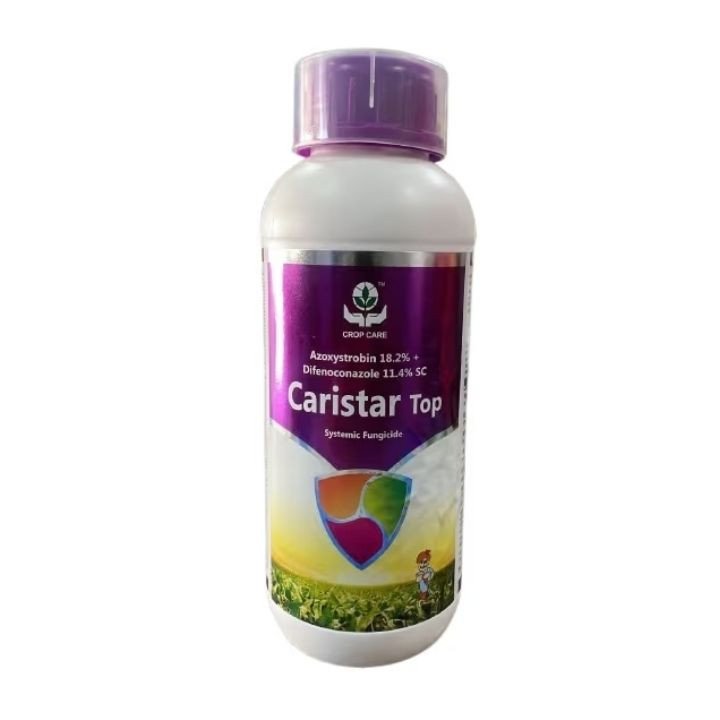
Crop Care Caristar Top Fungicide (Azoxystrobin 18.2% + Difenoconazole 11.4% SC)
Crop Care Caristar Top Fungicide – Azoxystrobin 18.2% + Difenoconazole 11.4% SC
Crop Care Caristar Top Fungicide is a broad-spectrum systemic fungicide containing Azoxystrobin 18.2% + Difenoconazole 11.4% SC. It combines two fungicidal modes of action to help manage important fungal diseases affecting crops such as paddy, chilli, tomato, maize and wheat.
Caristar Top combines the preventive activity of Azoxystrobin with the systemic and curative activity of Difenoconazole. The combination helps inhibit fungal respiration, spore development and sterol biosynthesis, providing complementary protection when applied at the recommended disease stage.
Product Specifications
| Product Name | Caristar Top |
| Brand | Crop Care |
| Company | Crop Care Pesticides India Pvt. Ltd. |
| Product Type | Fungicide |
| Technical Name | Azoxystrobin 18.2% + Difenoconazole 11.4% SC |
| Formulation | Suspension Concentrate (SC) |
| Chemical Groups | Strobilurin + Triazole |
| FRAC Groups | Group 11 + Group 3 |
| Mode of Action | Systemic, Preventive and Curative |
| Application Method | Foliar Spray |
Technical Composition
Azoxystrobin 18.2% + Difenoconazole 11.4% SC
- Azoxystrobin 18.2%: A QoI or strobilurin fungicide belonging to FRAC Group 11. It inhibits mitochondrial respiration in susceptible fungal pathogens.
- Difenoconazole 11.4%: A triazole DMI fungicide belonging to FRAC Group 3. It interferes with sterol biosynthesis required for normal fungal growth and development.
Key Features
- Broad-spectrum systemic fungicide.
- Contains two complementary active ingredients.
- Provides preventive and curative fungicidal activity.
- Helps manage important fungal diseases in paddy, chilli, tomato, maize and wheat.
- Effective against registered diseases such as blast, sheath blight, anthracnose, powdery mildew, early blight, late blight, rust and downy mildew.
- SC formulation provides convenient mixing and foliar application.
- Combines FRAC Group 11 and Group 3 fungicidal modes of action.
Benefits of Crop Care Caristar Top Fungicide
- Dual Mode of Action: Combines two different fungicide groups for complementary disease management.
- Systemic Protection: Active ingredients move into treated plant tissues and help protect against susceptible fungal infections.
- Preventive Activity: Helps protect healthy crop tissue when applied before severe disease development.
- Curative Activity: Difenoconazole contributes activity against early stages of established fungal infection.
- Broad Disease Spectrum: Useful against several important diseases affecting cereals and vegetable crops.
- Resistance Management Support: Combining two modes of action can form part of a planned fungicide resistance-management programme when used responsibly.
Recommended Crops, Diseases & Dosage
| Crop | Target Disease | Recommended Dose | Water Volume | Waiting Period |
|---|---|---|---|---|
| Chilli | Anthracnose / Fruit Rot and Powdery Mildew | 500 ml/ha | 500 L/ha | 5 Days |
| Tomato | Early Blight and Late Blight | 500 ml/ha | 500 L/ha | 5 Days |
| Paddy / Rice | Blast and Sheath Blight | 500 ml/ha | 500 L/ha | 31 Days |
| Maize | Blight and Downy Mildew | 500 ml/ha | 500 L/ha | 26 Days |
| Wheat | Rust and Powdery Mildew | 500 ml/ha | 500 L/ha | 35 Days |
Approximate Dose per Acre
| Recommended Formulation Dose | Approximately 200 ml per acre |
| Approximate Water Requirement | Approximately 200 litres per acre |
| Approximate Concentration | About 1 ml per litre of water |
| Approximate Dose for 15 Litre Spray Water | About 15 ml |
The per-acre and spray-water figures above are conversions from the registered recommendation of approximately 500 ml formulation in 500 litres of water per hectare. Always follow the current Caristar Top physical label if it specifies a different crop-specific direction.
Crop-Wise Uses of Caristar Top
Paddy – Blast & Sheath Blight
Caristar Top can be used in paddy for management of blast and sheath blight. Uniform foliar coverage is important, particularly around the crop canopy and sheath area where disease may develop.
Chilli – Anthracnose & Powdery Mildew
In chilli, the Azoxystrobin + Difenoconazole combination is recommended against anthracnose or fruit rot and powdery mildew. Apply during the early disease stage according to label recommendations.
Tomato – Early Blight & Late Blight
Caristar Top can be used for management of early blight and late blight in tomato. Timely application is particularly important where environmental conditions favour rapid blight development.
Maize – Blight & Downy Mildew
In maize, the combination is recommended against blight and downy mildew. Apply uniformly to obtain adequate coverage of susceptible foliage.
Wheat – Rust & Powdery Mildew
In wheat, Caristar Top can be used for management of rust and powdery mildew according to the registered technical recommendation.
Mode of Action
Azoxystrobin – FRAC Group 11: Azoxystrobin is a QoI fungicide that inhibits mitochondrial respiration by acting at the Qo site of the fungal cytochrome bc1 complex. This reduces energy production required for fungal development and spore activity.
Difenoconazole – FRAC Group 3: Difenoconazole is a DMI triazole fungicide that inhibits sterol biosynthesis in susceptible fungi. Sterols are important components of fungal cell membranes, and disruption of their production inhibits fungal growth.
By combining these two modes of action, Caristar Top provides complementary preventive and systemic disease-management activity.
Preventive & Curative Action
Caristar Top is best incorporated into a planned disease-management programme. Azoxystrobin is particularly useful as a preventive fungicide, while Difenoconazole provides systemic activity that can help manage susceptible fungal infections during their early development.
For best results, apply before disease becomes severe. Established crop damage cannot be reversed by a fungicide even when further fungal development is reduced.
How to Use Crop Care Caristar Top Fungicide
- Identify the crop and fungal disease correctly before application.
- Shake the container well before measuring the SC formulation.
- Measure the required quantity according to the crop area and current product label.
- Partially fill the spray tank with clean water.
- Mix the measured Caristar Top with a small quantity of water and add it to the tank.
- Add the remaining required water while maintaining agitation.
- Apply uniformly as a foliar spray using properly calibrated spray equipment.
- Ensure adequate coverage of disease-prone crop surfaces.
- Observe the crop-specific waiting period before harvesting.
Best Time to Apply
Apply Caristar Top at the early appearance of the registered fungal disease or preventively when weather conditions are highly favourable for disease development and the label recommends treatment.
Avoid waiting until a severe infection has developed, because fungicides generally provide better disease management when integrated early into the crop-protection programme.
Application Tips
- Use clean water for preparation of the spray solution.
- Maintain approximately the label-recommended dose and water volume.
- Ensure uniform spray coverage throughout the crop canopy.
- Avoid spraying during strong winds to reduce drift.
- Avoid application immediately before heavy rainfall.
- Do not exceed the recommended dose.
- Do not shorten the crop-specific pre-harvest interval.
- Check compatibility before mixing with another pesticide, fertilizer or micronutrient.
- Use only on crops and diseases included on the current physical product label.
Resistance Management
Azoxystrobin belongs to FRAC Group 11, while Difenoconazole belongs to FRAC Group 3. Repeated use of fungicides from the same modes of action can increase selection pressure for resistant fungal populations.
Do not depend continuously on Caristar Top for every fungicide spray. Where repeat treatment is required, use it in an appropriate programme or rotation with registered fungicides having different effective modes of action.
Safety Precautions
- Read the current product label and accompanying leaflet before use.
- Wear gloves, protective clothing, suitable eye protection, mask and footwear during mixing and spraying.
- Avoid direct contact with skin, eyes and mouth.
- Avoid inhaling spray mist.
- Do not eat, drink or smoke while handling or spraying the fungicide.
- Avoid contamination of ponds, canals, fish farms and other water bodies.
- Do not use near aquaculture areas where prohibited by the current label.
- Wash hands, exposed skin and equipment thoroughly after use.
- Keep securely stored away from children, food and animal feed.
Why Farmers Can Choose Crop Care Caristar Top Fungicide
Crop Care Caristar Top Fungicide combines Azoxystrobin 18.2% + Difenoconazole 11.4% SC for systemic, preventive and curative disease management. Its dual FRAC Group 11 + Group 3 chemistry makes it useful against important diseases such as paddy blast and sheath blight, chilli anthracnose and powdery mildew, tomato early and late blight, maize blight and downy mildew, and wheat rust and powdery mildew when applied according to label directions.
Frequently Asked Questions
Q1. What is Crop Care Caristar Top Fungicide?
Caristar Top is a broad-spectrum systemic fungicide marketed by Crop Care Pesticides India Pvt. Ltd. and contains Azoxystrobin 18.2% + Difenoconazole 11.4% SC.
Q2. What is the technical composition of Caristar Top?
It contains Azoxystrobin 18.2% + Difenoconazole 11.4% SC.
Q3. What is the recommended dose of Caristar Top per acre?
The commonly registered rate for this formulation is approximately 200 ml per acre in about 200 litres of water. Follow the current product label for the final crop-specific recommendation.
Q4. What is the dose of Caristar Top per litre of water?
Based on the registered formulation concentration, the spray rate is approximately 1 ml per litre of water.
Q5. How much Caristar Top is required for a 15 litre spray pump?
At approximately 1 ml per litre, around 15 ml for 15 litres of spray water corresponds to the registered concentration. Maintain the correct total per-area dose as stated on the label.
Q6. Which diseases does Caristar Top control in paddy?
The registered technical combination is recommended against blast and sheath blight in paddy.
Q7. Which diseases does Caristar Top control in chilli?
It is recommended against anthracnose or fruit rot and powdery mildew in chilli.
Q8. Can Caristar Top be used for tomato blight?
Yes. The Azoxystrobin 18.2% + Difenoconazole 11.4% SC combination is recommended for early blight and late blight in tomato.
Q9. What is the waiting period after Caristar Top application?
The verified same-technical recommendations list approximately 5 days for chilli and tomato, 31 days for paddy, 26 days for maize and 35 days for wheat. Always follow the current physical Caristar Top label if its directions differ.
Q10. Is Caristar Top systemic?
Yes. Caristar Top is a systemic fungicide combination with preventive and curative disease-management activity.
Q11. What are the FRAC groups of Caristar Top?
Azoxystrobin belongs to FRAC Group 11, while Difenoconazole belongs to FRAC Group 3.
Q12. Can Caristar Top be sprayed repeatedly?
Continuous repeated use of the same fungicide modes of action should be avoided. Rotate or sequence with suitable registered fungicides from other effective FRAC groups as part of resistance management.
Crop Care Caristar Top Azoxystrobin + Difenoconazole Systemic Fungicide
Crop Care Caristar Top Fungicide (Azoxystrobin 18.2% + Difenoconazole 11.4% SC) provides dual-mode systemic disease management for important fungal diseases affecting paddy, chilli, tomato, maize and wheat. Use it according to the registered crop, disease, dose and waiting-period instructions provided on the current product label.
Disclaimer: The details provided are for informational guidance only. Always adhere to the recommended application instructions as stated on the product label and in the accompanying leaflet.
Similar Products

Best Selling



Customer Reviews
Recent Reviews
No reviews yet.