
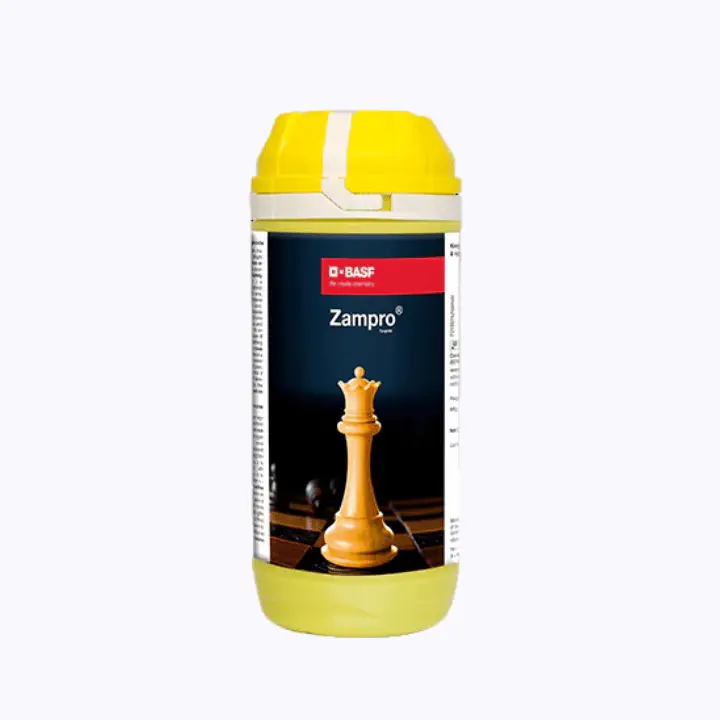
Downy mildew and late blight aren't caused by true fungi in the strictest biological sense — they belong to a group called oomycetes, water molds that behave like fungi but respond differently to certain treatment mechanisms. BASF Zampro is built specifically around this pathogen group, combining Ametoctradin 27% and Dimethomorph 20.27% in an SC formulation that hits oomycete pathogens through two distinct biological pathways rather than relying on a single mechanism.
Ametoctradin works by inhibiting mitochondrial respiration within the pathogen, cutting off its energy production. Dimethomorph, meanwhile, disrupts fungal cell wall formation, interfering with the pathogen's ability to build and maintain its structural integrity. Together, this dual mechanism gives Zampro both systemic movement within the plant and contact-level surface protection, covering more ground than either active could manage alone.
| Detail | Specification |
|---|---|
| Brand | BASF |
| Product Name | Zampro |
| Technical Content | Ametoctradin 27% + Dimethomorph 20.27% |
| Formulation | Suspension Concentrate (SC) |
| Mode of Entry | Systemic |
| Application Method | Foliar Spray |
| Registered Crops | Grapes, Tomato, Potato, Cucurbits |
Downy mildew and late blight are notorious for their speed — under favorable humid, cool conditions, these diseases can spread through a field or vineyard within days rather than weeks. Zampro's dual mode of action isn't just about broader coverage; it's specifically positioned as a novel resistance management tool, since oomycete pathogens have shown a capacity to develop resistance to single-mode-of-action fungicides relatively quickly in intensive cropping systems.
| Crop | Target Disease |
|---|---|
| Grapes | Downy Mildew |
| Cucurbits | Downy Mildew |
| Tomato | Late Blight |
| Potato | Late Blight |
Notice the pattern here — grapes and cucurbits both face downy mildew pressure, while tomato and potato, both nightshade family crops, share the late blight threat. This split reflects how closely related crops within the same plant family tend to share disease vulnerabilities, which is part of why Zampro's registration groups them this way.
| Crop | Target Disease | Dose (per Acre) | Application Method |
|---|---|---|---|
| Grapes | Downy Mildew | 320–400 ml | Foliar Spray |
| Cucurbits | Downy Mildew | 320–400 ml | Foliar Spray |
| Tomato | Late Blight | 320–400 ml | Foliar Spray |
| Potato | Late Blight | 320–400 ml | Foliar Spray |
A consistent 320–400 ml per acre range applies uniformly across all four crop-disease combinations, simplifying dosage planning for growers managing more than one of these crops. Apply as a foliar spray with thorough canopy coverage, as per label recommendation, and always confirm exact water dilution volume and application timing based on disease pressure and local field conditions.
Downy mildew and late blight both thrive under wet, humid conditions — which creates a frustrating irony where the weather most conducive to disease spread is also the weather most likely to wash off a freshly applied fungicide. Zampro's rain fastness of just 2 hours addresses this directly: once absorbed within that window, the application holds up even if rain follows shortly after, reducing the risk of a wasted spray during exactly the weather conditions when protection matters most.
Why does Zampro work well specifically against downy mildew and late blight?
Both diseases are caused by oomycete pathogens, and Zampro's dual mode of action — inhibiting mitochondrial respiration and disrupting cell wall formation — is specifically effective against this pathogen group.
What is the recommended dose of Zampro?
The recommended dose is 320–400 ml per acre, consistent across grapes, tomato, potato, and cucurbits, as per label recommendation.
How does the 2-hour rain fastness benefit growers?
It means the applied fungicide is largely stable and effective within 2 hours of spraying even if rain follows, which is particularly valuable since downy mildew and late blight both spread fastest in the wet, humid conditions most likely to bring rainfall.
Does Zampro help manage fungicide resistance?
Yes, its dual mode of action is specifically positioned as a resistance management tool, reducing reliance on any single mechanism that oomycete pathogens could otherwise adapt to more easily.
Disclaimer: The details provided are for informational guidance only. Always adhere to the recommended application instructions as stated on the product label and in the accompanying leaflet.
KisanShop service was reliable.
Good customer service.
Quality aur service dono ne meri expectation meet ki.
Support aur product dono se main happy hoon.
Genuine product hai.
Product meri current need ke hisaab se fit baithta hai.
Quality and service both met my expectations.
Satisfied with the product and overall service.
Genuine product.
KisanShop service was reliable.