

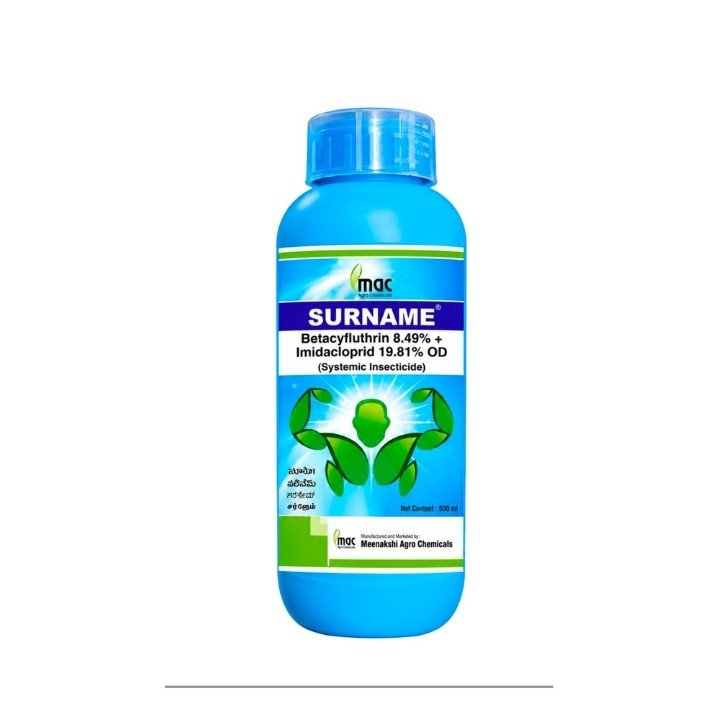
MAC Surname कीटनाशक - बेटासाइफ्लुथ्रिन 8.49% + इमिडाक्लोप्रिड 19.81% ओडी
MAC Surname Beta-cyfluthrin 8.49% + Imidacloprid 19.81% OD Insecticide
MAC Surname is a dual-action insecticide containing Beta-cyfluthrin 8.49% + Imidacloprid 19.81% w/w OD. It combines contact activity from Beta-cyfluthrin with systemic activity from Imidacloprid for managing label-approved chewing and sucking insect pests.
The formulation is registered in brinjal for the control of aphids, jassids and shoot-and-fruit borer. Its oil-dispersion formulation supports uniform spreading, retention and penetration on treated plant surfaces when applied according to label directions.
Important: Crop registrations can differ between brands containing the same active ingredients. Use MAC Surname only on crops and pests printed on its current container label.
MAC Surname Product Specifications
| Specification | विवरण |
|---|---|
| Product Name | MAC Surname Insecticide |
| ब्रांड | MAC |
| Manufacturer/Marketer | मीनाक्षी एग्रो केमिकल्स |
| तकनीकी सामग्री | Beta-cyfluthrin 8.49% + Imidacloprid 19.81% w/w OD |
| फॉर्मूलेशन | Oil Dispersion (OD) |
| Product Type | Contact and systemic insecticide |
| Registered Crop | Brinjal |
| Target Pests | Aphids, jassids and shoot-and-fruit borer |
| Application Method | Foliar spray |
| Registered Dose | 175–200 ml per hectare |
| Water Volume | 500 litres per hectare |
| Waiting Period | 7 days in brinjal |
| Pack Size Shown | 500 मिली |
Technical Composition
| Active Ingredient | Concentration | Primary Activity |
|---|---|---|
| Beta-cyfluthrin | 8.49% w/w | Contact and ingestion activity with rapid knockdown |
| Imidacloprid | 19.81% w/w | Systemic activity against susceptible sucking pests |
| Formulation ingredients | Quantity sufficient to make the oil-dispersion formulation | |
काम करने का तरीका
MAC Surname combines two insecticidal modes of action. Beta-cyfluthrin is a synthetic pyrethroid that affects voltage-gated sodium channels within the insect nervous system. This causes prolonged nerve stimulation, loss of coordination, paralysis and death in susceptible insects.
Imidacloprid is a neonicotinoid insecticide that binds to nicotinic acetylcholine receptors in the insect nervous system. It causes continuous nerve stimulation, feeding cessation, paralysis and eventual death.
| Active Ingredient | IRAC Group | Target Site |
|---|---|---|
| Beta-cyfluthrin | Group 3A | Sodium-channel modulator |
| Imidacloprid | Group 4A | Nicotinic acetylcholine-receptor competitive modulator |
Contact and Systemic Activity
- Contact Activity: Beta-cyfluthrin acts when susceptible insects come into contact with treated surfaces.
- Ingestion Activity: Target insects can receive exposure while feeding on treated plant parts.
- Systemic Activity: Imidacloprid is absorbed by plant tissue and helps control susceptible sap-feeding pests.
- Dual Pest Spectrum: The combination targets both labelled sucking and chewing pests.
Key Features of MAC Surname
- Dual Active Ingredients: Combines a pyrethroid and a neonicotinoid insecticide.
- Contact and Systemic Action: Provides complementary activity against labelled pest groups.
- Rapid Knockdown: Beta-cyfluthrin supports quick action against susceptible insects.
- Sucking-Pest Control: Imidacloprid provides systemic activity against aphids and jassids.
- Borer Management: Registered for brinjal shoot-and-fruit borer.
- OD Formulation: Oil dispersion supports spray deposition and retention when applied correctly.
- Low Field Dose: Registered at 175–200 ml per hectare in brinjal.
Benefits for Brinjal Growers
- Controls labelled sucking and chewing pests with one formulation.
- Helps reduce sap-feeding damage caused by aphids and jassids.
- Supports management of shoot-and-fruit borer.
- Helps protect tender shoots, foliage and developing brinjal fruits.
- Rapid feeding disruption helps limit further pest injury.
- Systemic activity supports protection of treated plant tissue.
- Helps preserve crop health and marketable-yield potential.
Registered Crop, Pest and Dosage
| Crop | Target Pests | Dose per Hectare | Approx. Dose per Acre | Water per Hectare | Waiting Period |
|---|---|---|---|---|---|
| Brinjal | Aphids, jassids and shoot-and-fruit borer | 175–200 ml | Approximately 70–80 ml | 500 litres | 7 days |
Dose-conversion note: The acre dose is a rounded conversion from the registered hectare recommendation. Measure according to the actual treated area and follow the current MAC Surname label.
Approximate Spray Concentration
| Calculation | Approximate Quantity |
|---|---|
| Per litre at 175 ml in 500 litres | 0.35 मिली per litre |
| Per litre at 200 ml in 500 litres | 0.40 मिली per litre |
| For a 15-litre pump | Approximately 5.25–6 ml |
Per-litre and pump calculations assume the registered water volume of 500 litres per hectare. Field application should be calibrated according to treated area rather than increasing concentration to compensate for low water volume.
Coverage of the 500 ml Pack
| Application Rate | Approximate Area Covered |
|---|---|
| 175 मिली per hectare | Approximately 2.85 hectares or 7 acres |
| 200 मिली per hectare | Approximately 2.5 hectares or 6.2 acres |
Pack coverage is a mathematical estimate. Actual coverage depends on the crop, pest, selected label rate, sprayer calibration and treated field area.
Target-Pest Information
Aphids
Aphids feed on plant sap and may cause curling, yellowing, sticky honeydew and reduced plant vigour. Imidacloprid provides systemic activity against susceptible aphid populations.
Jassids
Jassids feed from the underside of leaves and may cause yellowing, curling and hopper-burn symptoms. Timely application helps manage susceptible populations before severe foliage damage develops.
Brinjal Shoot-and-Fruit Borer
Young larvae initially damage tender shoots and later bore into developing fruits. Application should target eggs and young larvae before extensive penetration into shoots or fruits occurs.
Best Time to Apply MAC Surname
- Monitor the brinjal crop regularly for aphids, jassids and borer symptoms.
- Apply when the pest reaches the locally recommended economic threshold.
- For borers, target eggs and newly emerged larvae before they enter plant tissue.
- Spray during early morning or late evening when wind speed is low.
- Avoid application while bees are actively visiting flowers.
- Do not spray immediately before rainfall.
- Avoid unnecessary calendar-based insecticide applications.
How to Use MAC Surname
- Identify the pest correctly before selecting the treatment.
- Confirm that the crop and pest are stated on the current product label.
- Calculate the product quantity according to the treated field area.
- Wear the personal protective equipment specified on the label.
- Shake the container thoroughly before measuring.
- Half-fill the spray tank with clean water.
- Add the measured quantity of MAC Surname while maintaining agitation.
- Add the remaining required water and mix thoroughly.
- Spray the upper and lower leaf surfaces and pest-harbouring plant parts.
- Avoid excessive runoff and spray drift.
- Use the prepared spray solution on the same day.
- Observe the 7-day waiting period before harvesting brinjal.
Resistance Management
MAC Surname contains IRAC Group 3A and Group 4A insecticides. Repeated use of the same combination can select resistant pest populations.
- Do not make repeated consecutive applications of the same combination.
- Rotate with an effective insecticide having different IRAC groups.
- Do not use another pyrethroid or neonicotinoid as the immediate rotation partner.
- Apply only when pest populations reach the recommended threshold.
- Use the complete label dose and ensure thorough crop coverage.
- Remove and destroy borer-infested shoots and fruits where practical.
- Integrate pheromone traps and other suitable non-chemical measures.
Pollinator and Environmental Precautions
This active-ingredient combination can be highly toxic to honey bees, aquatic organisms and freshwater fish. Strict drift, runoff and pollinator-protection measures are necessary.
- Do not apply while bees are actively foraging.
- Avoid spraying flowering crops and flowering weeds during pollinator activity.
- Prevent spray drift onto bee colonies, flowering vegetation and neighbouring crops.
- Do not apply near ponds, aquaculture units, streams or other water bodies.
- Prevent washing water and spray residues from entering drains or irrigation channels.
- Follow all buffer-zone and environmental precautions stated on the label.
Compatibility and Tank Mixing
Mix MAC Surname with another pesticide or fertilizer only when the labels of all products permit the combination. Conduct a small jar test before preparing an unfamiliar tank mixture.
Do not spray a mixture that produces sediment, flakes, excessive foam, heat or separation. Compatibility does not automatically establish crop safety or biological effectiveness.
Safety Precautions
- Read the complete product label and leaflet before application.
- Wear gloves, protective clothing, footwear and suitable eye protection.
- Avoid inhaling spray mist and prevent contact with skin and eyes.
- Do not eat, drink, smoke or chew while handling the insecticide.
- Do not spray against the wind.
- Keep people and animals away from the treated field as directed.
- Wash hands, exposed skin, clothing and spraying equipment after use.
- Observe the crop-specific pre-harvest interval.
- Seek medical attention if poisoning or significant exposure is suspected.
Storage and Disposal
- Store in the original container with the cap tightly closed.
- Keep in a cool, dry, locked and well-ventilated pesticide store.
- Protect from direct sunlight and excessive heat.
- Keep away from children, animals, food, seed and animal feed.
- Do not transfer the insecticide into food or beverage containers.
- Do not reuse the empty container.
- Dispose of empty packaging according to the label and applicable regulations.
Frequently Asked Questions
What is MAC Surname used for?
MAC Surname is registered in brinjal for controlling aphids, jassids and shoot-and-fruit borer.
What is the technical content of Surname?
It contains Beta-cyfluthrin 8.49% + Imidacloprid 19.81% w/w in an oil-dispersion formulation.
What is the dose of MAC Surname per acre?
The rounded equivalent dose is approximately 70–80 ml per acre in brinjal. This is converted from the registered rate of 175–200 ml per hectare.
How much MAC Surname is required for a 15-litre pump?
Approximately 5.25–6 ml per 15-litre pump when maintaining the registered concentration of 175–200 ml in 500 litres of water.
How much land can the 500 ml pack cover?
At the registered brinjal rate, the 500 ml pack can treat approximately 2.5–2.85 hectares or about 6.2–7 acres.
Is MAC Surname systemic or contact?
It provides both activities. Beta-cyfluthrin supplies contact and ingestion action, while Imidacloprid supplies systemic activity.
Can it control both sucking pests and borers?
Yes. Its brinjal registration includes aphids and jassids as sucking pests and shoot-and-fruit borer as a chewing pest.
What is the waiting period in brinjal?
Observe a waiting period of 7 days between the final spray and harvesting.
Can MAC Surname be sprayed during flowering?
Avoid spraying while honey bees and other pollinators are actively foraging. Follow the environmental and pollinator precautions printed on the label.
Can Surname be used on soybean, cotton or chilli?
Other brands with the same active ingredients may have additional crop registrations. Use MAC Surname on another crop only if that crop and its dose are specifically printed on the current MAC Surname label.
Disclaimer: This information is provided for general agricultural guidance only. Always follow the current product label for approved crops, pests, dosage, water volume, application frequency, waiting period, environmental precautions and safety instructions.
मिलते-जुलते उत्पाद


सबसे ज़्यादा बिकने वाले


ग्राहक समीक्षाएं
हाल की समीक्षाएं
अभी तक कोई समीक्षा नहीं।