

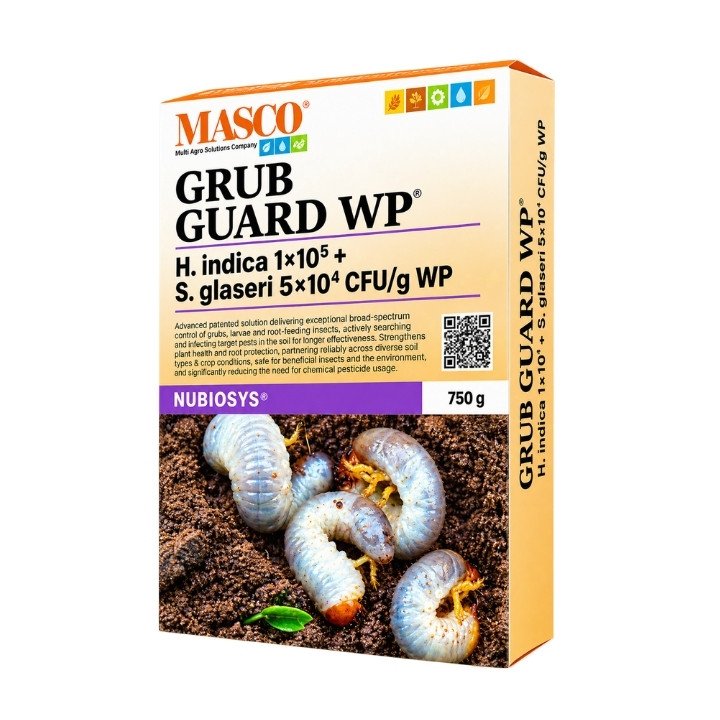
मास्को नुआग ग्रब गार्ड डब्ल्यूपी जैव कीटनाशक
MASCO Grub Guard WP for Biological Management of White Grubs
MASCO NuAg Grub Guard WP is a biological soil insect-management formulation containing the beneficial entomopathogenic nematodes Heterorhabditis indica and Steinernema glaseri. It is developed to help manage susceptible white grubs, insect larvae and root-feeding pests present in the soil.
The beneficial nematodes move through moist soil in search of suitable insect hosts. After entering a susceptible pest, they release associated symbiotic microorganisms that multiply inside the host and help cause pest mortality. Proper soil moisture, suitable temperature and correct application practices are important for biological performance.
MASCO Grub Guard WP Product Specifications
| Specification | विवरण |
|---|---|
| Product Name | Grub Guard WP |
| ब्रांड | MASCO NuAg |
| Technology Name Displayed on Pack | NUROSYS |
| Product Category | Biological soil insect-management product |
| Biological Agents | Heterorhabditis indica and Steinernema glaseri |
| फॉर्मूलेशन | WP – Wettable Powder |
| Primary Target | White grubs, susceptible soil larvae and root-feeding insects |
| Mode of Application | Label-approved soil application or soil-zone treatment |
| Recommended Dose | As stated on the current product label |
| Pack Size | 750 g |
Technical Composition
| Biological Agent | Declared Count | Biological Function |
|---|---|---|
| Heterorhabditis indica | 1 × 10⁵ CFU/g WP | Actively searches for and infects susceptible soil-dwelling insect hosts |
| Steinernema glaseri | 5 × 10⁴ CFU/g WP | Helps target susceptible grubs and other insect larvae in the soil |
| Carrier and formulation ingredients | As required | Support storage, dispersion and soil application of the biological formulation |
Composition note: The above biological count has been taken from the supplied product details and pack image. Always verify the viable count, formulation and expiry information printed on the physical pack before listing or application.
Key Features of Grub Guard WP
- Dual nematode formulation: Combines H. indica and S. glaseri for biological management of susceptible soil insect pests.
- Active host searching: Beneficial nematodes move through moist soil to locate suitable insect larvae.
- Root-zone action: Designed to act where white grubs and root-feeding larvae are commonly present.
- Biological mode of action: Uses living biological agents rather than relying only on conventional chemical insecticide chemistry.
- Multiple soil conditions: Developed for soil application, although actual performance depends on moisture, temperature and soil conditions.
- IPM suitability: Can be included in an Integrated Pest Management programme according to label guidance.
Benefits for Farmers
- Helps manage susceptible white grub populations in the crop root zone.
- Supports protection of roots from feeding by soil-dwelling insect larvae.
- Helps maintain crop establishment and plant vigour by reducing root-zone pest pressure.
- Biological agents actively search for suitable insect hosts in moist soil.
- Can support reduced dependence on repeated conventional insecticide applications.
- Useful as part of sustainable soil-pest and root-health management practices.
- Can be integrated with monitoring, cultural control and other compatible IPM measures.
Target Pest Spectrum
| Target Pest Group | Potential Crop Damage | Role of Grub Guard WP |
|---|---|---|
| White grubs | Larvae feed on roots, causing weak growth, yellowing or plant mortality | Helps biologically manage susceptible grub stages present in soil |
| Beetle larvae | Root feeding may reduce water and nutrient uptake | Beneficial nematodes search for suitable larval hosts |
| Root-feeding larvae | Damage to fine and developing roots may reduce plant vigour | Supports root-zone pest management under suitable conditions |
| Other label-listed soil insects | Underground feeding can affect crop establishment and productivity | Use only for susceptible pests stated on the current product label |
White Grub Damage Symptoms
- Plants may appear weak, pale or yellow despite adequate surface irrigation.
- Affected plants may show slow growth, wilting or drying in irregular field patches.
- Roots may appear cut, chewed or reduced when affected plants are removed carefully.
- White, curved, C-shaped larvae may be visible near the root zone during soil inspection.
- Severely damaged plants may pull out of the soil easily because of root loss.
Similar symptoms may also be caused by root diseases, termites, waterlogging, drought or nutrient deficiency. Confirm the presence of white grubs or another susceptible soil pest before application.
Recommended Crops and Application Area
| Use Area | Target Situation | Application Requirement |
|---|---|---|
| Field crops | Fields with confirmed white grub or soil-larvae activity | Apply to moist root-zone soil according to the product label |
| Vegetable crops | Root-zone infestation by susceptible insect larvae | Direct the approved treatment towards the affected soil area |
| Fruit and plantation crops | White grubs or susceptible larvae near the active root zone | Treat the root-zone soil using the label-approved method |
| Nursery and horticultural crops | Confirmed soil-dwelling larval infestation | Use only where the crop and application method are permitted on the label |
Crop-use note: A verified public crop-wise registration list was not available during research. Confirm the crop, pest and application method from the physical product label before use.
Dosage and Application Method
| Application Detail | Recommendation |
|---|---|
| Exact dose per acre | Use strictly as stated on the current product label |
| Target area | Moist soil around the crop root zone where susceptible grubs are present |
| Application timing | When grubs or susceptible larval stages are present and actively feeding |
| Soil condition | Apply when soil is moist but not severely waterlogged |
| Post-application moisture | Maintain suitable soil moisture according to label guidance |
Dose note: The exact dose per acre was not available from a reliable public manufacturer source. Do not copy the dosage of another product called “Grub Guard,” because products with this name may contain different biological agents and concentrations.
How to Apply MASCO Grub Guard WP
- Inspect the field and confirm the presence of white grubs or another label-listed soil pest.
- Check the manufacturing date, expiry date and storage condition of the pack.
- Read the complete product label before preparing the treatment.
- Measure the required quantity according to the label-recommended field dose.
- Prepare the product using clean, chlorine-free water when directed by the label.
- Mix gently to avoid damaging the living biological agents.
- Apply the prepared treatment uniformly to moist soil around the crop root zone.
- Ensure the treatment reaches the soil layer where grubs and larvae are active.
- Maintain suitable soil moisture after application according to label directions.
- Use the prepared biological suspension promptly and do not store it for later use.
काम करने का तरीका
Heterorhabditis indica and Steinernema glaseri are beneficial entomopathogenic nematodes that actively move through suitable moist soil in search of susceptible insect hosts. They enter the host through natural body openings or other suitable entry points.
After entering the insect, the nematodes release associated symbiotic bacteria. These bacteria multiply inside the host and help cause pest mortality. The nematodes can then reproduce within a suitable host, after which infective stages may move through the soil in search of additional susceptible larvae.
Factors That Support Biological Performance
| Factor | Why It Matters |
|---|---|
| Soil moisture | Nematodes require a moist soil-water film for movement and host searching |
| Soil temperature | Extreme heat or cold may reduce survival and biological activity |
| Application timing | Young or actively feeding larval stages may be easier to reach and manage |
| Sunlight protection | Direct sunlight and ultraviolet exposure may reduce nematode survival |
| Correct placement | The product needs to reach the soil zone where target grubs are present |
| Product viability | Improper storage or expired product may contain fewer viable biological agents |
Why Farmers Can Choose MASCO Grub Guard WP
- Contains two beneficial entomopathogenic nematode species.
- Developed for biological management of soil-dwelling insect larvae.
- Beneficial nematodes actively search for susceptible hosts in moist soil.
- Supports protection of crop roots from white grub feeding damage.
- Can form part of an Integrated Pest Management programme.
- Provides a biological alternative within a broader soil-pest management strategy.
- Supplied in a convenient 750 g wettable-powder pack.
Frequently Asked Questions
What is MASCO Grub Guard WP?
MASCO Grub Guard WP is a biological soil insect-management product containing Heterorhabditis indica and Steinernema glaseri, two beneficial entomopathogenic nematodes used against susceptible grubs and insect larvae.
Which pests does Grub Guard WP target?
It is intended primarily for white grubs, susceptible soil larvae and other label-listed root-feeding insects. Confirm the exact target pest from the product label.
What is the dose of Grub Guard WP per acre?
The exact acre dose could not be verified from a reliable public manufacturer source. Use only the dose printed on the current product pack and accompanying leaflet.
How do beneficial nematodes kill white grubs?
They search for susceptible larvae in moist soil, enter the insect host and release associated symbiotic bacteria that multiply and help cause pest mortality.
Should the soil be dry or moist during application?
Suitable soil moisture is important because beneficial nematodes move through the water film between soil particles. Follow the pack directions regarding irrigation before and after application.
Can Grub Guard WP be applied during hot afternoon conditions?
Avoid intense sunlight and extreme heat unless the product label directs otherwise. Biological nematode products are generally better applied during cooler periods with suitable soil moisture.
Can it be mixed with chemical pesticides or fertilizers?
Do not mix it with pesticides, fungicides, fertilizers or disinfectants unless compatibility is confirmed on the label. Some chemicals may reduce the viability of living nematodes.
Is Grub Guard WP completely safe for every beneficial insect?
The supplied information describes it as beneficial-insect friendly, but no pest control product should be presented as universally safe. Apply only to the target soil area and follow all label precautions.
Can this product completely replace chemical insecticides?
Grub Guard WP can help reduce dependence on conventional insecticides, but results depend on pest stage, soil conditions, product viability and application quality. Severe infestations may require a broader Integrated Pest Management programme.
Disclaimer: The details provided are for informational guidance only. Always adhere to the recommended application instructions as stated on the product label and in the accompanying leaflet.मिलते-जुलते उत्पाद
सबसे ज़्यादा बिकने वाले
ग्राहक समीक्षाएं
हाल की समीक्षाएं
अभी तक कोई समीक्षा नहीं।