

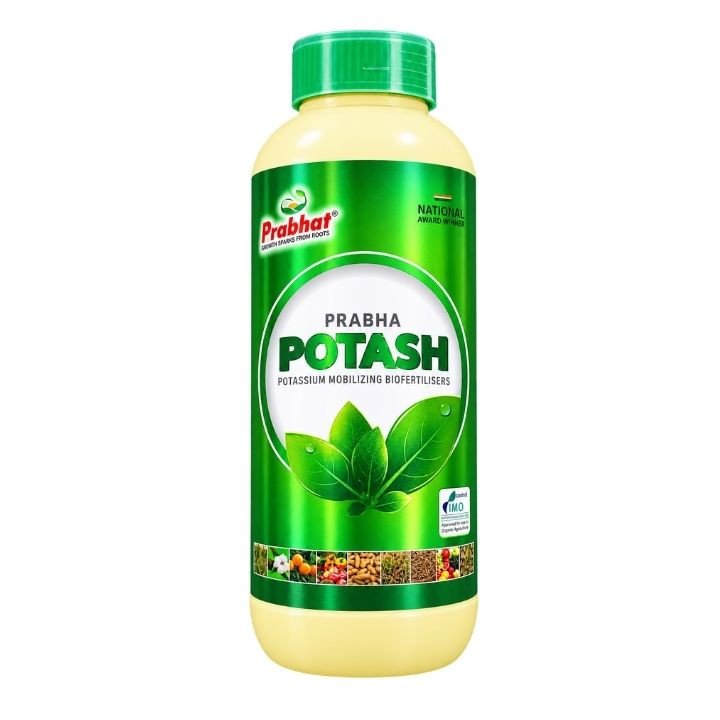
प्रभात प्रभा पोटाश – पोटैशियम मोबिलाइजिंग बायोफर्टिलाइजर
प्रभात प्रभा पोटाश – पोटैशियम मोबिलाइजिंग बायोफर्टिलाइजर
Prabhat Prabha Potash is an eco-friendly Potassium Mobilizing Biofertilizer containing beneficial bacteria Frateuria aurantia. These beneficial microorganisms colonize the rhizosphere around plant roots and help convert unavailable or insoluble forms of potassium present in the soil into forms that plants can absorb more efficiently.
Potassium is an essential plant nutrient required for several physiological processes, including water regulation, enzyme activity, carbohydrate movement, crop quality and tolerance to environmental stress. By improving the availability of native soil potassium, Prabha Potash supports balanced crop nutrition, vigorous plant development and better crop performance.
Prabha Potash can be used in a wide range of crops including cereals, pulses, fruits, vegetables, oilseeds, flowers, cotton, sugarcane, tea, coffee and medicinal plants. It is also suitable for integration with other compatible biofertilizers as part of a balanced nutrient-management programme.
उत्पाद विनिर्देश
| ब्रांड | Prabhat |
| Product Name | Prabha Potash |
| Product Category | Biofertilizer |
| Biofertilizer Type | Potassium Mobilizing Biofertilizer |
| Beneficial Microorganism | Frateuria aurantia |
| Primary Function | Mobilization of Insoluble / Unavailable Soil Potassium |
| Area of Activity | Rhizosphere / Root Zone |
| Product Type | Microbial Biofertilizer |
| Available Formulations | Liquid, Powder and Granular |
| Suitable Crops | Suitable for a Wide Range of Agricultural and Horticultural Crops |
Key Features & Benefits
- Potassium Mobilization: Helps mobilize insoluble and less-available forms of potassium present in soil.
- Improves Potassium Availability: Helps make native soil potassium more accessible to plant roots.
- Beneficial Rhizosphere Activity: Frateuria aurantia colonizes the root-zone environment and supports nutrient availability.
- Supports Crop Growth: Better potassium nutrition can support vigorous vegetative growth and healthy crop development.
- Supports Yield Potential: Improved potassium utilization can contribute to better crop productivity under proper nutrient and crop management.
- Improves Nutrient-Use Efficiency: Helps plants utilize naturally occurring soil potassium more effectively.
- Supports Stress Tolerance: Adequate potassium nutrition contributes to plant tolerance against certain environmental stresses such as cold and moisture-related stress.
- Supports Crop Quality: Potassium plays an important role in fruit development, grain filling and overall produce quality.
- Suitable for Many Crops: Can be used in cereals, pulses, vegetables, fruits, plantation crops, oilseeds, flowers and other crops.
- Biofertilizer Compatibility: Can be integrated with other compatible biofertilizers as part of an integrated nutrient-management programme.
- Eco-Friendly Approach: Uses beneficial microorganisms to support nutrient mobilization in the soil.
How Prabha Potash Works
Frateuria aurantia is a beneficial potassium-mobilizing microorganism. After application, the bacteria establish themselves in the rhizosphere, the soil region immediately surrounding plant roots.
The microorganisms help release potassium from minerals and other less-available soil sources through biological activity. This improves the availability of potassium in the root zone, allowing plants to absorb and utilize the nutrient more efficiently.
Importance of Potassium for Plants
Potassium is one of the major essential nutrients required for healthy plant development. Unlike nitrogen and phosphorus, potassium does not become a structural component of plant tissues, but it plays an important regulatory role in many physiological processes.
- Supports enzyme activation.
- Helps regulate water movement within plants.
- Supports photosynthesis and carbohydrate transport.
- Contributes to healthy root development.
- Supports flowering and fruit development.
- Helps improve crop quality.
- Supports tolerance to certain environmental stresses.
- Contributes to overall plant vigour.
Beneficiary Crops
| Crop Category | Suitable Crops |
|---|---|
| Pulses | Beans, Mung, Lentil, Gram and Other Pulses |
| Cereals | Wheat, Paddy, Maize, Barley, Oat, Sorghum and Other Cereals |
| Fruit Crops | Apple, Grapes, Banana, Pomegranate, Papaya, Guava, Strawberry, Citrus and Other Fruits |
| Vegetables | Potato, Brinjal, Tomato, Cauliflower, Okra, Capsicum, Onion, Cabbage, Ginger, Peas and Other Vegetables |
| Plantation Crops | Coffee and Tea |
| Commercial Crops | Sugarcane, Sugar Beet and Cotton |
| Other Crops | Flowers, Oilseeds, Medicinal Plants and Other Suitable Crops |
Prabha Potash for Paddy
In paddy, Prabha Potash can be incorporated into a balanced nutrient-management programme to improve the availability of potassium in the root zone. Adequate potassium supports crop vigour, grain development and overall plant health.
Prabha Potash for Wheat
Potassium plays an important role in wheat growth, water regulation and grain development. Potassium-mobilizing bacteria can help improve utilization of potassium already present in the soil.
Prabha Potash for Vegetables
Vegetable crops require balanced potassium nutrition during vegetative development, flowering and fruit formation. Prabha Potash can be used in crops such as tomato, brinjal, potato, capsicum, okra, onion, cauliflower, cabbage, ginger and peas as part of an integrated nutrient-management programme.
Prabha Potash for Fruit Crops
Fruit crops often require significant potassium for fruit development and quality. Prabha Potash can be incorporated into nutrient programmes for crops such as grapes, banana, pomegranate, papaya, guava, strawberry, citrus and apple.
Advantages of Potassium Mobilizing Bacteria
- Helps unlock potassium already present in agricultural soils.
- Supports better nutrient-use efficiency.
- Encourages beneficial microbial activity around plant roots.
- Can complement conventional fertilizer programmes.
- Supports sustainable nutrient-management practices.
- Useful across a broad range of agricultural crops.
Formulations Available
Prabha Potash is available in different formulations to suit various agricultural application methods:
- Liquid Formulation
- Powder Formulation
- Granular Formulation
The product shown here is the liquid formulation. Application quantity can differ according to formulation, crop and application method.
Method of Application
Prabha Potash may be applied through suitable agricultural methods according to the formulation and directions provided on the original product label.
Soil Application
The recommended quantity may be mixed with well-decomposed farmyard manure, compost or another suitable carrier and applied around the crop root zone as directed on the label.
Drip / Fertigation Application
Where specifically permitted on the product label, suitable liquid formulations may be applied through compatible irrigation systems according to the manufacturer's instructions.
Root-Zone Application
The product may be directed toward the active root zone so that beneficial microorganisms can establish in the rhizosphere.
Important: Always follow the exact crop-wise dose and application method printed on the current Prabha Potash bottle, packet or leaflet.
Recommended Dosage
The exact dosage of Prabha Potash depends on the formulation being used, crop, soil condition and application method.
Do not use a generalized dose without checking the current product label. Follow the manufacturer's recommended quantity for the specific liquid, powder or granular formulation being purchased.
Compatibility
Prabha Potash is intended to be compatible with suitable biofertilizer programmes. However, because it contains living beneficial microorganisms, care should be taken when combining it with antimicrobial crop-protection chemicals.
- Can be integrated with other compatible biofertilizers.
- Follow label instructions before tank mixing.
- Avoid mixing directly with products that may harm beneficial microorganisms unless compatibility is specifically confirmed.
- Maintain an appropriate application interval from bactericidal or strongly antimicrobial products where recommended.
Role in Integrated Nutrient Management
Prabha Potash can be used as part of an Integrated Nutrient Management (INM) programme along with soil testing, organic manure, crop residues and appropriately recommended mineral fertilizers.
Biofertilizers should generally complement a balanced nutrient programme rather than being treated as a guaranteed replacement for all conventional potassium fertilizer requirements.
Potential Fertilizer Saving
The manufacturer describes Prabha Potash as helping improve utilization of soil potassium and potentially reducing dependence on conventional potash inputs under appropriate soil and crop conditions.
Note: Any reduction in conventional potash fertilizer should be based on soil-test results, crop requirement and qualified agricultural recommendations. Fertilizer savings can vary significantly between fields and crops.
Benefits for Farmers
- Improves biological mobilization of soil potassium.
- Supports better crop nutrition.
- Can improve potassium-use efficiency.
- Supports vigorous crop growth.
- Useful in a wide range of field and horticultural crops.
- Compatible with integrated nutrient-management practices.
- Provides an eco-friendly biological approach to nutrient management.
Best Practices for Application
- Apply according to the crop-specific manufacturer recommendation.
- Apply to adequately moist soil where appropriate.
- Direct the product toward the active root zone.
- Avoid exposing the microbial formulation to excessive heat or direct sunlight for prolonged periods.
- Use clean water where dilution is required.
- Do not exceed the recommended dosage.
- Follow soil-testing recommendations for balanced fertilizer management.
Storage Instructions
- Store the product in its original sealed container.
- Keep in a cool and dry place.
- Protect from direct sunlight and excessive heat.
- Do not allow the product to freeze or overheat.
- Keep away from food and animal feed.
- Keep out of reach of children and animals.
- Use within the expiry or validity period printed on the product container.
Frequently Asked Questions
What is Prabhat Prabha Potash?
Prabha Potash is a Potassium Mobilizing Biofertilizer containing beneficial microorganisms that help improve the availability of soil potassium to crops.
Which microorganism is present in Prabha Potash?
Prabha Potash contains the beneficial potassium-mobilizing bacterium Frateuria aurantia.
What does Prabha Potash do?
It helps mobilize less-available forms of potassium present in soil, making potassium more accessible to plant roots.
Is Prabha Potash a chemical fertilizer?
No. It is a microbial biofertilizer based on beneficial potassium-mobilizing bacteria.
Can Prabha Potash replace potash fertilizer completely?
It should not automatically be considered a complete replacement for all conventional potash fertilizer. Potassium requirements should be determined according to crop requirement, soil testing and agricultural recommendations.
Which crops can Prabha Potash be used on?
It is suitable for a broad range of crops including cereals, pulses, vegetables, fruits, cotton, sugarcane, tea, coffee, oilseeds, flowers and medicinal plants.
Can Prabha Potash be used in vegetables?
Yes. It can be incorporated into nutrient-management programmes for vegetables such as tomato, brinjal, potato, cauliflower, okra, capsicum, onion, cabbage, ginger and peas.
Can Prabha Potash be used in fruit crops?
Yes. It can be used for crops such as grapes, banana, pomegranate, papaya, guava, strawberry, citrus and apple according to product recommendations.
Is Prabha Potash suitable for paddy and wheat?
Yes. Paddy and wheat are among the cereal crops for which potassium-mobilizing biofertilizers can be incorporated into a balanced nutrient-management programme.
Is Prabha Potash available only in liquid form?
No. The product is described as being available in liquid, powder and granular formulations. The product shown here is a liquid formulation.
Can Prabha Potash be used with other biofertilizers?
Yes, it can generally be integrated with compatible biofertilizers. Always follow the manufacturer's compatibility instructions.
Does Prabha Potash help improve crop yield?
Improved potassium availability can support crop growth and yield potential. Actual results depend on soil fertility, crop requirement, climate, irrigation, nutrition and overall crop management.
What is the dosage of Prabha Potash?
The correct dose depends on whether liquid, powder or granular Prabha Potash is being used. Always follow the exact dose printed on the current product label rather than applying an estimated quantity.
Disclaimer
The above information is intended for product-page and general agricultural awareness purposes. Product performance and fertilizer-saving potential can vary according to crop, soil potassium status, microbial activity, climate, irrigation, nutrient management and other field conditions. Always follow the current Prabha Potash product label, soil-test recommendations and qualified agricultural advice for dosage, application method, compatibility and nutrient management.
मिलते-जुलते उत्पाद




सबसे ज़्यादा बिकने वाले





ग्राहक समीक्षाएं
हाल की समीक्षाएं
अभी तक कोई समीक्षा नहीं।