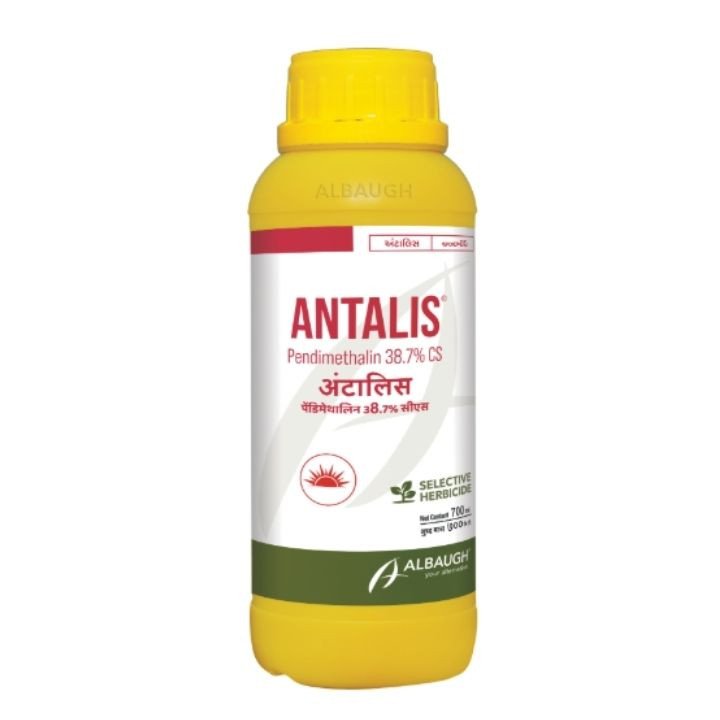

By the time weed seedlings are visible above the soil surface, a good portion of the early competitive advantage they'll have over the crop has already been established. Albaugh Antalis is built specifically to intervene before that point — as a pre-emergent, pre-plant incorporation herbicide based on Pendimethalin 38.7% in a capsule suspension (CS) formulation, it works by forming a treated zone in the soil that interferes with weed germination and early seedling development before weeds ever break through.
Being a capsule suspension rather than a standard emulsifiable concentrate has practical implications too — CS formulations are generally designed to release the active ingredient gradually, which can support a more consistent residual barrier in the soil compared to formulations that release everything at once.
| Detail | Specification |
|---|---|
| Brand | Albaugh |
| Product Name | Antalis |
| Technical Content | Pendimethalin 38.7% |
| Formulation | Capsule Suspension (CS) |
| Herbicide Type | Selective, Pre-Emergent / Pre-Plant Incorporation |
| Registered Crops | Soybean, Groundnut, Cotton, Mustard, Chilli, Cumin, Onion |
Unlike a non-selective, broad-kill herbicide, Antalis is formulated to control weeds while the intended crop remains unaffected — a critical distinction for a pre-emergent product, since it's typically applied to or incorporated into soil before the crop itself has fully established. This selectivity is what allows the same active ingredient to be registered across such a diverse crop list, from field crops like soybean and cotton to spice crops like cumin and chilli.
| Weed Category | General Description |
|---|---|
| Annual Grasses | Grassy weed species that complete their life cycle within a single season |
| Sedges | Grass-like weeds with triangular stems, often persistent in moist soil conditions |
| Certain Broadleaf Weeds | Non-grass weed species with broader leaf structures |
Specific weed species controlled can vary by crop and regional label registration, so it's worth confirming the exact target weed list for the crop being treated from the current product label rather than assuming universal coverage across every grass, sedge, or broadleaf weed present in a field.
| Crop | Crop Type |
|---|---|
| Soybean | Oilseed |
| Groundnut | Oilseed |
| Cotton | Cash Crop |
| Mustard | Oilseed |
| Chilli | Spice / Vegetable |
| Cumin | Spice |
| Onion | Bulb Vegetable |
This spread across oilseeds, cash crops, spices, and bulb vegetables reflects how broadly applicable pre-emergent grass and sedge control tends to be — early-season weed pressure from these categories is a common challenge regardless of what the actual crop being grown is.
| Application Type | Recommended Dose |
|---|---|
| Pre-Emergent / Pre-Plant Incorporation | 600–700 ml per acre |
Since Antalis works pre-emergence, timing relative to sowing is critical — application needs to happen before weed seeds germinate, either as a pre-plant soil incorporation or immediately after sowing but before crop and weed emergence. Applying too late, after weeds have already broken through the soil surface, significantly reduces the herbicide's effectiveness, since its mode of action targets the germination and early seedling stage rather than established plants.
Can Antalis be used after weeds have already emerged in the field?
No — as a pre-emergent herbicide, it's designed to prevent weed germination and early seedling establishment, and is significantly less effective once weeds have already emerged above the soil surface.
Why is the same herbicide registered across such different crops as cumin, cotton, and onion?
Pendimethalin's pre-emergent grass, sedge, and broadleaf weed control is broadly applicable across many crop types, and its selective action means it doesn't harm the specific crops it's registered for while still controlling early-stage weed germination.
Does soil moisture affect how well Antalis performs?
Yes, pre-emergent herbicides like this generally depend on adequate soil moisture to activate and move into the weed germination zone, so application timing relative to irrigation or expected rainfall matters.
What does "pre-plant incorporation" mean for this product?
It refers to physically mixing the herbicide into the soil before planting the crop, as opposed to simply spraying it on the soil surface after sowing — both application approaches are supported for Antalis depending on the crop and farming practice.
Disclaimer: The details provided are for informational guidance only. Always adhere to the recommended application instructions as stated on the product label and in the accompanying leaflet.
No reviews yet.