

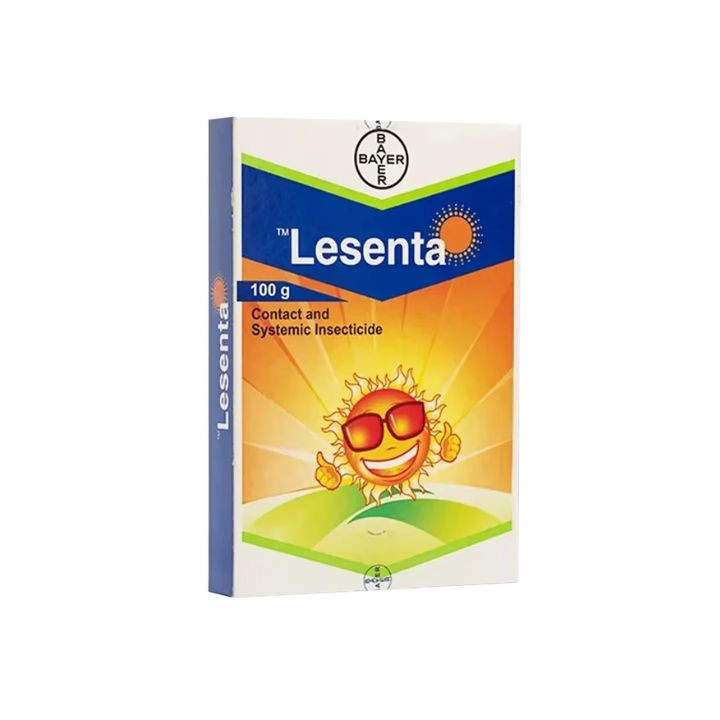
Bayer Lesenta: Built Around One of the Hardest Pests to Control — White Grub
White grub is one of those pests that punishes farmers who wait too long. By the time damage shows above ground — wilting, stunted growth, patches of dying crop — the grub has often already been feeding on roots underground for weeks, well out of reach of most foliar sprays. Bayer Lesenta was developed with this exact problem in mind, combining two active ingredients, Fipronil 40% and Imidacloprid 40%, in a single WG mixture that works both through soil and foliar routes.
The pairing isn't arbitrary. Imidacloprid targets the insect's nervous system by blocking a specific receptor pathway, causing nerve overstimulation and eventual collapse — it works largely through systemic movement and ingestion. Fipronil complements this mainly as an ingestion toxicant with some contact activity, interfering with nerve impulse transmission through a different route. Together, the combination is positioned as particularly strong against white grub, alongside sucking pests and select caterpillar species.
The Basics
| Detail | Specification |
|---|---|
| Brand | Bayer |
| Product Name | Lesenta |
| Technical Content | Fipronil 40% + Imidacloprid 40% |
| Formulation | Water Dispersible Granule (WG) |
| Toxicity Class | Yellow (Slightly Hazardous) |
Pest Coverage Isn't Uniform Across Crops
One thing worth understanding before spraying: Lesenta doesn't target the same pest everywhere it's used. In sugarcane and groundnut, the whole reason to reach for this product is usually white grub — a soil-dwelling pest that's notoriously hard to manage once established. In cotton, the target shifts entirely to jassids and thrips, both foliar sucking pests. Rice brings in yet another pest profile — yellow stem borer, leaf folder, and brown plant hopper — while chilli sees it used against thrips and fruit borer.
| Crop | Primary Pest Target |
|---|---|
| Sugarcane | White Grub |
| Groundnut | White Grub |
| Cotton | Jassids, Thrips |
| Rice | Yellow Stem Borer, Leaf Folder, Brown Plant Hopper |
| Chilli | Thrips, Fruit Borer |
Dose and Waiting Period Vary a Lot — Here's the Full Picture
The waiting periods on this product deserve real attention, because they differ dramatically by crop — from just 7 days in chilli and rice to nearly 300 days in sugarcane. This isn't inconsistency in the data; it reflects how the product is used differently depending on pest biology. Sugarcane's long waiting period ties to its soil-application use against white grub over an extended crop cycle, while the shorter periods in rice and chilli reflect standard foliar spray timing against surface pests.
| Crop | Dose per Acre | Water Volume | Concentration per Litre | Waiting Period |
|---|---|---|---|---|
| Sugarcane | 175–200 gm | 400–500 L | 0.4–0.43 gm | 296 days |
| Groundnut | 100–120 gm | 400 L | 0.25–0.30 gm | 106 days |
| Cotton | 50 gm | 200 L | 0.25 gm | 36 days |
| Rice | 40–50 gm | 200 L | 0.20–0.25 gm | 7 days |
| Chilli | 30–40 gm | 200 L | 0.15–0.20 gm | 7 days |
Because these numbers shift so much by crop, it's worth double-checking the specific row that applies before mixing a spray tank — using the sugarcane rate on chilli, for instance, would be a significant overdose.
Getting the Spray Right
Lesenta can be applied either as a foliar spray or a soil application, depending on which pest is being addressed. For foliar work, a knapsack, battery, or power sprayer fitted with a flat fan nozzle gives the coverage the product needs. Timing matters too — early morning or late afternoon on a calm day helps avoid drift and gives better contact with the target pest, and spraying should begin as soon as infestation is noticed rather than after damage has become visible.
A Side Benefit Beyond Pest Control
Beyond direct pest knockdown, Lesenta is associated with a supportive plant growth effect — sometimes referred to as a dual PGE benefit — that's linked to improved root development and generally greener foliage. This isn't the primary reason to use the product, but it's a noticeable secondary effect reported alongside its pest control performance.
Frequently Raised Questions
Why is the waiting period so much longer for sugarcane than for rice or chilli?
It reflects the different application context — sugarcane's white grub treatment is tied to a soil application over a long crop cycle, while rice and chilli use shorter-cycle foliar sprays against surface pests.
Can Lesenta be used on cotton for white grub, since it works well on that pest in sugarcane?
No — the registered use in cotton is specifically for jassids and thrips; always follow the crop-specific pest listing on the label rather than assuming cross-crop application.
Is soil or foliar application better for white grub control?
Since white grub feeds underground, soil-directed application is generally the appropriate route, as reflected in the sugarcane and groundnut dosage guidance.
Does spraying at midday work just as well as early morning or evening?
Early morning or late afternoon on a non-windy day is generally preferred, as it improves spray deposition and reduces drift compared to midday application.
Disclaimer: The details provided are for informational guidance only. Always adhere to the recommended application instructions as stated on the product label and in the accompanying leaflet.
Frequently Asked Questions about Bayer Lesenta Insecticide
What is the price of Bayer Lesenta Insecticide?
The price of Bayer Lesenta Insecticide starts at Rs. 469 (40 gm) at KisanShop. Final price depends on the pack size you choose.
Which pack sizes of Bayer Lesenta Insecticide are available?
40 gm, 40 gm x 2, 100 gm, 40 gm x 3, 100 gm x 2, 100 Gm x 5, 100 Gm x 10. Select the size you need on the product page.
Which brand makes Bayer Lesenta Insecticide?
Bayer Lesenta Insecticide is a product of Bayer, available to buy online at KisanShop.
What payment options are available?
You can pay with UPI, debit or credit cards, or Cash on Delivery (COD, subject to availability for your pincode).
Can I return Bayer Lesenta Insecticide?
Yes. KisanShop offers a 48 hours easy return. If you receive a wrong, damaged or defective product, we will replace it.
How long does delivery take?
KisanShop offers fast and reliable delivery. Exact delivery time depends on your pincode.
Similar Products


Best Selling




Customer Reviews
Recent Reviews
Glad I chose this product on KisanShop.
Product quality is better than I expected.
Support team helpful thi.
Product quality is better than I expected.
Overall a positive experience with this item.
Overall a positive experience with this item.
Bahut zyada satisfied hoon.
Quality better than local shop.
KisanShop ki service reliable lagi.
Service best thi.