

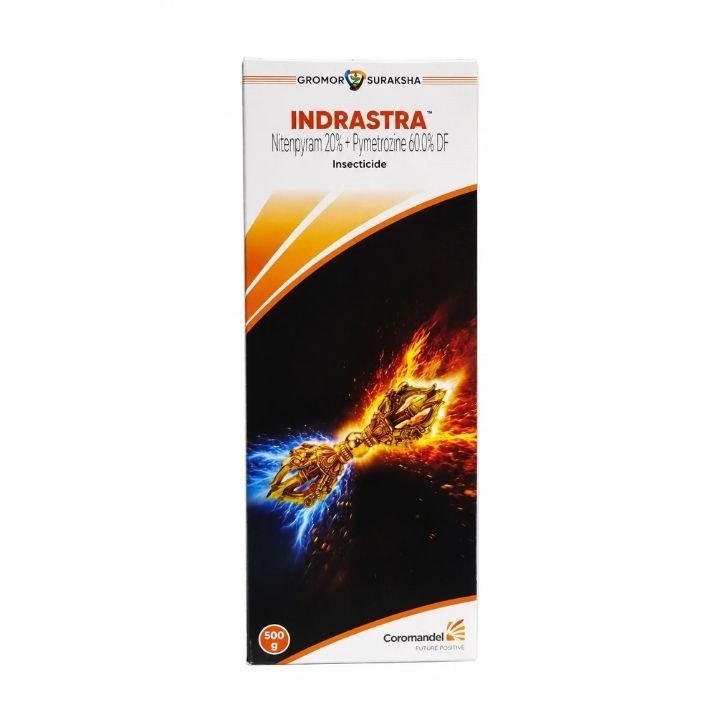
Coromandel Indrastra Insecticide – Nitenpyram 20% + Pymetrozine 60% DF
Dual-Action Insecticide for Hopper Management in Paddy
Coromandel Indrastra is an agricultural insecticide containing Nitenpyram 20% + Pymetrozine 60% DF. This combination is designed primarily for management of important sucking insect pests, particularly hopper complexes affecting paddy crops.
Nitenpyram provides fast neonicotinoid activity against susceptible sucking insects, while Pymetrozine works as a selective feeding blocker. Together, the two active ingredients provide complementary modes of action for controlling damaging hopper populations and reducing continued feeding on the crop.
Product Specifications
| Product Name | Indrastra |
|---|---|
| Brand | Coromandel |
| Product Range | Gromor Suraksha |
| Company | Coromandel International Limited |
| Technical Name | Nitenpyram 20% + Pymetrozine 60% DF |
| Product Type | Combination Insecticide |
| Formulation | DF - Dry Flowable |
| Primary Use | Management of Sucking Pests / Rice Hopper Complex |
| Application Method | Foliar Spray |
| Pack Size | 500 g |
Technical Composition
| Active Ingredient | Content | Insecticide Group |
|---|---|---|
| Nitenpyram | 20% | Neonicotinoid |
| Pymetrozine | 60% | Pyridine Azomethine |
| Formulation | Dry Flowable (DF) | |
Key Features of Coromandel Indrastra
- Dual Active Ingredients: Combines Nitenpyram and Pymetrozine for complementary action against susceptible sucking pests.
- Hopper-Focused Technology: Coromandel formulation trials evaluated the combination against BPH, WBPH and GLH in rice.
- Rapid Feeding Disruption: Both active ingredients interfere with pest feeding and nervous-system functions through different modes of action.
- Systemic Activity: The active ingredients provide movement within treated plant tissues, supporting protection against feeding pests.
- Dry Flowable Formulation: Designed for convenient dispersion in water for foliar spraying.
- Two Modes of Action: Combines neonicotinoid activity with selective feeding-blocker action.
Benefits of Indrastra Insecticide
- Helps manage important rice hopper pests.
- Helps reduce continued sap feeding and crop damage.
- Provides complementary activity from two different insecticide groups.
- Supports protection of paddy during important crop-development stages.
- Useful against both juvenile and adult sucking pests where susceptible.
- Can be incorporated into need-based rice pest-management programs.
Target Crop and Pest Complex
| Crop | Target Pest |
|---|---|
| Rice / Paddy | Brown Plant Hopper (BPH) |
| Rice / Paddy | White Backed Plant Hopper (WBPH) |
| Rice / Paddy | Green Leaf Hopper (GLH) |
Coromandel's development trials for the Nitenpyram 20% + Pymetrozine 60% DF formulation evaluated activity against Brown Plant Hopper, White Backed Plant Hopper and Green Leaf Hopper in rice. Always confirm the final approved crop and pest claims on the current Indrastra product label before application.
Brown Plant Hopper Management
Brown Plant Hopper is an important sucking pest of rice. Both nymphs and adults feed by extracting plant sap from the lower portions of rice plants. Severe infestations can weaken plants and cause rapid drying of affected patches.
Indrastra combines rapid insecticidal activity with feeding-blocker action to help reduce hopper feeding and population pressure when applied according to the product label.
White Backed Plant Hopper Management
White Backed Plant Hopper also feeds on rice plant sap and can reduce crop vigour when populations become high. Regular monitoring of the lower crop canopy is important because hopper populations can increase quickly under favourable conditions.
Timely use of an appropriate hopper insecticide can help prevent the infestation from reaching damaging levels.
Green Leaf Hopper Management
Green Leaf Hoppers are sap-feeding pests of rice. Feeding can weaken plants, and some species can also play a role in transmitting important rice diseases.
Managing hopper populations at an appropriate stage can therefore be an important component of an integrated rice crop-protection program.
How Nitenpyram Works
Nitenpyram belongs to the neonicotinoid group of insecticides. It acts on nicotinic acetylcholine receptors in the nervous system of susceptible insects and disrupts normal nerve transmission.
This nervous-system disruption results in loss of normal insect activity, paralysis and eventual mortality.
How Pymetrozine Works
Pymetrozine is a selective insecticide particularly active against sap-feeding insects such as planthoppers and aphids. It interferes with the pest's feeding behaviour, causing susceptible insects to stop feeding.
By rapidly reducing feeding activity, Pymetrozine helps limit additional sap loss and crop damage even before pest mortality is complete.
Dual Mode of Action
The combination of Nitenpyram and Pymetrozine provides two complementary mechanisms against susceptible sucking pests. Nitenpyram affects nervous-system signalling, while Pymetrozine interferes with feeding behaviour.
This combination can provide effective hopper management when used at the correct timing and according to the registered label recommendation.
Coromandel Rice Trial Information
| Crop | Rice |
|---|---|
| Target Pest Complex | BPH, WBPH and GLH |
| Trial Application Stage | 45–60 Days After Planting |
| Trial Spray Water Volume | 500 L/ha |
These figures describe Coromandel's formulation-development trials and should not be interpreted as the final commercial label dose or application schedule for Indrastra.
Dosage and Application
| Crop | Application Dose |
|---|---|
| Rice / Paddy | As per current Coromandel Indrastra product label |
Use the exact dosage printed on the current Coromandel Indrastra label. The publicly available Coromandel formulation information provides efficacy-trial data but does not establish the final commercial product-label dose.
How to Apply Coromandel Indrastra
- Inspect the paddy crop and confirm the presence of hopper infestation.
- Measure the label-recommended quantity of Indrastra accurately.
- Partially fill the spray tank with clean water.
- Add the required quantity of Indrastra while stirring continuously.
- Add the remaining water and maintain good agitation.
- Spray uniformly across the rice crop.
- Pay particular attention to the lower crop canopy where planthoppers commonly remain and feed.
Best Time for Application
Apply Indrastra when hopper infestation is first detected or when pest populations reach the locally recommended economic threshold. Regular inspection of the lower portions of rice plants can help identify hopper buildup before serious crop damage develops.
Applications should be based on pest incidence and current crop-protection recommendations rather than unnecessary calendar-based spraying.
Important Use Practices
- Follow the exact crop, pest and dosage recommendation stated on the current product label.
- Ensure sufficient spray coverage of the lower rice canopy.
- Avoid applying insecticides unnecessarily when hopper populations are below intervention thresholds.
- Rotate insecticides with different modes of action where repeated treatments are required.
- Preserve beneficial insects and natural enemies as part of an integrated pest-management program.
- Wear appropriate protective equipment during mixing and spraying.
- Follow all harvest interval and environmental precautions stated on the label.
Why Farmers Can Choose Coromandel Indrastra
- Coromandel branded Gromor Suraksha insecticide.
- Contains Nitenpyram 20% + Pymetrozine 60% DF.
- Developed specifically around sucking-pest management.
- Combination of two complementary insecticide modes of action.
- Coromandel trials demonstrate activity against BPH, WBPH and GLH in rice.
- Dry Flowable formulation designed for convenient spray preparation.
- Suitable for integration into responsible rice pest-management programs.
Frequently Asked Questions
Q1. What is Coromandel Indrastra?
Indrastra is a combination insecticide from Coromandel containing Nitenpyram 20% + Pymetrozine 60% DF.
Q2. What is the technical composition of Indrastra?
It contains Nitenpyram 20% and Pymetrozine 60% in a Dry Flowable formulation.
Q3. Which company makes Indrastra?
Indrastra is a Coromandel International Limited crop-protection product under the Gromor Suraksha range.
Q4. Which crop is Indrastra intended for?
Coromandel's formulation trials evaluated the combination in rice against important hopper pests. Follow the current commercial label for the final approved crop recommendation.
Q5. Which pests does Indrastra target?
Coromandel development data shows activity against Brown Plant Hopper, White Backed Plant Hopper and Green Leaf Hopper in rice.
Q6. What does Nitenpyram do?
Nitenpyram is a neonicotinoid insecticide that interferes with nicotinic acetylcholine receptors in susceptible insects, disrupting normal nervous-system activity.
Q7. What does Pymetrozine do?
Pymetrozine acts as a selective feeding blocker against susceptible sucking insects such as planthoppers, causing them to stop feeding.
Q8. What does DF mean in Indrastra?
DF means Dry Flowable, a solid formulation designed to disperse in water before agricultural spraying.
Q9. What is the dose of Coromandel Indrastra?
Use the exact commercial dosage stated on the current Indrastra product label. The available Coromandel development information should not be substituted for the registered label dose.
Q10. Where should Indrastra spray be targeted in paddy?
Ensure good overall crop coverage and pay particular attention to the lower rice canopy where planthoppers commonly feed.
Q11. When should Indrastra be sprayed?
Apply according to hopper incidence and the intervention threshold recommended for the crop, following the current Indrastra label.
Q12. What is the available pack size?
The product pack shown is 500 g.
Coromandel Indrastra for Paddy Hopper Management
Coromandel Indrastra Nitenpyram 20% + Pymetrozine 60% DF combines two complementary insecticidal modes of action for management of important sucking pests. In rice, Coromandel formulation trials demonstrated activity against Brown Plant Hopper, White Backed Plant Hopper and Green Leaf Hopper, making the combination relevant for hopper-focused crop-protection programs.
Disclaimer: The details provided are for informational guidance only. Always adhere to the recommended application instructions as stated on the product label and in the accompanying leaflet.
Similar Products



Best Selling

Customer Reviews
Recent Reviews
No reviews yet.