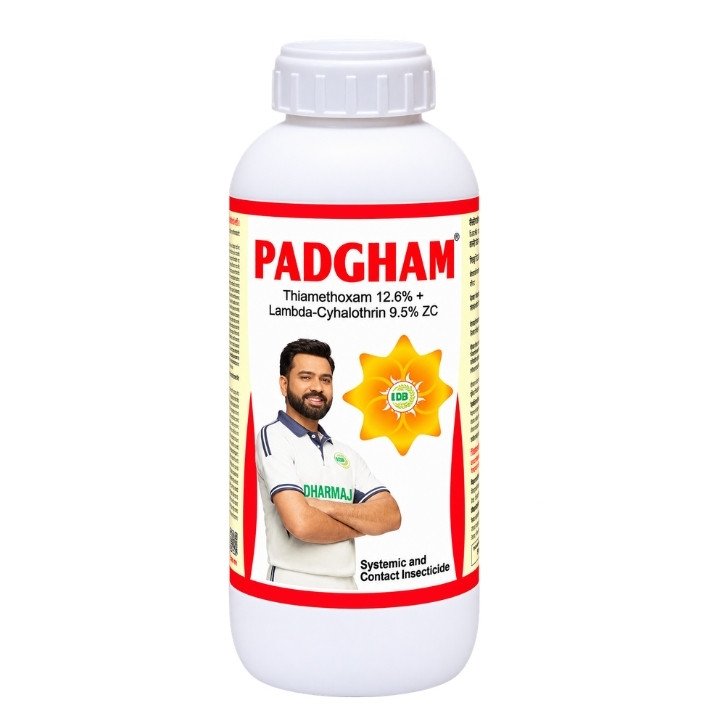
Dharmaj Padgham is a combination insecticide containing Thiamethoxam 12.6% + Lambda-Cyhalothrin 9.5% ZC. It is specially recommended for the management of important sucking and chewing insect pests in cotton, including jassids, thrips and bollworms.
Padgham combines two insecticidal active ingredients with different modes of action. Thiamethoxam provides systemic insecticidal activity, while Lambda-Cyhalothrin provides fast contact and ingestion action. This combination helps provide quick action against susceptible pests and protects the crop from feeding damage when used according to label recommendations.
Product Specifications
Brand
Dharmaj Crop Guard
Product Name
Padgham
Technical Composition
Thiamethoxam 12.6% + Lambda-Cyhalothrin 9.5% ZC
Product Category
Combination Insecticide
Formulation
ZC Formulation
Mode of Action
Systemic + Contact + Stomach Action
IRAC Group – Thiamethoxam
Group 4A – Neonicotinoid
IRAC Group – Lambda-Cyhalothrin
Group 3A – Pyrethroid
Recommended Crop
Cotton
Target Pests
Jassids, Thrips and Bollworms
Application Method
Foliar Spray
Manufacturer / Marketer
Dharmaj Crop Guard Limited
Key Features & Benefits
Dual Active Ingredient: Contains Thiamethoxam and Lambda-Cyhalothrin for effective management of susceptible insect pests.
Systemic & Contact Action: Combines systemic activity with fast contact insecticidal action.
Quick Pest Control: Lambda-Cyhalothrin provides rapid contact and ingestion activity against susceptible insects.
Protection Against Sucking Pests: Thiamethoxam provides effective systemic activity against susceptible sucking pests.
Broad Pest Management: Recommended for jassids, thrips and bollworms in cotton.
Advanced ZC Formulation: Padgham is formulated as an advanced ZC combination formulation.
Two Different Modes of Action: Combines IRAC Group 4A and Group 3A active ingredients.
Helps Reduce Crop Damage: Timely application helps protect cotton plants from feeding damage caused by target insect pests.
How Dharmaj Padgham Works
Padgham works through the combined action of Thiamethoxam and Lambda-Cyhalothrin.
Thiamethoxam
Thiamethoxam belongs to the neonicotinoid group of insecticides (IRAC Group 4A). It acts on nicotinic acetylcholine receptors in the insect nervous system. This disrupts normal nerve transmission, resulting in paralysis and eventual death of susceptible insects.
Thiamethoxam has systemic activity, allowing it to be absorbed into plant tissues and helping protect the crop against susceptible sucking insects.
Lambda-Cyhalothrin
Lambda-Cyhalothrin belongs to the synthetic pyrethroid group (IRAC Group 3A). It acts as a sodium-channel modulator in the insect nervous system.
It provides rapid contact and ingestion action, resulting in nervous-system disruption, knockdown and death of susceptible pests.
Target Pests
Jassids
Thrips
Bollworms
Recommended Crop
Crop
Target Pests
Cotton
Jassids, Thrips and Bollworms
Benefits in Cotton Crop
Helps manage both sucking and chewing insect pests.
Controls susceptible jassids and thrips that damage leaves and tender plant parts.
Helps manage susceptible bollworm infestation.
Helps reduce insect feeding damage.
Provides systemic as well as quick contact action.
Supports healthy crop development by reducing pest pressure.
Useful as part of an Integrated Pest Management programme.
Method of Application
Inspect the cotton crop regularly for target pest infestation.
Shake the product container properly before use.
Measure the recommended quantity according to the current product label.
Mix the required quantity first with a small amount of clean water.
Add the mixture to the spray tank containing the required volume of water.
Mix thoroughly to obtain a uniform spray solution.
Apply as a foliar spray using a suitable agricultural sprayer.
Ensure uniform coverage of the crop canopy and pest-affected areas.
Dosage
Use Dharmaj Padgham only at the crop-specific dosage mentioned on the current product label or leaflet. The exact dose and water volume should be selected according to the registered recommendation, crop stage, pest population and local agricultural guidance.
Important: Do not increase the dosage above the manufacturer's recommendation.
Best Time of Application
Apply when the target pest population reaches the locally recommended economic threshold level.
Early detection and timely spraying generally provide better pest management.
Prefer spraying during calm weather conditions.
Avoid spraying during strong winds.
Avoid spraying immediately before expected heavy rainfall.
Follow local agricultural advisory recommendations for application timing.
Advantages of Dual Mode of Action
Padgham contains two active ingredients belonging to different insecticide groups. This provides complementary insecticidal activity:
Thiamethoxam: Systemic action against susceptible sucking pests.
Lambda-Cyhalothrin: Rapid contact and stomach action against susceptible insects.
Provides activity against different types of cotton pests.
Helps provide quicker reduction in active pest populations.
Resistance Management
Repeated and unnecessary use of insecticides with the same mode of action can encourage the development of resistant insect populations. Padgham should therefore be incorporated into an Integrated Pest Management (IPM) and insecticide resistance-management programme.
Avoid unnecessary repeated applications.
Follow the maximum number of applications permitted on the product label.
Rotate with suitable insecticides having different modes of action where recommended.
Regularly monitor the crop and spray only when required.
Combine chemical control with cultural, mechanical and biological pest-management practices wherever suitable.
Safety Precautions
Use only for agricultural purposes and according to the approved product label.
Read the label and leaflet completely before use.
Wear suitable gloves, protective clothing, mask and eye protection while mixing and spraying.
Avoid inhaling spray mist.
Avoid contact with skin, eyes and mouth.
Do not eat, drink or smoke while handling the insecticide.
Wash hands, face and exposed skin thoroughly after application.
Keep children and animals away from the pesticide and treated area as directed on the label.
Avoid contaminating ponds, streams, canals and other water sources.
Do not reuse an empty pesticide container for household purposes.
Storage Instructions
Keep the product in its original tightly closed container.
Store in a cool, dry and well-ventilated place.
Protect from direct sunlight, moisture and excessive heat.
Store separately from food, animal feed and drinking water.
Keep out of reach of children and animals.
Frequently Asked Questions
What is Dharmaj Padgham?
Dharmaj Padgham is a combination insecticide containing Thiamethoxam 12.6% + Lambda-Cyhalothrin 9.5% ZC.
Which crop is Padgham recommended for?
Dharmaj officially recommends Padgham for use in cotton against specified insect pests.
Which pests does Padgham control in cotton?
Padgham is recommended for the management of jassids, thrips and bollworms in cotton.
Is Padgham a systemic insecticide?
Padgham combines systemic and contact insecticidal activity. Thiamethoxam provides systemic activity while Lambda-Cyhalothrin provides rapid contact and ingestion action.
What is the technical composition of Dharmaj Padgham?
It contains Thiamethoxam 12.6% + Lambda-Cyhalothrin 9.5% ZC.
What does ZC mean in Padgham?
ZC refers to a combination formulation system designed to deliver the two insecticidal active ingredients together in a single formulated product.
What is the dosage of Padgham?
Use only the exact crop-specific dosage mentioned on the latest Dharmaj Padgham product label or leaflet. Do not exceed the recommended dose.
Can Padgham control both sucking and chewing pests?
Yes. Its combination of Thiamethoxam and Lambda-Cyhalothrin provides complementary activity against susceptible sucking and chewing insect pests mentioned on the product label.
Disclaimer
The above information is provided for product-page and agricultural awareness purposes. Always follow the latest Dharmaj Crop Guard product label and leaflet for approved crop, target pest, dosage, water volume, application timing, waiting period, protective equipment and safety precautions. Pesticides should be used responsibly and only according to applicable agricultural regulations.