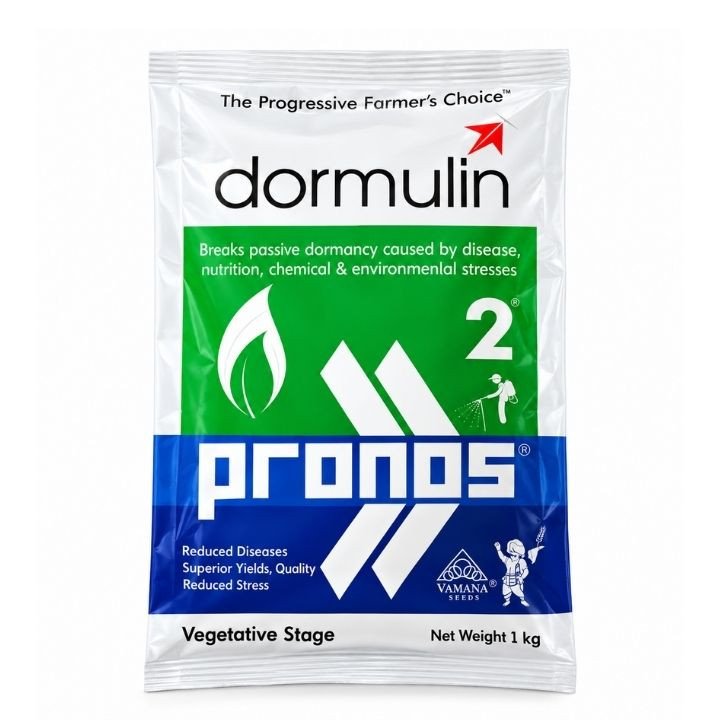
Every farmer has seen it — a crop that's had a rough stretch of weather, a disease scare, or a nutrient gap, and even after the immediate problem is dealt with, growth just doesn't bounce back the way it should. This lingering slowdown is what agronomists call physiological dormancy, and it's often harder to fix than the original stress itself. Fertis Pronos, built around a patented technology called Dormulin, is specifically designed to address this recovery gap rather than just adding another round of standard nutrition.
Marketed as a 5th generation patented fertilizer formulation, Pronos works on the idea that dormancy caused by disease pressure, nutritional deficiency, or environmental stress needs a targeted trigger to reverse — simply applying more of the same nutrients the crop was already getting doesn't necessarily restart normal growth once dormancy sets in.
| Detail | Description |
|---|---|
| Brand | Fertis |
| Product Name | Pronos |
| Technology | Dormulin (Patented, 5th Generation Formulation) |
| Application Method | Foliar Spray |
| Application Stages | Vegetative Stage; Panicle Initiation and Grain Filling Stages |
Pronos isn't meant to be a one-time spray — it's designed around two distinct application windows that correspond to different growth-stage vulnerabilities. The first dose targets the vegetative stage, when the crop is building its foundational structure. The second targets panicle initiation and grain filling, arguably the two most yield-determining stages in a crop's entire life cycle, where nutrient supply directly influences how well grains actually fill out.
| Application | Timing | Mixing Instruction |
|---|---|---|
| Dose 1 | Vegetative Stage | 1 kg Pronos mixed in 200 litres of water, sprayed over one acre of standing crop |
| Dose 2 | Panicle Initiation and Grain Filling Stages | 1 kg Pronos mixed in 200 litres of water, sprayed over one acre of standing crop |
Spraying during the vegetative stage helps establish stronger foundational growth before the plant shifts its energy toward reproductive development. The second dose, timed to panicle initiation and grain filling, arrives precisely when the crop's nutrient demand peaks for reproductive success — this is generally the window where a foliar boost has the most direct influence on final yield outcomes, since nutrient shortfalls at this stage are much harder to correct through soil application alone.
For both doses, the mixing ratio stays consistent — 1 kg of Pronos dissolved thoroughly in 200 litres of water, covering one acre of standing crop. Even, thorough coverage across the crop canopy matters here, since foliar absorption depends directly on how well the spray solution contacts leaf surfaces. As with any foliar application, spraying during cooler parts of the day tends to support better absorption and reduce the risk of leaf scorch under direct sun.
Is Pronos meant to replace regular fertilizer application, or work alongside it?
It's designed as a targeted foliar supplement for specific growth-stage windows rather than a replacement for a crop's regular base fertilization program.
What does "breaking dormancy" actually look like in the field?
It generally shows up as the crop resuming more normal, active growth after a period of stress-induced slowdown, rather than staying stunted or delayed.
Can the two doses be combined into a single spray instead of two separate applications?
The formulation is specifically designed around two distinct timing windows — vegetative stage and panicle initiation/grain filling — since these stages have different physiological needs, so following the two-dose schedule is recommended.
Does this help with disease management directly, or just growth recovery?
It's associated with reduced disease incidence as a secondary benefit, but it functions primarily as a growth and stress-recovery product rather than a dedicated fungicide or pesticide.
Disclaimer: The details provided are for informational guidance only. Always adhere to the recommended application instructions as stated on the product label and in the accompanying leaflet.

No reviews yet.