

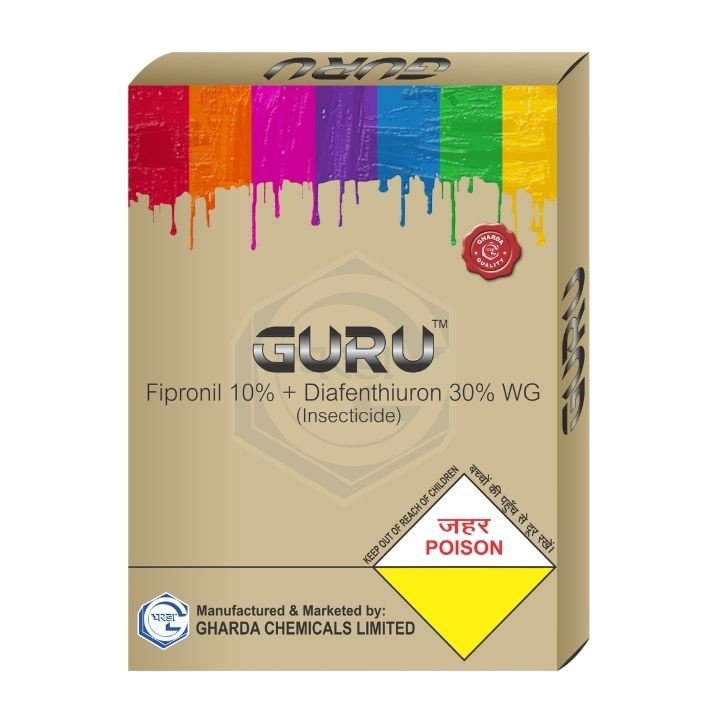
Gharda Guru Insecticide
Gharda Guru: Taking On Cotton's Three Toughest Pests Together
Ask any cotton grower which pests keep them up at night, and jassids, thrips, and pink bollworm come up more often than anything else. What makes this trio particularly frustrating is that they don't all respond to the same insecticide chemistry equally well — a spray that knocks down sucking pests decently might barely touch bollworm larvae hidden inside developing bolls. Gharda Guru was formulated around this exact gap, combining Fipronil 10% and Diafenthiuron 30% in a single WG mixture.
Each active brings something different to the combination. Fipronil works through the GABA-gated chloride channel in the insect nervous system, offering strong activity against jassids and thrips. Diafenthiuron, meanwhile, is a proacaricide/insecticide known for its non-systemic contact and stomach action, along with a distinct vapor-phase effect that helps it reach pests hiding on leaf undersides — a trait that's particularly useful against pink bollworm, which tends to conceal itself well within the plant.
Formulation Details
| Detail | Specification |
|---|---|
| Brand | Gharda |
| Product Name | Guru |
| Active Ingredients | Fipronil 10% + Diafenthiuron 30% |
| Formulation | Water Dispersible Granule (WG), w/w basis |
| Registered Crop | Cotton |
The Pest Complex It's Registered For
Guru's label is specific to cotton, and within that crop it covers three named pests that frequently overlap in the same field during a single season — jassids (Amrasca biguttula biguttula), thrips (Thrips tabaci), and pink bollworm (Pectinophora gossypiella). Pink bollworm in particular has become a growing concern across cotton-growing regions in recent years, given how internal boll damage often goes unnoticed until harvest quality is already compromised.
| Pest | Scientific Name | Typical Damage |
|---|---|---|
| Jassids | Amrasca biguttula biguttula | Leaf hopperburn, reduced photosynthesis |
| Thrips | Thrips tabaci | Leaf curling and silvering |
| Pink Bollworm | Pectinophora gossypiella | Internal boll and lint damage |
Dosage, Water Volume, and Timing
The registered rate works out to 75 gm of Fipronil plus 225 gm of Diafenthiuron active ingredient per hectare, translating to 750 ml of formulated product, diluted in 500 litres of water. A pre-harvest interval of 21 days applies before cotton picking, and a 48-hour re-entry period is specified before workers should go back into the treated field.
| Crop | Target Pests | Dose (per Hectare) | Water Dilution | Pre-Harvest Interval | Re-Entry Period |
|---|---|---|---|---|---|
| Cotton | Jassids, Thrips, Pink Bollworm | 750 ml (75 gm + 225 gm a.i.) | 500 litres | 21 days | 48 hours |
The 48-hour re-entry period is longer than what many standalone insecticides require, largely reflecting the combined toxicity profile of the two actives — this is worth communicating clearly to field workers before spraying rather than assuming standard re-entry timing applies.
Making the Spray Count
Because pink bollworm larvae spend most of their damaging phase inside the boll, timing matters more than usual here — spraying needs to happen before larvae bore into developing bolls, since coverage alone won't reach them once they're inside. For jassids and thrips, thorough leaf coverage including the undersides is important, which is where Diafenthiuron's vapor-phase action offers some additional margin even if spray coverage is imperfect.
Questions That Come Up With This Product
Will Guru still work on pink bollworm if the larvae have already entered the boll?
Its effectiveness is significantly higher when applied before larvae bore into bolls — once inside, physical protection from the boll wall reduces how well any contact-based insecticide can reach them.
Why is the re-entry period 48 hours instead of the more typical 24?
This reflects the combined toxicity profile of Fipronil and Diafenthiuron together, and the longer interval should be respected rather than treated as a general guideline.
Can Guru be used on crops other than cotton if I'm seeing similar pests elsewhere on the farm?
The current registration is specific to cotton for jassids, thrips, and pink bollworm; use on other crops should not be assumed without confirming label registration for that crop.
Does the vapor-phase action of Diafenthiuron mean I can skip spraying leaf undersides?
It provides some additional reach to hidden pests, but thorough spray coverage including leaf undersides is still recommended for the most reliable control.
Disclaimer: The details provided are for informational guidance only. Always adhere to the recommended application instructions as stated on the product label and in the accompanying leaflet.
Frequently Asked Questions about Gharda Guru Insecticide
What is the price of Gharda Guru Insecticide?
The price of Gharda Guru Insecticide starts at Rs. 900 (250 gm) at KisanShop. Final price depends on the pack size you choose.
Which pack sizes of Gharda Guru Insecticide are available?
250 gm, 250 gm x 2, 250 gm x 4. Select the size you need on the product page.
Which brand makes Gharda Guru Insecticide?
Gharda Guru Insecticide is a product of GHARDA CHEMICALS LIMITED, available to buy online at KisanShop.
What payment options are available?
You can pay with UPI, debit or credit cards, or Cash on Delivery (COD, subject to availability for your pincode).
Can I return Gharda Guru Insecticide?
Yes. KisanShop offers a 48 hours easy return. If you receive a wrong, damaged or defective product, we will replace it.
How long does delivery take?
KisanShop offers fast and reliable delivery. Exact delivery time depends on your pincode.
Similar Products

Best Selling

Customer Reviews
Recent Reviews
No reviews yet.