

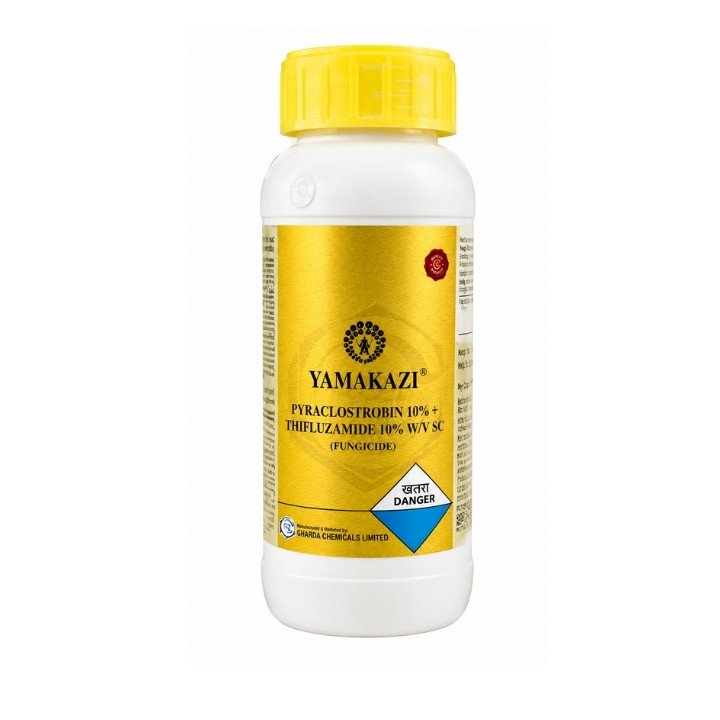
Gharda Yamakazi Fungicide – Pyraclostrobin 10% + Thifluzamide 10% SC
Gharda Yamakazi Fungicide for Sheath Blight and Leaf Blast in Rice
Gharda Yamakazi Fungicide is a dual-action rice fungicide containing Pyraclostrobin 10% and Thifluzamide 10% w/v in an SC formulation. It is recommended for managing sheath blight and leaf blast in rice.
Yamakazi combines two fungicidal groups with complementary modes of action. It provides systemic and translaminar movement along with preventive and curative disease-management activity. Applying it at the early stage of disease development and achieving uniform coverage of rice leaves and sheaths can support better results.
Gharda Yamakazi Fungicide Product Specifications
| Product Name | Yamakazi |
|---|---|
| Brand | Gharda Chemicals Limited |
| Product Category | Agricultural fungicide |
| Technical Name | Pyraclostrobin 10% + Thifluzamide 10% w/v SC |
| Formulation | SC – Suspension Concentrate |
| Recommended Crop | Rice |
| Target Diseases | Sheath blight and leaf blast |
| Application Method | Foliar spray |
| Available Pack Sizes | 500 ml and 1 litre |
| Country of Origin | India |
Technical Composition
| Active Ingredient | Concentration | Chemical Group | FRAC Group |
|---|---|---|---|
| Pyraclostrobin | 10% w/v | Strobilurin/QoI fungicide | Group 11 |
| Thifluzamide | 10% w/v | SDHI fungicide | Group 7 |
| Formulation | Suspension Concentrate (SC) | ||
Key Features
- Dual-action fungicide containing Pyraclostrobin and Thifluzamide.
- Recommended for sheath blight and leaf blast management in rice.
- Provides systemic and translaminar movement within treated plant tissue.
- Supports both preventive and curative disease-management programmes.
- Combines FRAC Group 11 and Group 7 fungicidal modes of action.
- Helps protect rice leaves and sheaths from label-listed fungal diseases.
- Suitable for application when disease incidence is observed in the crop.
Benefits for Farmers
- Helps manage two important fungal diseases of rice with one formulation.
- Supports protection of both the treated leaf surface and inner leaf tissue.
- Helps restrict disease development when applied at the appropriate stage.
- Supports healthy green foliage under proper disease-management practices.
- Two fungicidal groups help support resistance-management programmes.
- May help protect crop yield potential by reducing disease-related damage.
Recommended Crop and Target Diseases
| Crop | Target Disease | Typical Symptoms |
|---|---|---|
| Rice | Sheath blight | Oval or irregular lesions on lower leaf sheaths that may move upward under humid conditions and dense crop growth |
| Rice | Leaf blast | Spindle-shaped leaf lesions that can enlarge and reduce healthy photosynthetic leaf area |
Dosage and Application Method
| Crop | Target Diseases | Dose per Hectare | Approximate Dose per Acre | Water Volume |
|---|---|---|---|---|
| Rice | Sheath blight and leaf blast | 800–900 ml | Approximately 320–360 ml | 500 litres/ha or approximately 200 litres/acre |
The recommended spray concentration works out to approximately 1.6–1.8 ml per litre when 800–900 ml of formulation is mixed in 500 litres of water. The exact field quantity should always be calculated according to the product label, treated area and recommended water volume.
Application Information
| Application Method | Foliar spray |
|---|---|
| Best Application Stage | Apply when disease incidence is observed and before infection becomes severe across the field |
| Maximum Number of Sprays | One to two sprays, depending on disease incidence and label guidance |
| Spray Interval | 10–15 days, if repeat application is necessary |
| Pre-Harvest Interval | 18 days |
| Re-entry Period | 24 hours after application |
How to Use Gharda Yamakazi
- Read the complete product label and leaflet before application.
- Shake the Yamakazi container properly before measuring the formulation.
- Fill the spray tank approximately halfway with clean water.
- Measure the required quantity according to the treated rice area.
- Mix the measured product in a small quantity of water.
- Add the prepared mixture to the spray tank while stirring.
- Add the remaining water and maintain proper agitation.
- Spray uniformly over the rice canopy, leaves and sheaths.
- Ensure coverage of lower crop portions where sheath blight commonly develops.
- Use the prepared spray solution on the same day.
Mode of Action
Pyraclostrobin is a QoI fungicide that acts at the mitochondrial respiration process of susceptible fungi. It inhibits electron transport at the Qo site of Complex III, interfering with energy production and helping prevent spore germination and fungal development.
Thifluzamide is an SDHI fungicide that inhibits succinate dehydrogenase in fungal mitochondrial respiration. This restricts energy production and disrupts the growth and development of susceptible fungal pathogens.
The combination provides complementary preventive and curative activity along with systemic and translaminar movement in treated rice foliage.
Why Farmers Can Choose Gharda Yamakazi
- Officially recommended for sheath blight and leaf blast in rice.
- Two active ingredients with complementary fungicidal action.
- Systemic and translaminar movement for improved foliage protection.
- Supports preventive as well as early curative disease management.
- Suitable for one or two label-directed applications based on disease incidence.
- Manufactured and marketed by Gharda Chemicals Limited.
Frequently Asked Questions
What is Gharda Yamakazi Fungicide?
Yamakazi is a rice fungicide containing Pyraclostrobin 10% and Thifluzamide 10% w/v in a Suspension Concentrate formulation.
Which diseases does Yamakazi control?
It is recommended for the management of sheath blight and leaf blast in rice.
What is the Yamakazi dose per acre?
The hectare recommendation of 800–900 ml is approximately equivalent to 320–360 ml per acre. Use about 200 litres of water per acre when following the official water-volume recommendation.
What is the Yamakazi dose per litre of water?
Based on the official recommendation of 800–900 ml in 500 litres of water, the calculated concentration is approximately 1.6–1.8 ml per litre. Maintain the total recommended dose for the treated area.
When should Yamakazi be applied?
Apply when sheath blight or leaf blast incidence is observed. Early application generally provides better disease-management support than waiting until infection becomes severe.
How many Yamakazi sprays can be applied?
One to two sprays may be applied at an interval of 10–15 days according to disease incidence and label guidance.
What is the waiting period after spraying Yamakazi?
Maintain a minimum pre-harvest interval of 18 days after the last application.
When can workers re-enter the treated field?
The official re-entry period is 24 hours after application. If earlier entry is unavoidable, follow the protective-equipment instructions stated on the label.
Can Yamakazi be mixed with another agrochemical?
Tank-mix only when allowed by both product labels and after confirming compatibility. Avoid unverified mixtures and consult an agricultural specialist when compatibility information is unavailable.
Disclaimer: The details provided are for informational guidance only. Always adhere to the recommended application instructions as stated on the product label and in the accompanying leaflet.
Similar Products

Best Selling

Customer Reviews
Recent Reviews
No reviews yet.