

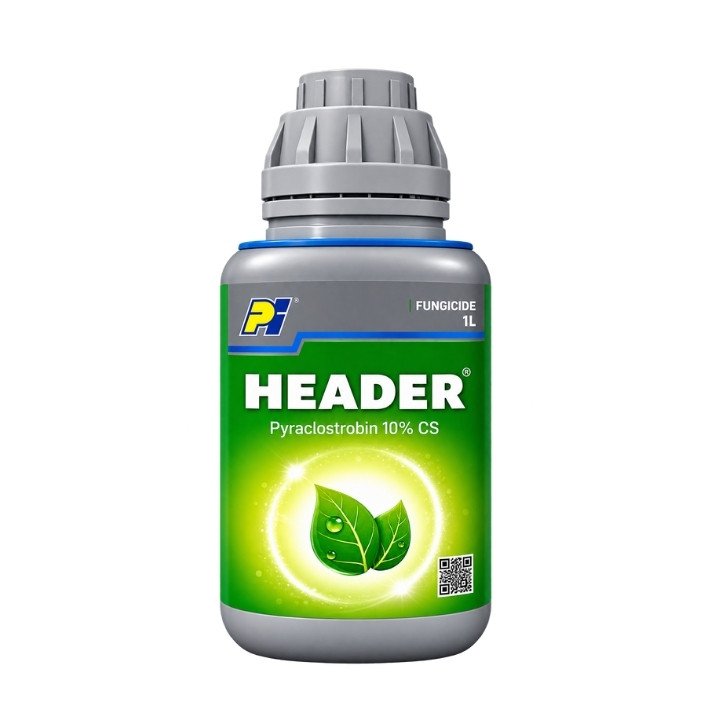
PI Header Fungicide - Pyraclostrobin 10% CS
PI Header Pyraclostrobin 10% CS Fungicide for Rice Blast
PI Header is a specialised systemic fungicide containing Pyraclostrobin 10% CS. It is developed for the management of blast disease in rice and provides crop-health benefits when used according to the product label.
Header belongs to the strobilurin or QoI group of fungicides. Its unique capsule-suspension formulation releases the active ingredient in a controlled manner, supporting sustained protection against rice blast.
Effective blast management helps preserve healthy foliage and the flag leaf. Under suitable crop-management conditions, this supports grain development, uniformity and crop yield potential.
PI Header Product Specifications
| Specification | Details |
|---|---|
| Product Name | PI Header Fungicide |
| Brand | PI Industries |
| Common Name | Pyraclostrobin |
| Technical Content | Pyraclostrobin 10% CS |
| Formulation | Capsule Suspension (CS) |
| Product Type | Systemic fungicide |
| Chemical Group | Strobilurin / Quinone Outside Inhibitor |
| FRAC Group | Group 11 |
| Recommended Crop | Rice |
| Target Disease | Rice blast |
| Application Method | Foliar spray only |
| Registered Dose | 1000 ml per hectare |
| Approximate Dose per Acre | Approximately 400 ml |
| Pack Size Shown | 1 litre |
| Other Available Pack | 400 ml |
Technical Composition
| Component | Concentration |
|---|---|
| Pyraclostrobin active ingredient | 10% |
| Formulation ingredients | Quantity sufficient to make the capsule-suspension formulation |
What Is CS Formulation?
CS means Capsule Suspension. In this formulation, the active ingredient is held in small capsules suspended in a liquid medium. The specialised formulation supports controlled release and sustained availability of Pyraclostrobin on treated rice foliage.
The CS formulation is one reason PI specifically instructs users not to add a separate spreader or sticker with Header. Unrecommended additives may interfere with formulation behaviour, spray deposition or crop safety.
Mode of Action
Pyraclostrobin is a FRAC Group 11 Quinone Outside Inhibitor fungicide. It binds to the Qo site of the cytochrome bc1 complex within fungal mitochondria.
This blocks mitochondrial electron transport and disrupts cellular respiration. Without adequate energy production, susceptible fungi cannot grow and develop normally, helping control rice blast infection.
Key Features of PI Header
- Rice-Blast Speciality: Specifically recommended for the management of blast disease in rice.
- QoI Fungicide: Blocks fungal mitochondrial respiration and energy production.
- Systemic Action: Provides protection through absorption and movement in treated plant tissue.
- Unique CS Formulation: Supports sustained protection against rice blast.
- Flag-Leaf Support: Effective disease management helps maintain healthy and functional flag leaves.
- Nitrate-Reductase Activity: PI states that Header supports higher nitrate-reductase activity under suitable crop conditions.
- Grain-Development Support: Healthy crop foliage supports uniform and bolder grain development.
Benefits for Rice Farmers
- Provides specialised protection against rice blast.
- Helps restrict disease development on susceptible rice foliage.
- Supports a healthier and greener flag leaf.
- Helps preserve photosynthetically active leaf area.
- Supports uniform panicle and grain development under proper management.
- May help improve nitrogen-use processes in healthy treated crops.
- Offers sustained protection through its capsule-suspension formulation.
- Can be included in a planned rice disease-management programme.
Crop, Disease and Dosage
| Crop | Target Disease | Active Ingredient Dose | Formulation Dose | Approximate Acre Dose |
|---|---|---|---|---|
| Rice | Blast | 100 g active ingredient per hectare | 1000 ml per hectare | Approximately 400 ml per acre |
Dose note: The acre rate is a rounded conversion from the official hectare recommendation. Use sufficient clean water for uniform coverage and follow the water volume stated on the current Header label or leaflet.
Pack Coverage
| Pack Size | Approximate Coverage at Label Rate |
|---|---|
| 400 ml | Approximately 1 acre |
| 1 litre | 1 hectare or approximately 2.47 acres |
Coverage is calculated from the registered rate of 1000 ml per hectare. Actual field measurement should be based on the treated area and a properly calibrated sprayer.
Recommended Application Method
Apply PI Header through foliar spraying only. It is not recommended for soil application, seed treatment, root dipping, drip irrigation or any other method unless specifically added to a current product label.
How to Apply PI Header
- Inspect the rice crop regularly for initial blast symptoms.
- Confirm that the observed disease is rice blast.
- Calculate the required product quantity according to the treated area.
- Wear the personal protective equipment specified on the label.
- Half-fill the spray tank with clean water.
- Add other permitted tank-mix products in their recommended sequence.
- Add PI Header as the final tank-mix partner.
- Add the remaining water and maintain gentle agitation.
- Do not add a separate spreader or sticker.
- Spray uniformly over the rice foliage.
- Avoid excessive spray runoff and drift.
- Use the prepared spray solution on the same day.
Essential Tank-Mixing Instructions
- Add Header last: Always add PI Header as the final tank-mix partner.
- No spreader: Do not add any spreader with Header.
- No sticker: Do not use a sticker or sticking agent with Header.
- Tank-mix only with products permitted by all applicable labels.
- Conduct a small jar test before preparing an unfamiliar mixture.
- Do not use mixtures that produce sediment, flakes, heat, excessive foam or separation.
When to Apply Header for Rice Blast
Apply Header according to the crop and disease timing printed on the current label. For best disease management, monitor the field regularly and begin treatment during the early stage of blast development rather than waiting for severe infection.
- Inspect rice leaves for spindle-shaped blast lesions.
- Monitor the crop more closely during weather favourable for blast.
- Protect important crop stages according to local disease risk.
- Apply during early morning or late evening when wind speed is low.
- Avoid spraying immediately before expected rainfall.
Rice Blast Symptoms
| Blast Type | Typical Symptoms |
|---|---|
| Leaf Blast | Spindle-shaped lesions with grey centres and brown margins on leaves |
| Collar Blast | Infection near the junction of the leaf blade and leaf sheath |
| Node Blast | Darkened or weakened nodes that may break under severe infection |
| Neck/Panicle Blast | Infection around the panicle neck that can affect grain filling |
Disease diagnosis should be confirmed before spraying because nutritional disorders, bacterial diseases and other fungal infections may produce superficially similar symptoms.
Resistance Management
Pyraclostrobin belongs to FRAC Group 11. Repeated use of QoI fungicides can select resistant fungal populations. PI advises using a molecule from a different group for the subsequent application.
- Do not make repeated consecutive Header applications.
- Use a fungicide with a different FRAC group for the next application.
- Apply the complete recommended dose.
- Do not use a reduced dose to cover additional land.
- Apply preventively or during the early disease stage.
- Follow resistant-variety, sanitation and balanced-nutrition practices.
- Use Header as part of an integrated disease-management programme.
Crop-Health Benefit Guidance
Header is promoted with crop-health benefits such as a healthier flag leaf, higher nitrate-reductase activity and support for uniform, bolder grains. These benefits depend on effective blast management and proper crop nutrition, irrigation and cultivation practices.
Header is a fungicide and does not replace nitrogen, phosphorus, potassium, micronutrients or other essential components of a balanced rice-nutrition programme.
Precautions
- Use personal protective equipment during mixing and spraying.
- Read and follow the product label and leaflet carefully.
- Do not use Header on crops other than those stated on the label.
- Use only through foliar application.
- Do not add any spreader or sticker.
- Add Header last when preparing a permitted tank mixture.
- Avoid inhaling spray mist and prevent contact with skin and eyes.
- Do not eat, drink, smoke or chew while handling the fungicide.
- Do not spray against the wind.
- Prevent contamination of ponds, canals and drinking-water sources.
- Follow the label directions regarding re-entry and harvest intervals.
Toxicity and Antidote Information
| Safety Detail | Information |
|---|---|
| Toxicity Triangle | Blue triangle |
| Label Classification | Moderately toxic |
| Cautionary Word | Danger |
| Specific Antidote | No specific antidote is known |
| Treatment | Treat symptomatically under medical supervision |
In case of suspected poisoning or significant exposure, obtain medical assistance immediately and show the attending medical professional the Header container label and leaflet.
Storage and Disposal
- Store Header in its original container with the cap tightly closed.
- Keep it in a cool, dry, locked and well-ventilated pesticide store.
- Protect the container from direct sunlight and excessive heat.
- Keep away from children, animals, food, beverages, seed and animal feed.
- Do not transfer the fungicide into a food or beverage container.
- Do not reuse the empty container for household or agricultural storage.
- Dispose of empty packaging according to the label and applicable regulations.
Why Farmers Can Choose PI Header
- Specialised Pyraclostrobin 10% CS formulation.
- Registered specifically for rice-blast management.
- Systemic QoI fungicidal action.
- Unique capsule-suspension formulation for sustained protection.
- Supports healthy flag-leaf function under proper crop management.
- Clear registered dose of 1000 ml per hectare.
- Available in practical 400 ml and 1-litre packs.
Frequently Asked Questions
What is PI Header used for?
PI Header is a systemic fungicide registered for managing blast disease in rice.
What is the technical content of Header?
Header contains Pyraclostrobin 10% in a capsule-suspension formulation.
What is the dose of PI Header per hectare?
Apply 1000 ml of Header per hectare, providing 100 g of Pyraclostrobin active ingredient.
What is the dose of PI Header per acre?
The rounded equivalent is approximately 400 ml per acre. Measure according to the actual treated area and follow the current product label.
How much area does a 1-litre bottle cover?
At the registered rate, one litre covers one hectare or approximately 2.47 acres.
What does CS mean in Header Fungicide?
CS means Capsule Suspension. The active ingredient is held in small capsules suspended in liquid, supporting controlled release and sustained protection.
Can a spreader or sticker be used with Header?
No. PI specifically instructs users not to use any spreader or sticker with Header.
When should Header be added to a tank mixture?
Header must always be added as the final tank-mix partner after the other permitted products have been properly dispersed.
Can Header be applied through drip irrigation?
No. PI recommends Header through foliar application only for rice-blast management and associated crop-health benefits.
Can Header be used repeatedly?
Repeated consecutive applications should be avoided. Use a fungicide having a different FRAC mode-of-action group for the subsequent treatment to reduce resistance risk.
Does Header increase yield?
Effective blast control and maintenance of healthy flag leaves can support crop yield and grain-quality potential. A fixed yield increase cannot be guaranteed because results also depend on variety, disease pressure, weather, nutrition and crop management.
What is the waiting period after spraying?
A specific pre-harvest interval is not stated in the supplied official online information. Follow the waiting-period instructions printed on the current Header container and leaflet.
Disclaimer: This information is provided for general agricultural guidance only. Always follow the current product label and accompanying leaflet for approved crops, diseases, dosage, water volume, application timing, tank mixing, safety instructions and waiting period.
Similar Products

Best Selling
Customer Reviews
Recent Reviews
No reviews yet.