

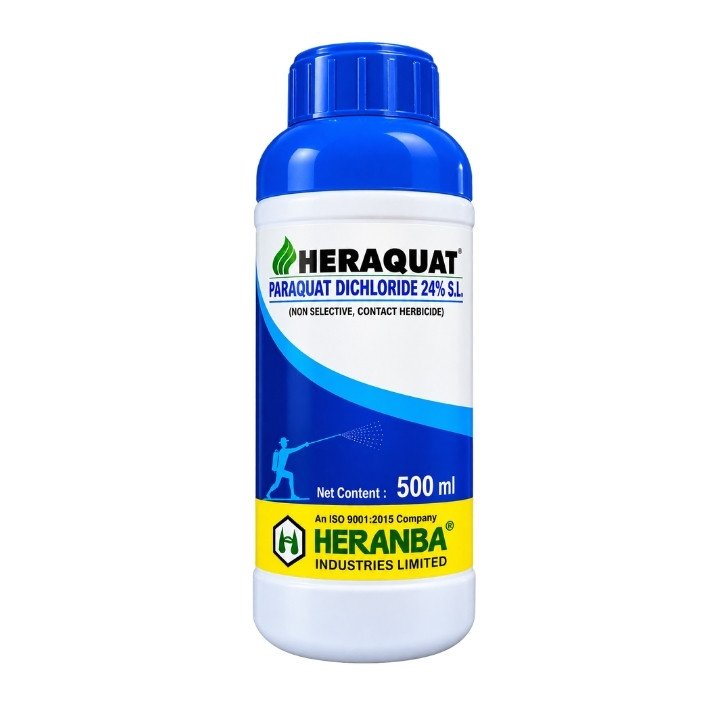
Heranba Heraquat Herbicide – Paraquat Dichloride 24% SL
Heranba Heraquat – Paraquat Dichloride 24% SL Contact Herbicide
Heranba Heraquat is a non-selective contact herbicide containing Paraquat Dichloride 24% SL. It is used for controlling emerged grassy and broadleaf weeds through label-approved directed inter-row, pre-plant or other specified applications.
Heraquat is absorbed mainly through green foliage and acts rapidly on the contacted plant tissue, with some movement through the xylem. Because it is non-selective, spray contact with the green leaves, shoots, bark or other susceptible parts of the main crop can cause serious crop injury.
This product must be applied only to the crops, weeds, timings and doses stated on its current label. Never use it as an unrestricted over-the-top spray on a standing crop.
Heranba Heraquat Product Specifications
| Specification | Details |
|---|---|
| Product Name | Heranba Heraquat |
| Trade Name | Heraquat |
| Manufacturer | Heranba Industries Limited |
| Technical Name | Paraquat Dichloride 24% SL |
| Product Category | Herbicide |
| Herbicide Type | Non-selective contact herbicide |
| Formulation | SL – Soluble Liquid |
| Primary Absorption | Through green foliage |
| Movement | Primarily contact action with some xylem translocation |
| Application Type | Directed inter-row, pre-plant or other label-approved application |
| Pack Size Shown | 500 ml |
Key Features
- Non-Selective Action: Controls susceptible green vegetation contacted by the spray.
- Contact Herbicide: Acts mainly on the foliage and plant tissue receiving spray coverage.
- Post-Emergence Weed Control: Intended primarily for controlling weeds that have already emerged.
- Broad Weed Spectrum: Label recommendations cover several grassy, broadleaf and sedge weeds.
- Multiple Label-Approved Uses: Recommended for specified applications in crops including tea, potato, cotton, rubber, coffee, sugarcane, sunflower, rice, wheat, maize, grapes and apple.
- Directed Application: Useful for inter-row weed management where crop foliage can be completely protected from spray.
Mode of Action
Heraquat is absorbed by the green foliage of emerged weeds. As a contact herbicide, it damages the plant tissue directly reached by the spray. Uniform foliage coverage is therefore important for satisfactory control.
Paraquat has limited movement compared with a fully systemic herbicide. Established perennial weeds may regrow from roots, rhizomes or other underground structures after the treated foliage is damaged. Repeat spot treatment should be undertaken only where permitted by the current product label.
Approved Crops, Target Weeds and Dosage
| Crop or Use | Application Timing | Target Weeds | Dose per Hectare |
|---|---|---|---|
| Tea | Directed inter-row application when weeds are at the 2–3 leaf stage | Imperata, Setaria species, Commelina benghalensis, Boerhavia hispida and Paspalum conjugatum | 0.8–4.25 litres |
| Tea – season-long programme | Initial application followed by label-approved spot treatment where required | Label-listed weeds | Initial application: 2.5–5 litres; subsequent spot application: 1 litre |
| Potato | Overall or inter-row application at 5–10% crop emergence, strictly according to label | Chenopodium species, Anagallis arvensis, Trianthema monogyna, Cyperus rotundus and Fumaria parviflora | 2 litres |
| Cotton | Directed inter-row application when weeds are at the 2–3 leaf stage | Digera arvensis, Cyperus iria, Trianthema monogyna, Corchorus species and Leucas aspera | 1.25–2 litres |
| Rubber | Directed inter-row application when weeds are at the 2–3 leaf stage | Digitaria species, Eragrostis species and Fimbristylis species | 1.5–2.5 litres |
| Coffee | Use only according to the current label | Digitaria marginata, Paspalum conjugatum, Ageratum conyzoides, Borreria hispida, Euphorbia hirta, Commelina benghalensis and Eleusine indica | 1 litre |
| Sugarcane | Use only according to the current label | Echinochloa crus-galli, Digitaria sanguinalis, Eleusine indica, Physalis minima and Portulaca oleracea | 2 litres |
| Sunflower | Use only according to the current label | Cyperus iria, Eleusine indica, Eragrostis species, Chenopodium album and Trianthema monogyna | 1.6 litres |
| Rice | Pre-plant minimum-tillage application before sowing or transplanting to standing weeds | Echinochloa crus-galli, Cyperus iria, Ageratum conyzoides, Commelina benghalensis, Marsilea quadrifolia and Brachiaria mutica | 1.25–3.5 litres |
| Wheat | Pre-plant minimum-tillage application before sowing | Grassy and broadleaf weeds | 4.25 litres |
| Maize – pre-plant | Minimum-tillage application before sowing | Cyperus rotundus, Commelina benghalensis, Trianthema monogyna, Amaranthus species and Echinochloa species | 0.8–2 litres |
| Maize – standing crop | Directed inter-row application when weeds are at the 2–3 leaf stage | Cyperus iria, Cyperus rotundus, Commelina benghalensis, Amaranthus species, Echinochloa species and Trianthema monogyna | 0.8–2 litres |
| Grapes | Directed inter-row application when weeds are at the 2–3 leaf stage | Cyperus rotundus, Cynodon dactylon, Convolvulus species, Portulaca species and Tridax species | 2 litres |
| Apple | Directed inter-row application when weeds are at the 2–3 leaf stage | Rosa moschata, Rosa eglanteria and Rubus ellipticus | 3.25 litres |
| Waterways | Only where explicitly permitted by the current label and local regulations | Eichhornia crassipes | 4.25 litres |
| Canals | Only where explicitly permitted by the current label and local regulations | Hydrilla | 4.25 litres |
| Ponds | Only where explicitly permitted by the current label and local regulations | Typha latifolia | 4.25–8.5 litres |
Dose note: The recommendations above are expressed per hectare. Do not calculate the required dose solely from pack size. Confirm the crop, weed, application stage, water volume and dose from the current product label before spraying.
Approximate Dose Conversion per Acre
| Dose per Hectare | Approximate Equivalent per Acre |
|---|---|
| 0.8 litre | 324 ml |
| 1 litre | 405 ml |
| 1.25 litres | 506 ml |
| 1.5 litres | 607 ml |
| 1.6 litres | 648 ml |
| 2 litres | 809 ml |
| 2.5 litres | 1.01 litres |
| 3.25 litres | 1.32 litres |
| 3.5 litres | 1.42 litres |
| 4.25 litres | 1.72 litres |
Conversion caution: These are mathematical conversions only. The current Indian product label is the controlling recommendation and must be followed.
Application Instructions
- Read the complete label and leaflet before opening the container.
- Confirm that the intended crop, weed and application stage appear on the label.
- Wear the protective equipment specified on the product label.
- Measure only the recommended quantity for the treated area.
- Use clean water and calibrated spraying equipment.
- Use a hood or protective shield for directed inter-row spraying where appropriate.
- Keep spray completely away from green crop foliage, shoots and susceptible bark.
- Spray emerged and actively growing weeds uniformly without excessive runoff.
- Avoid application during strong wind or when spray drift may reach crops or nearby vegetation.
- Do not enter the treated area until the label-specified re-entry period has passed.
- Clean the sprayer safely after use without contaminating wells, canals or drinking-water sources.
Important Crop-Safety Precautions
- Heraquat is non-selective and can damage any green plant tissue contacted by spray.
- Never spray over the top of a standing crop unless the product label specifically permits that exact use.
- Use directed inter-row spraying only where the crop can be protected completely.
- Do not allow spray drift onto neighbouring crops, ornamental plants or trees.
- Do not apply with leaking or poorly calibrated equipment.
- Do not use a higher dose or repeat treatment more frequently than the label permits.
- Do not mix with another agrochemical unless both labels permit the combination.
Human and Environmental Safety
Paraquat is highly hazardous if swallowed and can also cause serious harm through unsafe handling. Keep the product in its original labelled container, locked away from children, food, animal feed and household articles.
- Never transfer the product into a beverage, food or unlabelled container.
- Do not eat, drink, smoke or chew while mixing or spraying.
- Avoid inhalation of spray mist and contact with skin or eyes.
- Use protective clothing, gloves, footwear and face or eye protection as required by the label.
- Wash exposed skin and contaminated clothing thoroughly after spraying.
- Do not contaminate drinking water, irrigation sources or fish-bearing water.
- Dispose of empty containers according to label instructions; never reuse them.
First-Aid Warning
If swallowed or exposure is suspected, treat it as a medical emergency. Do not wait for symptoms. Immediately contact a doctor or poison-treatment facility and carry the product container or label. Do not induce vomiting or give anything by mouth unless directed by a medical professional or the product label.
There is no specific antidote stated for paraquat poisoning; treatment is symptomatic and supportive under urgent medical supervision.
Why Choose Heranba Heraquat?
- Contains Paraquat Dichloride 24% SL.
- Non-selective contact action on emerged weeds.
- Label recommendations for grassy, broadleaf and sedge weeds.
- Suitable for specified directed inter-row and pre-plant applications.
- Manufactured by Heranba Industries Limited.
- Available in a convenient 500 ml pack as shown.
Frequently Asked Questions
What is the technical name of Heranba Heraquat?
Heraquat contains Paraquat Dichloride 24% SL.
Is Heraquat a selective herbicide?
No. It is a non-selective contact herbicide and can damage any susceptible green plant tissue reached by the spray.
Can Heraquat be sprayed directly over a standing crop?
Generally, no. Standing-crop uses require a carefully directed inter-row spray unless the current label specifically permits another method for that crop.
Does Heraquat kill weeds from the roots?
It acts mainly on contacted foliage and is not a fully systemic root-killing herbicide. Established perennial weeds may regrow from underground roots, rhizomes or tubers.
Can Heraquat be used before sowing rice, wheat or maize?
The supplied recommendations include specified pre-plant minimum-tillage applications. Apply only before sowing or transplanting and strictly according to the current label.
Can a 500 ml pack be used on one acre?
The required quantity depends on the crop and label dose. A 500 ml pack is close to the mathematical acre equivalent of 1.25 litres per hectare, but it is not the correct dose for every crop or use.
Can Heraquat be mixed with other herbicides?
Use a tank mixture only when the labels of all products specifically permit it. Do not prepare an unapproved mixture.
Is Heraquat manufactured by Sumitomo?
No. The attached product is manufactured by Heranba Industries Limited.
Disclaimer: This information is provided only as a summary of the supplied and manufacturer-published recommendations. Always adhere to the current product label and accompanying leaflet. Paraquat is hazardous and must be handled only by trained adults using the prescribed protective equipment.
Similar Products
Best Selling
Customer Reviews
Recent Reviews
No reviews yet.