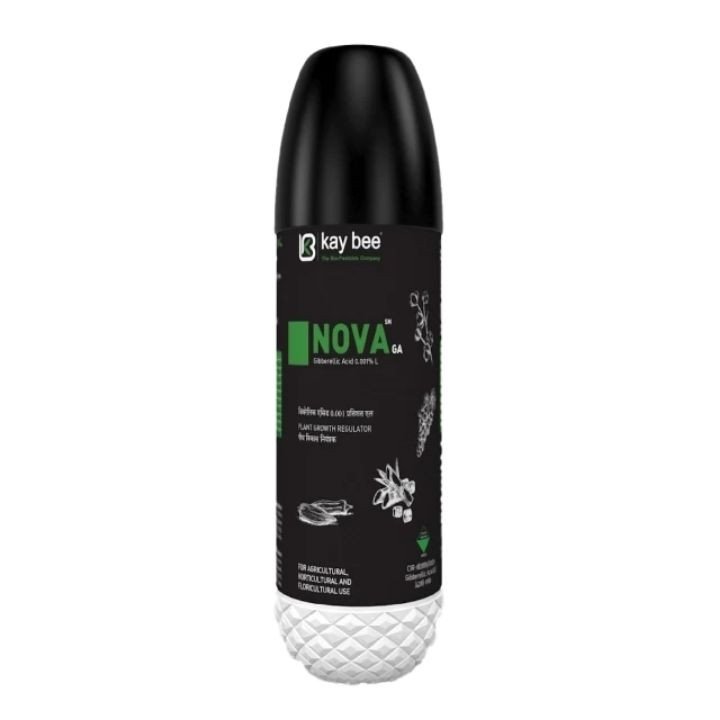
Gibberellic acid occupies a strange middle ground in crop nutrition — it isn't a nutrient in the traditional sense, yet its effect on plant development can be more visible than many fertilizers. Kay Bee Nova GA, formulated at 0.001% Gibberellic Acid, works by entering plant cells through stomatal openings and engaging in a range of enzymatic and structural processes, most notably driving cellular elongation that translates directly into visible growth.
What makes gibberellic acid distinct from standard fertilizers is that it doesn't primarily feed the plant — it signals the plant's own genetic machinery to behave differently. This is why its effects show up as structural and developmental changes: longer internodes, larger leaves, and notably, activation of genes tied to flowering, rather than the kind of nutrient-deficiency correction typical of an NPK-based product.
| Detail | Specification |
|---|---|
| Brand | Kay Bee Bio-Organics Pvt. Ltd. |
| Product Name | Nova GA |
| Active Component | Gibberellic Acid 0.001% |
| Category | Plant Growth Regulator (PGR) |
| Application Method | Foliar Spray |
Once inside the plant, gibberellic acid triggers a cascade of enzymatic activity that supports cell elongation and division, particularly in stems and leaves. But its role isn't limited to vegetative expansion — the same hormonal signaling activates genes associated with flowering initiation, which is why Nova GA is used not just for general vigour but specifically to encourage earlier and more prolific flowering and fruit set in many of its recommended crops.
| Crop Category | Examples |
|---|---|
| Cereal Crops | Paddy and similar cereals |
| Oilseed Crops | Groundnut and similar oilseeds |
| Cash Crops | Sugarcane, Cotton |
| Vegetable Crops | Tomato, Brinjal, Okra, Cabbage, Cauliflower |
| Fruit & Plantation Crops | Bananas, Grapes, Tea |
| Tuber & Bulb Crops | Potato |
This breadth across cereal, oilseed, cash, vegetable, fruit, and tuber crop categories reflects how gibberellic acid's cellular-level mechanism applies fairly universally across plant types, rather than being tied to one specific crop physiology.
Dosage sits at 2 ml per litre of water as a foliar spray, but timing matters more with Nova GA than with many standard nutritional sprays. Application should happen during the cooler morning or evening hours — spraying during peak noon heat is specifically discouraged, since high temperatures can interfere with how effectively the gibberellic acid is absorbed and utilized by the plant.
One practical caution: Nova GA is not compatible with sulphur-based products, copper-based fungicides, or Bordeaux mixture. This isn't a minor footnote — tank-mixing with any of these can compromise the product's effectiveness, so it's worth checking the spray schedule to ensure Nova GA isn't accidentally combined with, or applied too close to, treatments involving these specific chemistries.
Is Nova GA a fertilizer or something different?
It functions as a plant growth regulator rather than a traditional fertilizer — instead of primarily supplying nutrients, it triggers hormonal and genetic activity that drives cell elongation and flowering.
Why can't Nova GA be applied during the afternoon?
High noon-time temperatures can interfere with the plant's absorption and utilization of gibberellic acid, so morning or evening application during cooler hours is recommended for better results.
Can Nova GA be tank-mixed with copper-based fungicides?
No, it's specifically noted as non-compatible with sulphur, copper-based fungicides, and Bordeaux mixture, so these should be kept separate in the spray schedule.
Does Nova GA help with flowering, or just vegetative growth?
Both — while it drives vegetative cell elongation, it also activates genes tied to flowering, making it useful for supporting increased flowering and fruiting alongside general growth.
Disclaimer: The details provided are for informational guidance only. Always adhere to the recommended application instructions as stated on the product label and in the accompanying leaflet.

No reviews yet.