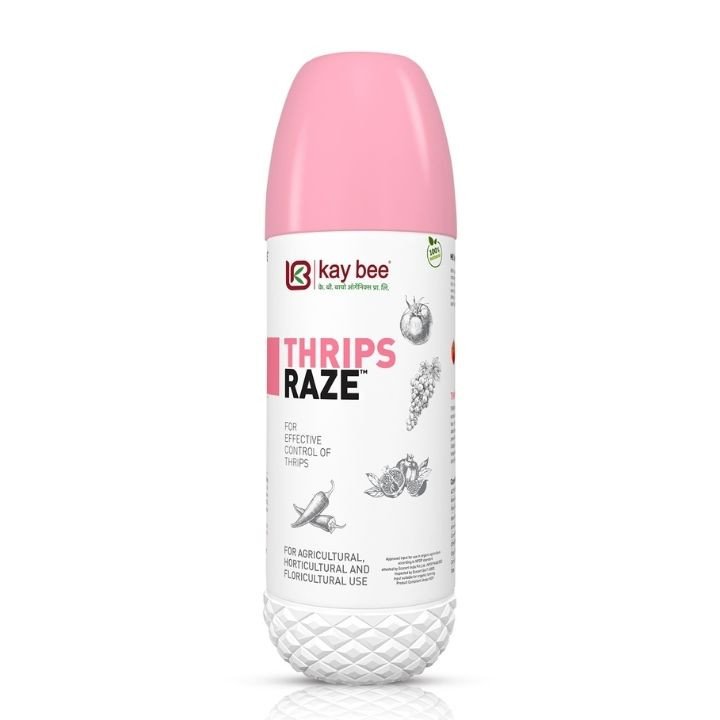
Thrips are among the more frustrating pests to manage long-term, largely because their short life cycle and rapid reproduction give them a head start in developing resistance to conventional chemistry. Kay Bee's Thrips Raze Black Special takes a different route entirely — it's formulated using marker compounds derived from botanical extracts, designed specifically around a multi-level mode of action that the product's own documentation claims makes resistance development essentially unable to establish.
That claim is backed by an unusually layered mechanism. Rather than relying on a single toxic pathway, Thrips Raze works through contact, systemic, and fumigant action simultaneously — antifeedent effects, desiccation, cytolysis, and knockout impact on neonates and early instars, combined with stomach poisoning, anti-molting hormonal disruption, neurotoxicity, and insect growth regulator (IGR) activity against later instars. The idea is that hitting the pest through this many simultaneous routes overwhelms its detoxification capacity before resistance has a chance to build.
| Detail | Specification |
|---|---|
| Brand | Kay Bee Bio-Organics |
| Product Name | Thrips Raze Black Special |
| Category | Bio-Pesticide (Botanical Extract Based) |
| Mode of Action | Contact, Systemic, and Fumigant |
| Application Method | Foliar Spray |
| Residue Profile | Residue-free, suitable for organic and export production |
What separates Thrips Raze's mode of action from many conventional thrips insecticides is how it targets different life stages through different mechanisms. Neonates and early instars are hit through antifeedent activity, desiccation, and a cytolytic knockout effect, essentially preventing the youngest thrips from feeding and surviving. Later instars face a separate set of pressures — stomach poisoning, hormonal disruption that interferes with molting, and neurotoxic effects. This staged approach means the product doesn't rely on catching every thrips at the same vulnerable point in its life cycle.
| Crop | Target Pest | Dosage (ml per Litre) |
|---|---|---|
| Chilli | Thrips, Black Thrips | 1.5–2.5 |
| Capsicum | Thrips, Black Thrips | 1.5–2.5 |
| Onion | Thrips | 1.5–2.5 |
| Potato | Thrips | 1.5–2.5 |
| Brinjal | Thrips | 1.5–2.5 |
| Tomato | Thrips | 1.5–2.5 |
| Okra | Thrips | 1.5–2.5 |
| Cucurbits | Thrips | 1.5–2.5 |
| Grape | Thrips | 1.5–2.5 |
| Mango | Thrips | 1.5–2.5 |
| Pomegranate | Thrips | 1.5–2.5 |
| Rose | Thrips | 1.5–2.5 |
| Cotton | Thrips | 1.5–2.5 |
The consistent 1.5–2.5 ml/litre range across every listed crop makes this one of the more straightforward products to plan a spray program around, though where within that range to land depends on crop growth stage and how established the initial thrips population already is.
Chilli and capsicum are the two crops where Black Thrips gets specific mention alongside standard thrips species — this pest variant has been an increasing concern in chilli-growing regions, sometimes associated with leaf curling and shrinking symptoms that can be mistaken for viral disease early on. Thrips Raze's multi-mechanism action is positioned as effective against this variant specifically, not just generic thrips species.
Under general preventive use, application at 7–8 day intervals is recommended, though this shifts to need-based spraying if thrips population intensity in the field warrants more frequent treatment. As with most botanical extract-based products, timing within the day matters — morning and evening spraying is preferred, while noon-time application during peak heat is discouraged, since high temperatures can degrade the active compounds before they've had a chance to work.
Thrips Raze is specifically noted as non-compatible with sulphur, copper-based fungicides, and Bordeaux mixture. Combining it with any of these in the same spray tank — or applying them too close together in the schedule — risks compromising the botanical product's effectiveness, so this compatibility limitation is worth keeping in mind when planning a broader crop protection calendar.
Alongside its thrips-specific action, the product is associated with a phytotonic effect — supporting general crop resilience against various stress conditions, which growers have linked to improved overall crop quality and yield beyond just the direct reduction in thrips damage.
Is Thrips Raze suitable for organic or export-focused farming?
Yes, it's formulated as a residue-free botanical product, positioning it as suitable for organic farming systems and export-oriented crop production where residue limits are strict.
Why does the product claim thrips can't develop resistance to it?
Its multi-level mode of action — hitting different life stages through separate mechanisms like antifeedent effects, hormonal disruption, and neurotoxicity simultaneously — is designed to overwhelm the pest's detoxification system rather than relying on a single vulnerable pathway.
How often should Thrips Raze be sprayed?
A 7–8 day interval is generally recommended for preventive use, though spraying frequency should be adjusted based on actual thrips population intensity observed in the field.
Can this product be tank-mixed with a copper-based fungicide during the same spray round?
No, it's specifically listed as non-compatible with copper-based fungicides, sulphur, and Bordeaux mixture, so these should be applied separately.
Disclaimer: The details provided are for informational guidance only. Always adhere to the recommended application instructions as stated on the product label and in the accompanying leaflet.

No reviews yet.