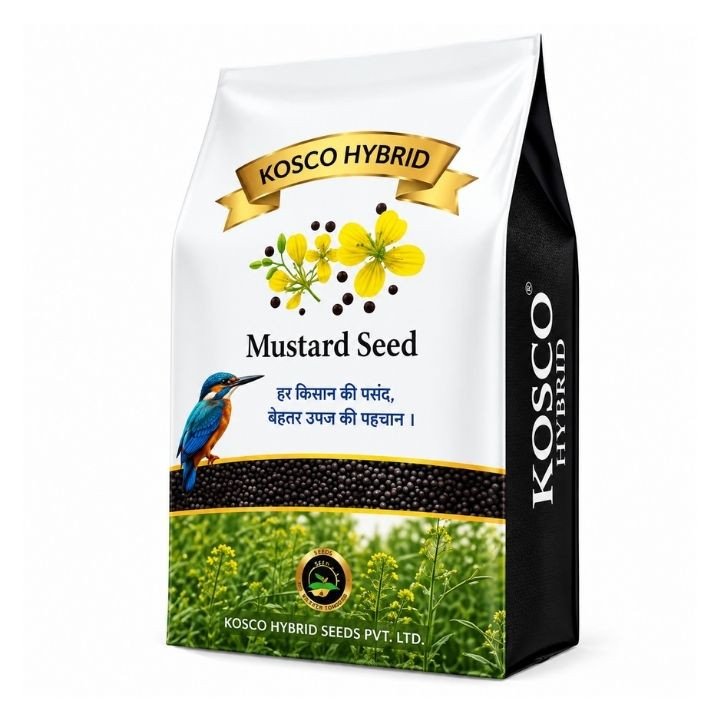
Most Indian mustard varieties grown for generations carry erucic acid levels above 40% in their oil — a figure that's raised health concerns internationally due to its link with cardiac fat accumulation. Pusa Mustard 32, the variety behind Kosco's PM-32 seed, was specifically bred to break from that pattern. Classified as a "single-zero" quality variety, its oil stays under 2% erucic acid, bringing it in line with the edible oil standards used globally — a meaningful shift for a crop that's traditionally been evaluated mainly on yield alone.
That said, PM-32 doesn't sacrifice productivity to get there. Trials conducted by IARI place its average seed yield between 25.0 and 27.1 quintals per hectare, with well-managed, high-fertility farms capable of pushing that ceiling to around 33.5 q/ha — figures that hold up reasonably well against many conventional mustard varieties still grown for their erucic-heavy oil.
| Characteristic | Performance |
|---|---|
| Average Seed Yield | 25.0–27.1 quintals/hectare |
| Maximum Yield Potential | Up to 33.5 quintals/hectare under optimal management |
| Oil Content | 38.0%–38.5% |
| Erucic Acid in Oil | Less than 2% (Single-Zero Quality) |
| Maturity Duration | 142–145 days (Medium-to-Late) |
| Test Weight | 4.61 gm per 1000 seeds |
| Grains per Pod (Siliquae) | 17–18 |
PM-32 isn't a one-size-fits-all mustard seed — it's specifically recommended for Zone II of India's agro-climatic classification, and growing it well outside that zone may not replicate the trial results. This zone covers Northern and Western Rajasthan, Punjab, Haryana, Delhi, Western Uttar Pradesh, and the plains of Jammu & Kashmir and Himachal Pradesh. It's bred for timely sown, irrigated Rabi conditions rather than late-sown or rainfed situations.
| Region | Suitability |
|---|---|
| Rajasthan (Northern & Western) | Recommended Zone |
| Punjab & Haryana | Recommended Zone |
| Delhi & Western Uttar Pradesh | Recommended Zone |
| Plains of J&K and Himachal Pradesh | Recommended Zone |
Beyond the yield and oil-quality numbers, PM-32's field performance includes a few practical resilience traits. It shows tolerance to high temperatures during the seedling stage — a period when many mustard varieties are most vulnerable to a sudden heat spell — along with reasonable tolerance to low water stress. On the disease front, trial data points to a low susceptibility profile against white rust, one of mustard's more damaging fungal diseases, which can otherwise significantly cut into pod formation if it takes hold early.
There's a secondary economic angle worth knowing about: because PM-32 carries significantly lower glucosinolate levels (under 30 micromoles) compared to older mustard varieties, the leftover seed meal after oil extraction is considerably more suitable as poultry and livestock feed. High glucosinolate content in older varieties has historically limited how much oil cake could safely be fed to animals — PM-32's lower profile widens that usability.
Is PM-32's oil actually noticeably different when cooking with it, or is the erucic acid difference only a lab measurement?
The distinction is primarily nutritional rather than a difference in taste or cooking behavior — the lower erucic acid content is what aligns it with international edible oil safety standards.
Can PM-32 be grown outside Zone II if my region has similar Rabi conditions?
It's specifically recommended for Zone II based on IARI trial data; growing it outside this zone may not produce the same yield or quality results seen in official trials.
Does the lower glucosinolate seed meal actually sell for more, or is it just a usability benefit?
It primarily expands usability as safe animal feed rather than guaranteeing a market price premium, though better feed quality can support demand from livestock and poultry buyers.
How does 142–145 days maturity compare to typical mustard varieties?
This places PM-32 in the medium-to-late maturity category, generally longer than early-maturing mustard varieties, so it should be factored into crop rotation planning accordingly.
Disclaimer: The details provided are for informational guidance only. Always adhere to the recommended sowing and cultivation instructions as stated on the product label and in the accompanying leaflet.
No reviews yet.