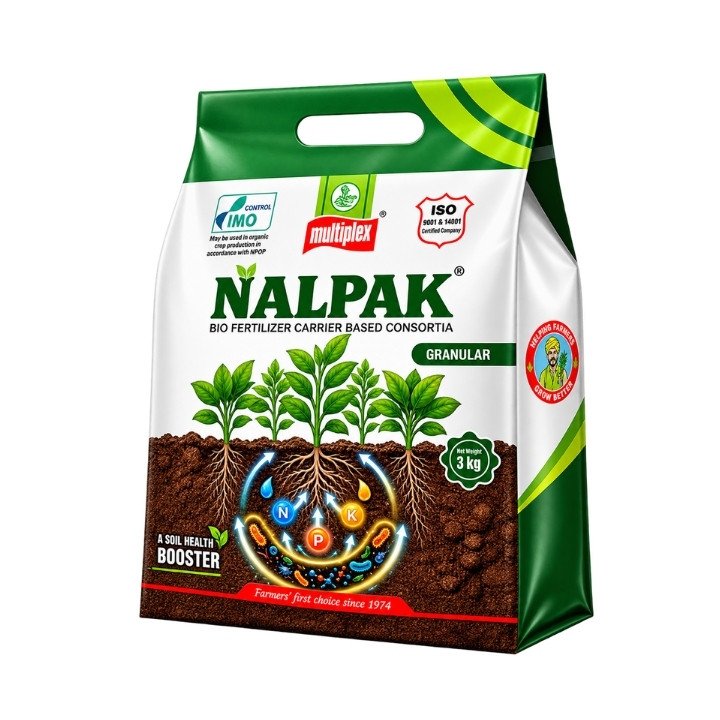
Multiplex Nalpak is an NPK bacterial-consortium biofertilizer containing beneficial microorganisms that help improve the availability of nitrogen, phosphorus and potassium in the soil. The supplied product image represents the 3 kg granular formulation.
Nalpak combines nitrogen-fixing, phosphorus-solubilising and potassium-mobilising bacteria. These beneficial microorganisms support nutrient cycling, soil biological activity, root development and healthy crop growth when used as part of an integrated nutrient-management programme.
| Specification | Details |
|---|---|
| Product Name | Multiplex Nalpak |
| Brand | Multiplex |
| Product Type | NPK bacterial-consortium biofertilizer |
| Supplied Variant | Granular |
| Supplied Pack Size | 3 kg |
| Microorganism 1 | Azotobacter chroococcum – nitrogen-fixing bacterium |
| Microorganism 2 | Bacillus megaterium – phosphorus-solubilising bacterium |
| Microorganism 3 | Frateuria aurantia – potassium-mobilising bacterium |
| Target Nutrients | Nitrogen, phosphorus and potassium |
| Recommended Crops | All crops |
| Application Methods | Seed treatment, root dip, nursery, soil application and drip irrigation depending on formulation |
| Available Forms | Liquid, carrier powder and granular |
| Liquid Pack Sizes | 100 ml, 250 ml, 500 ml and 1 litre |
| Powder Pack Sizes | 1 kg and 5 kg |
| Granular Pack Size | 3 kg |
| Beneficial Microorganism | Functional Role |
|---|---|
| Azotobacter chroococcum | Helps fix atmospheric nitrogen and supports nitrogen availability in the root zone |
| Bacillus megaterium | Helps solubilise complex or fixed soil phosphorus into more available forms |
| Frateuria aurantia | Helps mobilise soil-bound potassium for improved availability to plants |
| Formulation | Minimum CFU Count |
|---|---|
| Liquid formulation | 1.5 × 10⁸ CFU/ml in a mixture of any two or more specified microorganisms |
| Carrier-based formulation | 3 × 10⁷ CFU/g in a mixture of any two or more specified microorganisms |
Viable-count note: CFU means colony-forming units and indicates the viable microbial population in the formulation. Always check the formulation, viable count, batch details and expiry date printed on the supplied pack.
The manufacturer states that Nalpak may support a 10–30% increase in crop yield. Actual response is not guaranteed and can vary with crop, soil fertility, climate, formulation quality, microbial survival and overall farm management.
| Crop Group | Example Crops | Potential Nutritional Support |
|---|---|---|
| Cereals | Paddy, wheat, maize, sorghum and millet | Supports nutrient availability, rooting, tillering and vegetative growth |
| Pulse crops | Red gram, green gram, black gram and chickpea | Supports root-zone biology and phosphorus and potassium availability |
| Oilseed crops | Groundnut, soybean, mustard and sunflower | Supports balanced nutrient availability and crop development |
| Vegetable crops | Tomato, chilli, brinjal, okra, cabbage and cucurbits | Supports roots, vegetative growth, flowering and fruit development |
| Fruit crops | Mango, banana, grapes, pomegranate and citrus | Supports rhizosphere activity and nutrient utilisation |
| Commercial crops | Cotton, sugarcane, tea and coffee | Supports soil biological activity and nutrient efficiency |
| Flowers and plantation crops | Label-recommended flower and plantation crops | Supports root-zone nutrient cycling and healthy growth |
| Formulation or Method | Recommended Quantity | Application Instructions |
|---|---|---|
| Liquid formulation – main field | 2 litres per acre | Mix with dried farmyard manure or apply through the label-approved method |
| Carrier powder – main field | 5 kg per acre | Mix with dried farmyard manure and broadcast uniformly |
| Granular formulation | As stated on the 3 kg granular pack label | Follow the granular formulation's specific soil-application instructions |
| Seed treatment | 100 ml liquid or 500 g carrier formulation per acre's seed | Mix with 500 ml rice starch or jaggery solution and coat the seeds |
| Seedling root dip | 250 ml liquid formulation in 50 litres of water | Dip seedling roots for approximately 10–20 minutes before transplanting |
| Nursery application | 1 kg carrier powder or 200 ml liquid formulation | Mix with 10 kg dried farmyard manure for a nursery supplying one acre |
| Drip irrigation | 2 litres liquid formulation in 200 litres of water per acre | Apply through the drip system according to label directions |
Granular dose note: A 3 kg pack is the available granular pack size; pack size does not automatically confirm the per-acre dose. Since the official online page does not separately state the granular dosage, confirm the exact dose from the label printed on the 3 kg pack before application.
Azotobacter chroococcum helps fix atmospheric nitrogen in the crop root zone, supporting biological nitrogen availability. It does not replace the complete nitrogen requirement of a high-yielding crop.
Bacillus megaterium produces organic acids and related compounds that help solubilise complex soil phosphates, making a portion of the fixed phosphorus more available in the rhizosphere.
Frateuria aurantia helps mobilise potassium that is present in less-available soil forms. This supports better access to existing soil potassium under suitable biological and soil conditions.
Multiplex Nalpak is an NPK bacterial-consortium biofertilizer containing beneficial microorganisms associated with nitrogen fixation, phosphorus solubilisation and potassium mobilisation.
Nalpak is not a conventional chemical NPK fertilizer. Its microorganisms help fix, solubilise or mobilise selected nutrients in the root zone. Continue the recommended crop-nutrition programme unless a qualified agricultural specialist advises otherwise.
The official dose is 2 litres per acre for the liquid formulation and 5 kg per acre for the carrier powder. Confirm the separate dose of the 3 kg granular formulation from its physical pack label.
The available granular pack weighs 3 kg, but the official online page does not state its separate per-acre dosage. Do not assume that one pack treats one acre; check the directions printed on the granular pack.
Nalpak is recommended for all crops, including cereals, pulses, oilseeds, vegetables, fruits, cotton, sugarcane, plantation crops and flowers.
The liquid formulation may be applied through drip irrigation at 2 litres in approximately 200 litres of water per acre, subject to the product label and proper filtration of the irrigation system.
No. Nalpak supports nutrient availability but should not be presented as a complete replacement for the crop's recommended fertilizer requirement. Use it as part of integrated nutrient management based on soil testing.
No. The manufacturer states that Nalpak should not be mixed with insecticides, fungicides or weedicides because these products may harm the beneficial microorganisms.
No yield increase can be guaranteed. The manufacturer reports a potential increase of 10–30%, but actual results depend on crop, soil, weather, irrigation, nutrient management, microbial viability and application practices.
Store it in its original sealed pack in a cool, dry and shaded place. Protect the product from direct sunlight, excessive heat and chemical pesticides, and use it before the expiry date printed on the pack.
Disclaimer: The details provided are for informational guidance only. Always adhere to the recommended application instructions as stated on the product label and in the accompanying leaflet.

No reviews yet.
.jpg)