

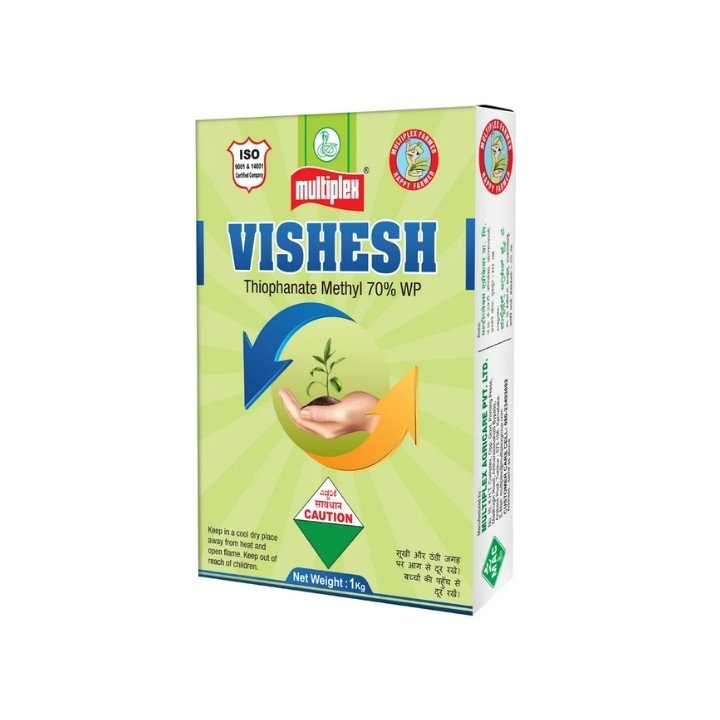


Multiplex Vishesh Fungicide – Thiophanate Methyl 70% WP

Multiplex Vishesh Systemic Fungicide for Broad-Spectrum Disease Management
Multiplex Vishesh Fungicide is a systemic crop-protection product containing Thiophanate Methyl 70% WP. It helps manage important fungal diseases by moving into treated plant tissues and restricting further fungal development.
Vishesh offers preventive and curative activity under proper application practices. It is useful against registered diseases such as powdery mildew, anthracnose, rust and apple scab when applied during the early stages of infection and according to the product label.
Multiplex Vishesh Fungicide Product Specifications
| Specification | Details |
|---|---|
| Product Name | Multiplex Vishesh Fungicide |
| Brand | Multiplex |
| Technical Name | Thiophanate Methyl 70% WP |
| Product Category | Systemic Fungicide |
| Formulation | WP – Wettable Powder |
| Chemical Group | Methyl Benzimidazole Carbamate (MBC) |
| FRAC Group | Group 1 |
| Action Type | Systemic, preventive and curative |
| Application Method | Foliar spray |
| General Dose | 2 g per litre of water |
| Available Pack Sizes | 250 g, 500 g and 1 kg |
Technical Composition
| Component | Concentration |
|---|---|
| Thiophanate Methyl active ingredient | 70% w/w |
| Relevant formulation ingredients | 30% w/w |
| Formulation type | Wettable Powder (WP) |
Key Features of Multiplex Vishesh
- Systemic Movement: The active ingredient is absorbed by treated plant tissues and supports protection from within.
- Preventive Activity: Helps restrict fungal establishment when applied before or during the early infection stage.
- Curative Support: Useful for managing early fungal development after initial symptoms become visible.
- Broad Disease Spectrum: Recommended against multiple fungal diseases on registered crops.
- Wettable Powder Formulation: Disperses in water to create a spray suspension for uniform foliar application.
- Crop Health Support: Timely disease management helps maintain functional and healthy crop foliage.
Benefits for Farmers
- Helps reduce the spread of registered fungal diseases.
- Supports healthier leaves, shoots and developing produce.
- Provides both preventive protection and early curative activity.
- Helps preserve photosynthetic leaf area under disease pressure.
- Supports crop quality and productive potential when used as part of an integrated disease-management programme.
- Suitable for application with knapsack or power sprayers using the recommended water volume.
Recommended Crops and Target Diseases
| Crop | Target Disease | Label-Based Formulation Dose | Water Volume | Waiting Period |
|---|---|---|---|---|
| Papaya | Powdery Mildew | Approximately 286 g per acre | 300–400 litres per acre | 4–8 days |
| Apple | Scab | Approximately 286 g per acre | 300–400 litres per acre | 3 days |
| Bottle Gourd | Anthracnose | Approximately 572 g per acre | 300–400 litres per acre | 1 day |
| Grapes | Powdery Mildew, Anthracnose and Rust | Approximately 286 g per acre | 300–400 litres per acre | 7 days |
Crop-use note: Use Multiplex Vishesh only on crops and diseases listed on the current product label. Recommendations may be updated, so confirm the crop-specific dose and waiting period from the supplied label before spraying.
Target Disease Spectrum
| Disease | Common Symptoms | Role of Vishesh Fungicide |
|---|---|---|
| Powdery Mildew | White powder-like fungal growth on leaves, shoots or fruits | Helps restrict fungal growth on registered crops |
| Anthracnose | Dark, sunken lesions on leaves, stems or fruits | Supports early management and helps reduce lesion development |
| Rust | Yellow, orange or brown pustules developing on foliage | Useful for registered rust management in grapes |
| Apple Scab | Olive-green to dark lesions on leaves and fruit surfaces | Helps protect apple foliage and developing fruits under proper use |
Dosage and Application Method
| Application Detail | Recommendation |
|---|---|
| General Dose | 2 g per litre of water |
| 15-Litre Spray Pump | Approximately 30 g, subject to crop-label recommendation |
| Application Method | Foliar spray |
| Application Timing | At the preventive stage or immediately after early disease symptoms appear |
| Spray Coverage | Cover upper and lower leaf surfaces and other disease-prone plant parts uniformly |
| Repeat Application | Only as required and according to the product label or local agricultural recommendation |
How to Use Multiplex Vishesh Fungicide
- Inspect the crop and identify the disease correctly before application.
- Read the complete product label and wear suitable protective equipment.
- Measure the required quantity according to the crop-specific recommendation.
- Prepare a smooth slurry by mixing the measured powder with a small quantity of clean water.
- Half-fill the spray tank with clean water.
- Add the prepared slurry to the tank while stirring continuously.
- Add the remaining water and agitate thoroughly to create a uniform suspension.
- Spray evenly across the crop canopy, including the lower leaf surfaces.
- Avoid application during strong wind, intense afternoon heat or immediately before rainfall.
- Use the prepared spray suspension on the same day and clean the equipment after application.
Mode of Action
Thiophanate Methyl belongs to FRAC Group 1 and acts as a fungal cell-division inhibitor. After absorption into treated plant tissue, it interferes with microtubule assembly and mitosis in susceptible fungi. This restricts fungal growth, spore development and further expansion of early disease lesions.
Because Group 1 fungicides carry a high resistance risk, Vishesh should be used according to label directions and rotated with registered fungicides having a different mode-of-action group.
Why Farmers Can Choose Multiplex Vishesh Fungicide
- Contains a recognised systemic fungicide active ingredient.
- Offers preventive and early curative disease-management support.
- Recommended against important diseases of papaya, apple, bottle gourd and grapes.
- Provides a farmer-friendly general mixing rate of 2 g per litre.
- Available in multiple pack sizes for different farm requirements.
- Useful as part of an integrated crop disease-management programme.
Frequently Asked Questions
What is the technical composition of Multiplex Vishesh?
Multiplex Vishesh contains Thiophanate Methyl 70% WP, a systemic fungicide belonging to FRAC Group 1.
What is the dose of Vishesh Fungicide per litre?
The general recommended dose is 2 g per litre of water. Always confirm the crop-specific dose from the current product label before application.
How much Vishesh is required for a 15-litre spray pump?
At a general dose of 2 g per litre, approximately 30 g is required for a 15-litre tank. The final quantity must follow the crop and disease recommendation printed on the label.
Is Multiplex Vishesh a contact or systemic fungicide?
Vishesh is a systemic fungicide. It is absorbed by treated plant tissues and provides preventive and early curative activity against susceptible fungal diseases.
Which crops are officially recommended for Vishesh Fungicide?
Registered recommendations commonly include papaya, apple, bottle gourd and grapes. Use on any additional crop only when that crop and disease are mentioned on the supplied product label.
Can Vishesh control bacterial or viral diseases?
No. Thiophanate Methyl is intended for susceptible fungal diseases and should not be considered a treatment for bacterial or viral infections.
Can Vishesh be mixed with other crop-protection products?
Use a tank mixture only when both product labels permit it. Conduct a small jar test and consult an agricultural expert before combining unfamiliar products.
Disclaimer: The details provided are for informational guidance only. Always adhere to the recommended application instructions as stated on the product label and in the accompanying leaflet.
Similar Products

Best Selling


Customer Reviews
Recent Reviews
No reviews yet.