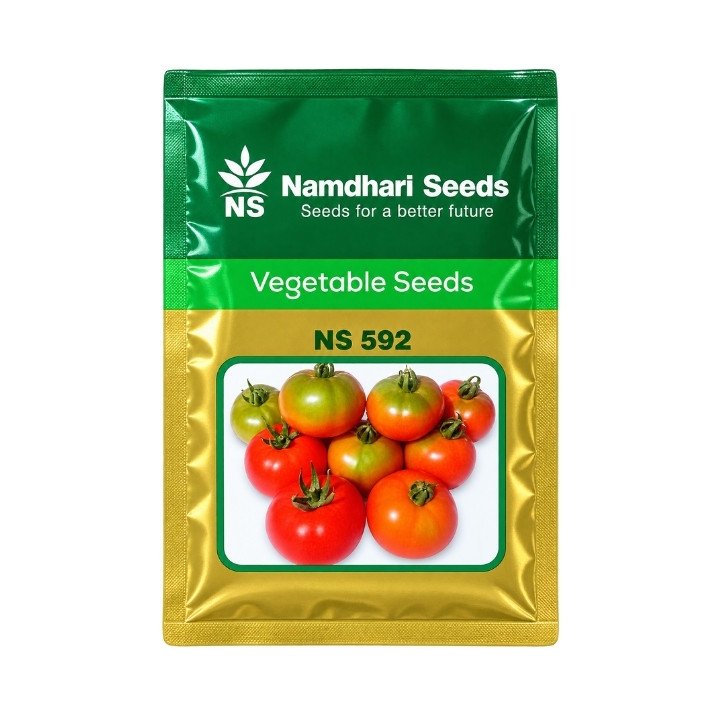
Namdhari NS 592 F1 Hybrid Tomato Seeds
Namdhari NS 592 is a versatile F1 Hybrid Tomato variety suitable for commercial vegetable cultivation as well as suitable kitchen, terrace and garden growing systems. It is characterized by early maturity, good plant foliage and high yield potential under proper crop-management conditions.
The plants develop good foliar cover and produce attractive smooth, flat-round tomato fruits with green shoulders. Fruits develop an attractive red colour on maturity and have a characteristic acidic to tangy tomato taste.
NS 592 is also listed with tolerance/resistance to Tomato Yellow Leaf Curl Virus (TYLCV), an important characteristic for tomato cultivation in areas where leaf curl pressure is a concern.
Product Specifications
| Brand |
Namdhari Seeds |
| Variety Name |
NS 592 |
| Crop |
Tomato |
| Seed Type |
F1 Hybrid |
| Plant Characteristic |
Early, High-Yielding Hybrid with Good Foliar Cover |
| Fruit Shape |
Smooth, Flat Round |
| Fruit Colour |
Red at Maturity |
| Fruit Shoulder |
Green Shoulder |
| Taste |
Acidic / Tangy Tomato Taste |
| Listed Disease Tolerance |
Tomato Yellow Leaf Curl Virus (TYLCV) |
| Maturity |
Approximately 65–80 Days After Planting |
| Listed Germination |
80% |
| Suitable Seasons |
Rabi, Summer and Rainy Season |
| Growing Method |
Nursery Raising Followed by Transplanting |
| Product Category |
Vegetable Seeds – Tomato Seeds |
| Pack Weight |
7 Grams |
| Approx. Seed Count |
About 3000 Seeds – As Provided |
Key Features
- F1 Hybrid Tomato: Quality hybrid suitable for market-oriented tomato cultivation.
- Early Maturity: Crop maturity is approximately 65–80 days after planting under suitable conditions.
- High Yield Potential: Developed for productive tomato cultivation when provided with proper nutrition, irrigation and crop protection.
- Good Foliar Cover: Plants develop good foliage that supports healthy crop growth and fruit development.
- Flat-Round Fruits: Produces attractive smooth, flat-round tomato fruits.
- Green Shoulder: Immature and developing fruits show a characteristic green shoulder.
- Attractive Red Colour: Fruits develop marketable red colour at maturity.
- Tangy Taste: Fruits have the characteristic acidic to tangy flavour preferred for many culinary applications.
- TYLCV Tolerance: The supplied product specification lists tolerance/resistance to Tomato Yellow Leaf Curl Virus.
- Seasonal Flexibility: Listed for Rabi, Summer and Rainy-season cultivation according to suitable regional conditions.
Fruit Characteristics
| Characteristic |
Details |
| Fruit Shape |
Flat Round |
| Fruit Surface |
Smooth |
| Immature Characteristic |
Green Shoulder |
| Mature Fruit Colour |
Red |
| Taste Profile |
Acidic / Tangy |
| Market Use |
Fresh Vegetable Market |
Benefits of Namdhari NS 592 Tomato
- Early-maturing F1 hybrid tomato.
- Good yield potential under suitable crop management.
- Healthy plant foliage and good foliar cover.
- Attractive smooth and flat-round fruits.
- Characteristic green shoulder.
- Marketable red colour at maturity.
- Suitable for fresh tomato markets.
- Listed tolerance/resistance to Tomato Yellow Leaf Curl Virus.
- Suitable for different recommended growing seasons.
Recommended Uses
- Commercial tomato cultivation
- Fresh vegetable production
- Local mandi supply
- Wholesale vegetable markets
- Retail tomato markets
- Kitchen garden cultivation
- Terrace or container cultivation where adequate space is available
- Fresh salads
- Cooking and vegetable preparations
- Sauces, gravies and other culinary applications
Recommended Growing Seasons
| Season |
Suitability |
| Rabi |
Suitable |
| Summer |
Suitable under appropriate regional conditions |
| Rainy Season |
Suitable with proper drainage and disease management |
The ideal sowing period can vary by state, altitude, temperature and local climate. Always follow the season recommendation printed on the current Namdhari NS 592 seed packet.
Climate Requirements
Tomato performs best under warm conditions with good sunlight. The crop requires sufficient sunlight for healthy vegetative growth, flowering, fruit setting and fruit-colour development.
- Provide approximately 6–8 hours or more of good sunlight where possible.
- Protect young plants from severe environmental stress.
- Maintain good air movement through the crop canopy.
- Adjust planting time according to the local growing climate.
Soil Requirements
NS 592 tomato should be grown in fertile, well-drained soil rich in organic matter. The supplied growing specification indicates a preferred soil pH of approximately 6.2–6.8.
- Choose fertile and well-drained soil.
- Incorporate well-decomposed compost or farmyard manure.
- Avoid prolonged waterlogging.
- Follow soil-test recommendations before fertilizer application.
- Maintain good soil structure for healthy root growth.
Nursery Preparation
Tomato is normally established by raising seedlings in a nursery and later transplanting healthy seedlings into the main field.
- Use healthy seeds from the original Namdhari NS 592 packet.
- Prepare raised nursery beds or use suitable seedling trays.
- Use clean, well-drained nursery media.
- Sow seeds at a shallow and uniform depth.
- Cover lightly with fine growing medium.
- Maintain adequate moisture during germination.
- Avoid excessive watering and nursery waterlogging.
- Protect seedlings against nursery pests and diseases.
- Select healthy and vigorous seedlings for transplanting.
Transplanting
Transplant healthy seedlings into properly prepared land after they become sufficiently established. Avoid using weak, elongated, diseased or damaged seedlings.
- Transplant during favourable weather conditions.
- Provide irrigation immediately after transplanting where required.
- Maintain adequate spacing for proper plant development.
- Replace failed plants early to maintain a uniform crop stand.
Plant Spacing
The ideal spacing for NS 592 depends on plant vigour, season, irrigation method, staking system and local cultivation practice.
Maintain sufficient plant-to-plant and row-to-row distance to provide:
- Good sunlight penetration
- Proper air circulation
- Space for branching
- Convenient spraying and crop monitoring
- Easy fruit harvesting
Follow the exact spacing recommendation on the current Namdhari Seeds packet or local horticultural guidance.
Irrigation Management
- Provide irrigation after transplanting where required.
- Maintain adequate soil moisture during establishment.
- Provide sufficient moisture during flowering and fruit development.
- Avoid severe moisture stress.
- Avoid excessive irrigation and prolonged waterlogging.
- Maintain relatively uniform moisture to support consistent fruit development.
- Adjust irrigation according to soil type, temperature and rainfall.
Nutrient Management
Tomato is a nutrient-responsive crop. Balanced nutrition supports vegetative growth, flowering, fruit setting, fruit size and crop productivity.
- Apply well-decomposed organic manure during field preparation.
- Use soil-test-based fertilizer recommendations.
- Apply nitrogen, phosphorus and potassium according to crop requirements.
- Use split fertilizer applications where recommended.
- Avoid excessive and unbalanced nitrogen application.
- Correct calcium, magnesium or micronutrient deficiencies where identified.
Flowering & Fruit Setting
Maintain adequate soil moisture and balanced nutrition during flowering and fruit-setting stages. Severe temperature stress, moisture stress or heavy pest pressure may negatively affect flower retention and fruit development.
Regular field scouting is recommended throughout flowering and fruiting.
Tomato Yellow Leaf Curl Virus Tolerance
The supplied specification for Namdhari NS 592 lists tolerance/resistance to Tomato Yellow Leaf Curl Virus (TYLCV).
Disease tolerance should not be treated as complete immunity. Farmers should continue to manage virus-vectoring insects, particularly whiteflies, and follow recommended field sanitation and Integrated Pest Management practices.
Crop Protection
- Inspect plants regularly for sucking pests and fruit-damaging insects.
- Monitor for whiteflies, aphids, thrips and other locally important pests.
- Maintain good field sanitation.
- Remove severely infected plants where recommended.
- Control weeds that can serve as alternate pest or disease hosts.
- Use suitable monitoring traps where recommended.
- Use only crop-protection products registered for tomato.
- Follow pesticide label dosage and waiting-period instructions.
Weed Management
Keep the crop relatively free from weeds, particularly during early plant development. Weeds compete with tomato plants for nutrients, water, sunlight and growing space.
Mechanical cultivation, hand weeding, suitable mulch or registered herbicides may be used according to the local cultivation system.
Staking & Plant Support
Where plant growth requires support, suitable staking or trellising can help keep plants and fruits above the soil surface.
- Provide support before plants become heavily loaded with fruits.
- Tie plants carefully without damaging stems.
- Maintain good canopy aeration.
- Remove severely damaged or diseased plant material where appropriate.
Maturity & Harvesting
The supplied specification indicates maturity at approximately 65–80 days after planting. Actual maturity can vary with season, temperature, crop management and the market stage at which fruits are harvested.
Harvest fruits at the appropriate maturity stage depending on whether they are intended for local sale, transportation or immediate consumption.
Harvesting Tips
- Harvest fruits regularly during the productive period.
- Select fruits according to the required market maturity.
- Handle tomatoes carefully to minimize bruising.
- Avoid damaging branches while picking.
- Separate cracked, diseased or physically damaged fruits.
- Grade produce according to colour, size and quality.
Post-Harvest Handling
- Keep harvested tomatoes under shade.
- Avoid prolonged exposure to strong direct sunlight.
- Handle fruits carefully to prevent bruising.
- Separate damaged and diseased fruits.
- Grade tomatoes according to market requirements.
- Use suitable ventilated packaging for transportation.
Why Choose Namdhari NS 592 F1 Hybrid Tomato?
- Early Hybrid: Suitable for relatively early crop production.
- High Yield Potential: Suitable for productive commercial cultivation.
- Good Foliar Cover: Healthy foliage supports crop development.
- Attractive Fruits: Smooth, flat-round tomato type.
- Green Shoulder: Characteristic fruit appearance.
- Red Mature Fruits: Attractive fresh-market colour.
- Tangy Taste: Characteristic acidic tomato flavour.
- TYLCV Tolerance: Listed resistance/tolerance to Tomato Yellow Leaf Curl Virus.
- Multiple Seasons: Suitable for Rabi, Summer and Rainy-season cultivation according to local conditions.
Pack Information
| Net Weight |
7 Grams |
| Approximate Seed Count |
About 3000 Seeds – As Provided |
| Listed Germination |
80% |
Note: Seed count and germination can differ by lot, seed size and packaging batch. The germination percentage, purity, seed count and net weight printed on the sealed packet being purchased should be treated as final.
Storage Instructions for Seeds
- Keep seeds in the original sealed packet until use.
- Store in a cool and dry place.
- Protect seeds from direct sunlight, heat and excessive moisture.
- Keep separately from pesticides, fertilizers and other chemicals.
- Keep out of reach of children and animals.
- Use the seed within the validity period printed on the original packet.
Frequently Asked Questions
What is Namdhari NS 592?
Namdhari NS 592 is an F1 Hybrid Tomato seed variety suitable for commercial and fresh-market tomato cultivation.
What is the fruit shape of NS 592?
The supplied variety specification describes the fruits as smooth and flat round.
What is the fruit colour?
Fruits develop an attractive red colour at maturity and have a characteristic green shoulder during development.
What is the maturity period of Namdhari NS 592?
The supplied specification indicates approximately 65–80 days after planting, depending on crop and growing conditions.
Is NS 592 resistant to Tomato Yellow Leaf Curl Virus?
The supplied product information lists resistance/tolerance to Tomato Yellow Leaf Curl Virus (TYLCV). Proper whitefly and virus-management practices should still be followed.
What is the taste of NS 592 tomato?
The variety is described as having a characteristic acidic to tangy tomato flavour.
Which seasons are suitable for NS 592?
The supplied information lists Rabi, Summer and Rainy seasons. The exact sowing window should be adjusted according to local climatic conditions.
Can NS 592 be grown in a terrace or kitchen garden?
Yes, tomato can be grown in suitable large containers or beds provided adequate sunlight, root space, nutrition, irrigation and plant support are available.
What is the germination percentage?
The supplied specification lists approximately 80% germination. Always verify the germination standard printed on the specific seed packet and batch.
What is the pack weight?
The supplied pack specification is 7 grams.
How many seeds are in the packet?
The supplied product specification mentions approximately 3000 seeds. Actual count can vary according to seed size and packing lot, so the current sealed packet should be treated as final.
Is Namdhari NS 592 suitable for commercial farming?
Yes. Its early maturity, good foliar cover, high-yield potential, attractive flat-round fruits and listed TYLCV tolerance make it suitable for commercial tomato cultivation under appropriate growing conditions.
Disclaimer
Variety performance, germination, maturity, fruit size, yield, colour and disease response may vary according to climate, soil type, sowing period, plant population, irrigation, nutrition, pest and disease pressure and overall crop-management practices. Variety-specific figures on this page are based on the supplied product information. Always follow the latest instructions and specifications printed on the original Namdhari NS 592 seed packet.