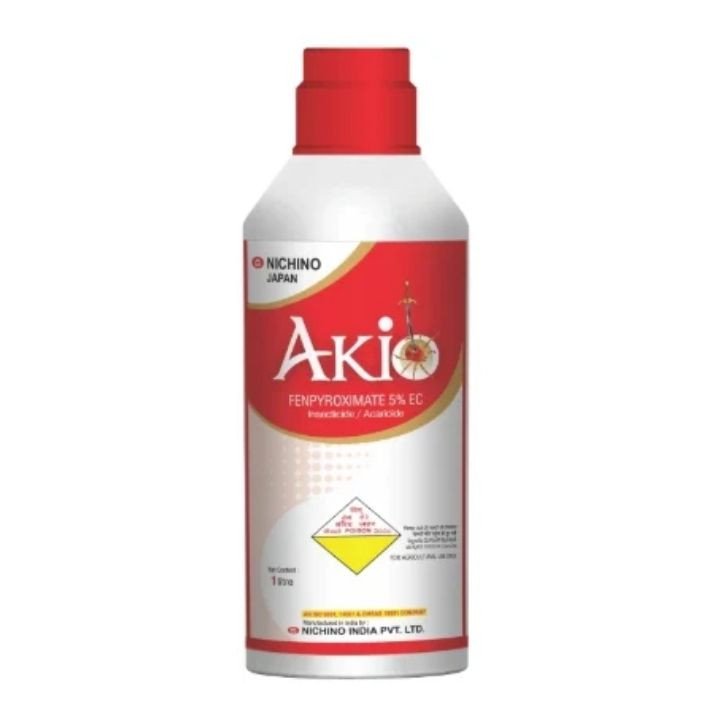
Most insecticides work by attacking an insect's nervous system, but mites and certain sucking pests don't always respond well to that route — which is exactly why Nichino Akio takes a different path. Built on Fenpyroximate 5% in an EC formulation, Akio blocks mitochondrial electron transport at Complex I inside the pest's cells, effectively shutting down energy production rather than targeting nerve signaling. Once that energy pathway collapses, feeding activity drops almost immediately, followed by death of the pest.
This IRAC Group 21A classification places Akio in a distinct chemical category from the pyrethroids, neonicotinoids, and organophosphates that dominate most spray programs — a genuinely useful trait for growers looking to rotate modes of action and slow resistance buildup in persistent pest populations.
| Detail | Specification |
|---|---|
| Brand | Nichino India |
| Product Name | Akio |
| Technical Name | Fenpyroximate 5% |
| Formulation Type | Emulsifiable Concentrate (EC) |
| Chemical Group | Pyrazole |
| IRAC Classification | Group 21A (Mitochondrial Complex I Electron Transport Inhibitor) |
| Pack Size | 100 ml |
| Country of Origin | India |
Beyond its cellular-level mode of action, Akio also moves systemically within plant tissue, which extends its usefulness beyond pests sitting directly in the spray path. This systemic property is part of why the product's pest coverage isn't limited strictly to mites — it also shows activity against sucking pests like jassids, contributing to broader crop protection from a single application.
| Pest | Typical Crop Damage |
|---|---|
| Red Spider Mite | Sap removal from leaves, causing yellowing and drying |
| Pink Mite | Affects tender plant parts, reducing healthy growth |
| Purple Mite | Feeds on leaves, weakening overall crop vigour |
| Yellow Mite | Causes leaf curling, discoloration, and stunted growth |
| Jassids | Sap-sucking damage leading to leaf curling and yellowing |
| Eriophyid Mites | Damages buds, leaves, and tender plant tissue |
| Crop | Target Pest | Dose per Acre | Application Method |
|---|---|---|---|
| Cotton | Red Spider Mite, Pink Mite, Purple Mite | 120–300 ml | Foliar Spray |
| Chilli | Yellow Mite | 120–300 ml | Foliar Spray |
| Other Registered Crops | Jassids, Mites, Eriophyid Mites | As per label recommendation | Foliar Spray |
The wide 120–300 ml range reflects how pest population density changes the required rate — lighter infestations generally call for the lower end of the range, while heavier mite pressure justifies moving toward 300 ml. Pre-harvest interval is crop-specific, so this should always be confirmed against the current product label rather than assumed.
Akio performs best when applied early — at the stage when pest populations are still low to moderate rather than after visible crop damage has already set in. Morning or evening spray timing is generally preferred over midday application, and spraying should be avoided during strong winds or when rainfall is imminent, since both can compromise how well the product settles on the leaf surface.
Does Akio only work on mites, or does it help with other sucking pests too?
While its core strength lies in mite control across multiple species, its systemic movement within the plant also supports activity against sucking pests like jassids on certain crops.
Why does the dose range span so widely from 120 ml to 300 ml?
Pest population density is the main driver — lower pest pressure generally calls for the lower end of the range, while heavier infestations justify moving toward the upper limit.
Is it safe to enter the field right after spraying?
It's best to wait until the spray solution has dried completely on the crop before re-entering the treated area.
Can Akio be tank-mixed with other pesticides?
A jar compatibility test should be conducted first, since mixing without checking compatibility can affect the performance of either product.
Disclaimer: The details provided are for informational guidance only. Always adhere to the recommended application instructions as stated on the product label and in the accompanying leaflet.
No reviews yet.